 DISPLAY NOW 10
Cover simulation A 3D cross-section that steps through patterning R, G and B pixels in the order of the patent drawings (Claim's piece). The cover shows the finished overhang method of AMAT US20220077257A1: organics, cathode and local encapsulation go on separately for each color and the rest is etched away, so the eaves (overhangs) stay between pixels. On top are the inkjet layer and the global passivation layer. The buttons compare it with two lift-off routes (Orthogonal, LG Display). Thickness and width are not to scale.
This issue's lead
FMM-less OLED Patterning
To draw OLED pixels color by color without a fine metal mask, the patents this piece read show two ways to remove the unwanted organics: lift-off, which peels them away with the mold, and etching from above; etching splits again by whether an overhang is left standing between pixels. The principles were first written down not by panel makers but by a US university and start-up and an equipment maker.
Article title FMM-less OLED Patterning Patents
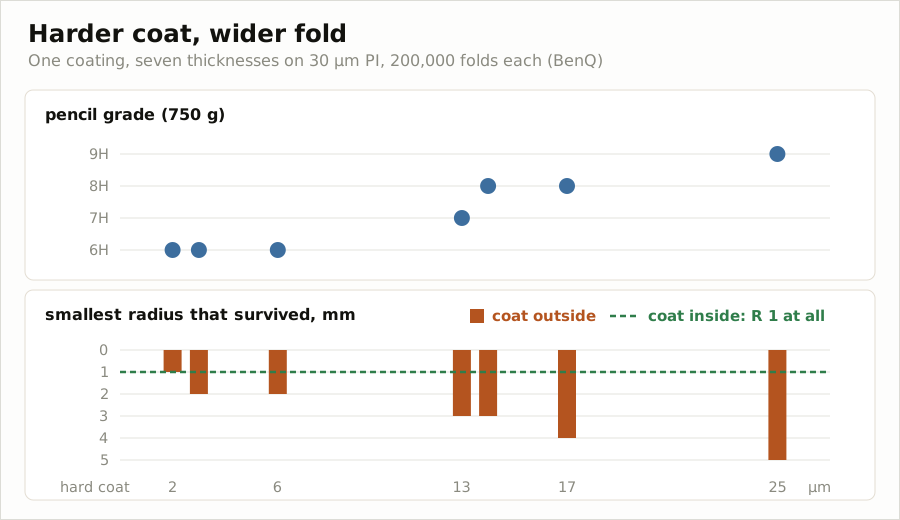
Thicken the same hard coat from 2μm to 25μm and pencil hardness rises from 6H to 9H, but the radius it survives when folded outward 200,000 times grows from 1mm to 5mm. That is because the limit at which cracks spread on the stretched side falls with the square root of thickness. This episode covers the fix of laying a thin hard layer over a soft one, where the hard coat went after cover windows moved from CPI to UTG, and closes Part 2 on a single axis of surface roughness.
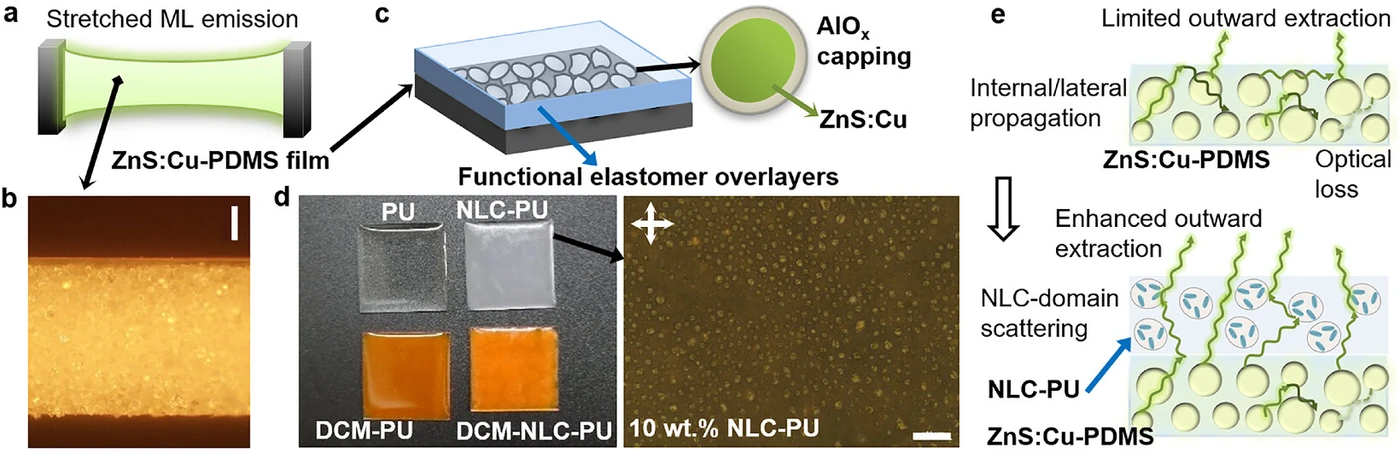
Researchers at Ajou University and DGIST placed functional elastomer layers on top of a stretchable mechanoluminescent film. A transparent layer did almost nothing, while a layer loaded with liquid crystal, raising haze to 70 to 90%, drew out 1.57 times the emission. The emission spectrum stayed the same. It is the result of using liquid crystal for scattering rather than alignment.
From October 12 to 18, 1,391 papers published in 28 major journals were checked, narrowed to 127 first-round candidates, and 18 are introduced here. Two in-depth articles are covered separately. This window brought together four papers in which the substitution position on a molecule decides performance, and Korean research is unusually prominent.
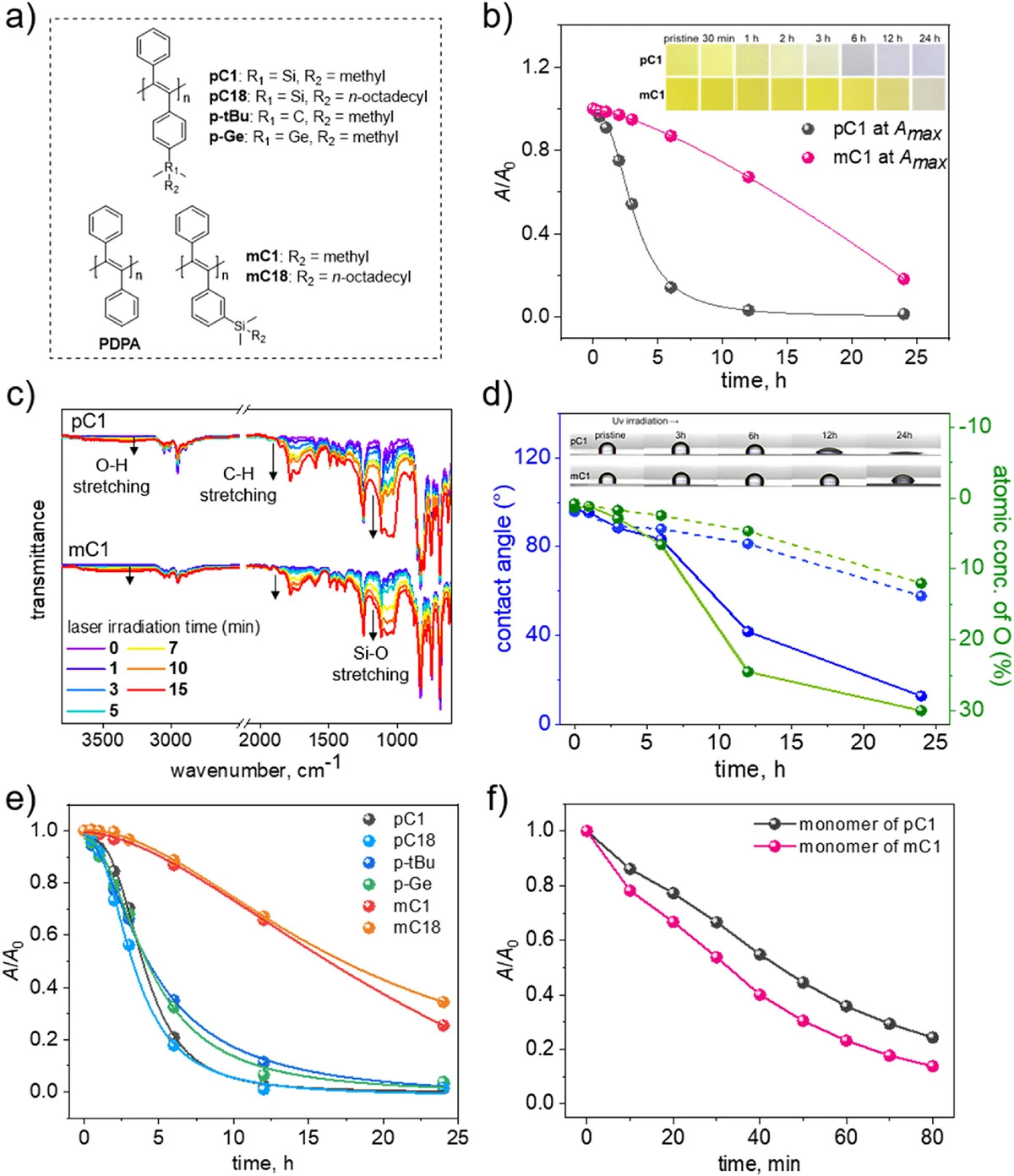
Researchers at the Korea Research Institute of Chemical Technology compared two polymers with exactly the same composition. They differ only in whether the side chain sits at the para or meta position, yet their photostability differed by 5 to 10 times. Oxygen permeability and thermal decomposition temperature are nearly the same, so encapsulation does not explain it. What separated them was whether the chain was coil-like or worm-like, and the one with longer conjugation was actually more stable.
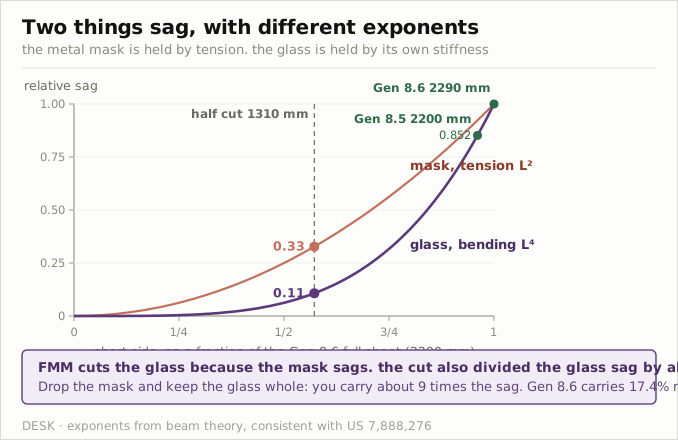
LG Display has published productivity figures for FLiPP for the first time. The main gain is not picture quality but not cutting the mother glass. The fine metal mask sagged in the middle, so the glass had to be cut in half; remove the mask and the whole sheet can be used. But glass that is not cut sags on its own. Self-weight sag scales with the fourth power of the short side, so halving the glass cuts it to about 1/9, and leaving it whole means carrying all of it. The same week, BOE had gone half a year without solving glass cracks on its Gen 8.6 line, and the evaporators on that line came from Sunic System.