
LG Display's Paju Gen 8.5 WOLED Line Turning to FLiPP
LG Display has published productivity figures for FLiPP for the first time. The main gain is not picture quality but not cutting the mother glass. The fine metal mask sagged in the middle, so the glass had to be cut in half; remove the mask and the whole sheet can be used. But glass that is not cut sags on its own. Self-weight sag scales with the fourth power of the short side, so halving the glass cuts it to about 1/9, and leaving it whole means carrying all of it. The same week, BOE had gone half a year without solving glass cracks on its Gen 8.6 line, and the evaporators on that line came from Sunic System.
This Week's Hot Issue
This column gathers the display industry news that broke over the past week (Monday through Sunday) and digs a little deeper into the single hottest issue among them.
News the Press Covered, October 12 to 18
First, Apple’s first foldable took off in pre-orders. The iPhone Duo opened pre-orders on October 16, its initial stock ran out within minutes, and estimated delivery slipped to late January 2027. It uses a 7.6-inch inner foldable OLED and a 5.4-inch cover OLED. Electronic Times reported that Samsung Display has begun raising output.
Second, the supply landscape for notebook OLED came out in numbers. Sigmaintell’s tally shows Samsung Display supplying more than 70% of OLED panels for major global PC brands, with only Dell sourcing its premium XPS lineup from LG Display. Notebook OLED shipment growth was covered in Issue 9, so we will not reopen it here.
Third, microLED stepped back one more notch from consumer devices. Daktronics, the leader in electronic signboards, announced a restructuring on October 14. Open the filing and the cut to in-house microLED development is $3.1 million a year, bundled with the Ireland plant closure at $7.7 million and production relocation across the U.S., Mexico, and China at $7.0 million. The annual savings the company stated are $18 million or more. Of the three items, microLED is the smallest. On the other side, Raontech released a microLED driver and optical engine for AR that puts RGB pixels on a single chip, and Samsung Electronics extended The Wall into control centers and situation rooms. In Issue 9 we described Kopin’s U.S. Army award as “leaving the screen for the field,” and that direction firmed up for another week.
Fourth, China moved up in emitter materials. At an event held on October 14 with Tsinghua University and others, Visionox presented results in emitter materials, stating 50% longer lifetime, 8% higher luminous efficiency, and 6.5% lower power consumption. In the same week that LG Display raised lifetime through process, Visionox raised it through materials. The levers are different.
Fifth, LG Display picked up a disclosure issue. It disclosed that it had filed a complaint against a former executive for alleged breach of trust involving 6.859 billion won.
And Gen 8 mother glass ran through the whole week. LG Display put FLiPP’s productivity into numbers for the first time, talks began on investment to convert its Paju Gen 8.5 line to FLiPP, and BOE had gone half a year without solving glass substrates breaking on its Gen 8.6 line. All three come down to one question: how to use the mother glass.
The hottest issue of October 12 to 18 is “FLiPP’s uncut mother glass.”
The Blanks Left Two Months Ago Have Been Filled
We covered FLiPP in Issue 2. That was right after LG Display first unveiled the technology at its IMID 2026 booth, and all the company had offered were three numbers, 1.6x luminance, 2.4x lifetime, and 13% lower power consumption, plus a relative figure saying the aperture ratio had improved by 55%. That article checked that all three figures fall out of the aperture ratio alone by calculation, and closed with several blanks left open.
On October 8, 2026, LG Display held an online “FLIPP Tech Seminar” for domestic and foreign press and analysts. CTO Choi Young-seok presented, and the productivity figures came out there. Four blanks were filled at once.
| What Issue 2 left blank | The answer in October |
|---|---|
| The absolute aperture ratio was not disclosed, so we back-calculated from a competitor’s figure | FMM 42% → FLiPP 65% |
| The basis for “64% improvement in panel ratio” was not disclosed | Panel utilization 75% → 93% or more (23.5-inch basis), productivity about 24% |
| It only said material loss would fall, with no value | Deposition efficiency about 40% → about 74%, 1.9x versus FMM |
| We answered by inference why Gen 8.5 rather than Gen 8.6 | The Paju Gen 8.5 WOLED line will be upgraded into a dedicated FLiPP line |
Added to these is a figure of about 40% shorter deposition process time. That comes from applying the inline deposition used on existing WOLED lines, which removes time spent on mask changes and alignment.
The Aperture Ratio Multiple Was Right; the Baseline Was Wrong
Without the absolute aperture ratio, Issue 2 took as its baseline the 30% FMM aperture ratio that Samsung Display’s vice president So Byung-soo cited in March 2026. Multiplying that by the announced 55% improvement, it estimated FLiPP’s aperture ratio at about 46.5%.
| Issue 2 estimate | Company figure | ||
|---|---|---|---|
| FMM baseline aperture ratio | 30% | 42% | Wrong |
| FLiPP aperture ratio | about 46.5% | 65% | Wrong |
| Aperture ratio multiple | 1.55x | 65 ÷ 42 = 1.548x | Right |
The ratio inference was right to the second decimal place (1.55x and 1.548x), and the baseline was wrong. The cause most likely lies in a difference of basis. The 30% So Byung-soo mentioned is for high-resolution smartphone FMM. LG Display did not disclose the reference size or resolution for its 42%, but what FLiPP targets first is IT panels such as notebooks and monitors, and the panel utilization figure in the same presentation assumed 23.5 inches. The same phrase, “FMM aperture ratio,” can point to different values depending on screen size.
Issue 2 pointed out that FMM aperture ratios are low because of the shadow effect caused by the mask’s thickness, and that this margin grows relatively larger as pixels get smaller. If so, the baseline aperture ratio falls as resolution rises. The 30% for smartphones and the 42% aimed at IT panels may not contradict each other; they may be two points on the same curve.
So one of Issue 2’s section headings has to be corrected. The article had a section titled “Aperture ratio 46%, the lowest of the three.” It set FLiPP’s estimated 46% next to JDI eLEAP’s stated rise from 28% to 60% and Visionox ViP’s from 29% to 69%, and listed FLiPP as the lowest. At the actual 65%, it comes after ViP and above eLEAP.
But the change in ranking is not the point. The body of Issue 2 itself wrote at the time that “this table should not be read as a ranking as is,” because JDI spoke on a 300PPI basis and Visionox on a basis of up to 1,700PPI. The reference resolution of this 65% has not been disclosed either. If it is a 23.5-inch IT panel, that is about 94PPI at 1,920×1,080 and about 125PPI at 2,560×1,440, far below 300PPI. Ranking aperture ratios with different reference resolutions side by side still does not hold up. Issue 2’s mistake was to put a ranking in the section heading after the body had said exactly that.
An aperture ratio cannot be compared on its own. An aperture ratio stated without resolution is not a basis for comparison. The original patent read in Issue 2 already said so. Orthogonal’s US10,468,637 ties “an aperture ratio above about 60%” and “a resolution above about 600ppi” into a single condition in claim 1, and in claim 11 it pairs the aperture ratio with “a subpixel size below about 25µm” instead of resolution. Either way, it never claimed aperture ratio apart from resolution or pixel size. The resolution behind FLiPP’s 65% has not been disclosed, and if it is an IT panel it is far from 600ppi, most likely in a different place from where these claims were aimed.
The Gap in Panel Utilization Came From the Spacing Between Panels
Among the figures released this time, the one that jumped the most was not aperture ratio but panel utilization. On a 23.5-inch panel basis, it went from 75% to 93% or more, a 24% gain in productivity.
Panel utilization is how many panels can be cut from one sheet of mother glass. Issue 2 did one calculation of this kind. The booth showed 24 27-inch panels drawn on a Gen 8.5 mother glass of 2,200×2,500mm; we checked that they actually fit and wrote that the panels occupy 87.7% of the 5.50m² glass area. We then closed with “the basis for the 64% improvement was not disclosed.”
Now that the numbers are out, we recalculated. At first they did not reproduce. Put a 16:9 23.5-inch panel on a full Gen 8.5 sheet and you get 32 panels at 88.6%; put it on a half Gen 8.6 sheet and you get 32 panels at 81.2%. The gap is 7.4 percentage points, while the company’s gap is 18 percentage points.
So we swept through changing conditions: four aspect ratios, two glass generations, four cutting methods, and six levels of spacing left between panels. Among them was a point where both numbers came out of the same combination.
| Full Gen 8.6 sheet · 23.5-inch 16:10 | Panels | Area utilization |
|---|---|---|
| Spacing between panels 0 to 10mm | 35 | 93.4% |
| Spacing between panels 12 to 16mm | 30 | 80.1% |
| Spacing between panels 18mm or more | 28 | 74.7% |
The glass is the same and the panel is the same. The only thing that changed is how many millimeters are left between panels. Leave 18mm and you get 74.7%; cut it to 10mm or less and you get 93.4%. The company’s “about 75%” and “93% or more” are both in this table.
The aspect ratio matters too. At 16:9, no matter how much the spacing is reduced, it stops at 88.8%. To pass 93%, it has to be 16:10. The company said only “23.5-inch” and did not disclose the aspect ratio.
The company presented 75% as the value for the FMM method that cuts the mother glass in half, and 93% as the value for FLiPP, which uses the glass whole. Yet by calculation, the gap can be reproduced within the same full sheet just by “how much space is left between panels.” Cutting the glass and the spacing between panels most likely moved together. It is a natural connection that the mask demanded that spacing. Issue 2 confirmed that the shadow effect forces gaps between pixels, and there is no reason the same cause would not work at panel boundaries.
However, the company did not say the spacing shrank from so many millimeters to so many. What has been confirmed is that both numbers come from the same combination; that the mask created that spacing is inference.
Here the three figures in this announcement tie into one. Aperture ratio from 42% to 65% recovers the margin inside the pixel, and panel utilization from 75% to 93% recovers the margin between panels. Deposition efficiency from 40% to 74% recovers the material that used to be thrown away outside the glass. The three figures are not separate findings but one result of stripping away the same margin at three scales.
The Mask Sags, So the Glass Gets Cut
To see why not cutting the mother glass is a gain, start with why it was being cut.
In Gen 8 FMM processes, a half cut that splits the mother glass in two is required. The reason lies not in the glass but in the mask. A fine metal mask is a thin metal sheet stretched and fixed onto a frame, and if it is enlarged to the size of the mother glass, its center sags under its own weight. Deposit through a sagging mask and the pixel positions shift, so instead of enlarging the mask, the industry has been cutting the glass.
The price of the half cut is material. Each cut piece needs its own edge margin again, and the organic material that sticks to the mask and chamber walls during deposition stays the same. As a result, deposition efficiency for Gen 8 FMM is about 40%. More than half the organic material poured in is thrown away without being used on the substrate.
FLiPP does not use a mask. With no thin metal sheet to stretch, there is nothing to sag, and the reason to cut the glass disappears. So deposition efficiency rises to about 74%, which is 1.9x. This number is not an improvement in picture quality but a cut in material cost, and adding panel utilization and shorter process time makes it clear that what FLiPP is really aiming at is cost.
In Issue 2 we wrote that “FLiPP is a picture quality technology and at the same time an answer about investment scale.” Now that the figures are out, the order should be reversed. Cost comes first and picture quality follows. Luminance and lifetime rising along with aperture ratio is the part that comes for free, and three of the four figures the company put numbers on are about cost and productivity.
If You Do Not Cut It, the Glass Sags Instead
Remove the mask and mask sag disappears. But there is one more thing that sags: the glass itself.
US7,888,276 (Japanese priority date 2004), a patent from glass substrate maker Nippon Electric Glass, addresses this head-on. It is a patent on the composition of display glass, and in explaining why such a composition is needed, it describes self-weight sag like this.
The amount of sag of a glass substrate under its own weight is proportional to the glass density and inversely proportional to Young’s modulus. The amount of sag is inversely proportional to the square of the plate thickness.
It also writes down why sag is dangerous. Sagging glass touches the cassette or other adjacent glass, leading to breakage, and it sways heavily and becomes unstable when taken out of the cassette. The values this patent targets are a density of 2.5g/cm³ or less and a specific modulus of 27.5GPa/g·cm⁻³ or more. The reason glass had to be made lighter and stiffer was not picture quality but sag.
Add one more piece of plate theory and a number comes out. The sag of a plate under its own weight is proportional to the fourth power of the support span. Combine that with the patent’s inverse-square dependence on thickness, and sag is proportional to the fourth power of the support span divided by the square of the thickness.
Apply this relationship to the half cut and the result is plain to see.
| Short side | Relative sag | |
|---|---|---|
| Full Gen 8.6 sheet | 2,290mm | 1 |
| Gen 8.6 half (2,290×1,310mm) | 1,310mm | 0.107 |
| Full Gen 8.5 sheet | 2,200mm | 0.852 |
Cut the 2,290×2,620mm Gen 8.6 mother glass in half and it becomes 2,290×1,310mm, so the short side shrinks from 2,290mm to 1,310mm. Because it is a fourth power, sag drops to about 1/9 (0.107). The cut that FMM had no choice but to make because of the mask was, even if unintentionally, making glass handling about nine times easier.
Here, note that the two sags have different exponents. A mask is a thin metal sheet pulled tight onto a frame, so it is held up by tension, not bending stiffness. The sag of a strip governed by tension is proportional to the square of the support span. Issue 2 used this relationship to calculate mask sag. Glass, by contrast, is not stretched but is a plate held up by its own thickness, so bending governs and it is a fourth power.
So cutting the mother glass in half reduces mask sag to about 1/3 and glass sag to about 1/9. The gain returned from the same cut differs by a factor of three.
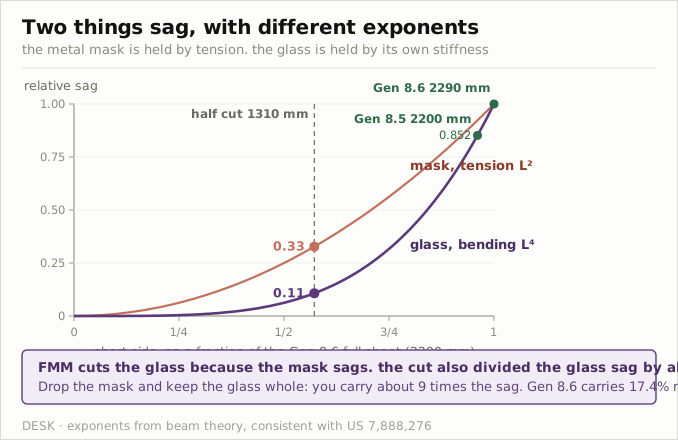
FLiPP saying it will not cut the glass means carrying that factor of about nine in full. This is the price of higher panel utilization and deposition efficiency. The item appears nowhere in the reports or the presentation.
Thickness sits in the same term. Sag is inversely proportional to the square of thickness, so if the glass thins from 0.5mm to 0.4mm, sag becomes 1.56x. The demand to make panels thinner and the demand to move glass safely pull in opposite directions within the same term.
The last row of the relative sag table matters too. The Gen 8.5 mother glass LG Display plans to use has a short side of 2,200mm, while BOE’s Gen 8.6 has 2,290mm. That is a 4.1% difference, but because of the fourth power, sag differs by 17.4%. The area difference is 9.1%. Make the mother glass one generation larger and area grows by 9% while sag grows by 17%.
Issue 2 explained LG Display’s choice of Gen 8.5 by investment cost and the lines it already owns, and that inference was right. But there may be one more reason. If you intend to use the glass without cutting it, the smaller sheet is physically better.
BOE Has Been Breaking Glass on Gen 8.6 for Half a Year
The same week, a report showed that physics actually causing problems.
According to The Elec’s report on October 13, BOE has gone about 6 months without solving the glass substrate crack problem on its Chengdu B16 Gen 8.6 OLED line. From the early production stage, some glass substrates repeatedly cracked or broke, and the company is running 2 lines while looking for the cause.
The cause has not been pinned down. Whether it is equipment, materials, or process conditions has not been sorted out. Crack conditions are irregular, the same equipment behaves differently depending on materials and recipes, and several customers’ products are being validated at the same time, which reportedly makes analysis harder.
The frequency itself is said to be low. The problem is the loss each time one breaks. When a large sheet of glass breaks inside equipment, production stops while fragments are cleared and the equipment is inspected, and it can take half a day to a day to return to normal operation. The article gave the example that even two or three cracked sheets out of 1,000 put in are a problem on a mass-production floor, and relayed the industry view that on a continuously running line it effectively has to be close to zero.
The timing matters. BOE began producing validation panels of OLED for Apple’s iPad on this line in September 2026. This is not yet formal supply but a prototype validation stage for customer approval. It is being validated on a line where the cracks have not been solved.
A line has to be drawn here. BOE B16 is an FMM line. So reading these cracks as “the price of not cutting the mother glass” would be wrong. The article did not say at which process stage the cracks occur either. The TFT backplane process runs on full sheets and the half cut is done at the deposition stage, so the glass dimensions differ by stage.
What should be read is something else. Gen 8.6 glass is actually breaking on the mass-production floor right now, and it is hard enough that the cause has not been found in half a year. That sag spans equipment, materials, and process is also exactly as the patent explained. Density and Young’s modulus belong to materials, the support span of cassettes and transfer belongs to equipment, and thermal history belongs to process. It is not strange that BOE cannot tell which of the three it is.
Sunic System Supplied the Evaporators on That Line
There is a point where this case bears directly on Korean readers.
The evaporation equipment supplier for BOE’s Chengdu Gen 8.6 line is Sunic System. It disclosed the Phase 1 evaporation equipment contract in June 2024 and the Phase 2 contract on February 25, 2026. The contract end date is December 21, 2027, and the amount was not disclosed because BOE asked for trade-secret protection. Phase 2 corresponds to 16,000 sheets per month, and the whole facility BOE is building is 32,000 sheets per month on a Gen 8.6 mother-glass basis. Total investment is 63 billion yuan.
The meaning of this contract is bigger than its numbers. Japan’s Canon Tokki held a monopoly on the evaporator market up to Gen 6. As Sunic System won BOE’s Phase 2 after Phase 1, the landscape began to change at Gen 8.6. It is a case of a Korean equipment maker breaking a monopoly by stepping in at a generation change.
Yet glass is breaking on that line, and equipment is among the candidate causes. And according to The Elec, Sunic System plans to supply evaporation equipment for an additional B16 line from November as originally planned. That means follow-on supply goes ahead on schedule while the cracks remain unsolved.
There is no evidence that the evaporators are the cause. All that has been confirmed now is that the cause has not been identified. Still, the fact remains that the foothold a Korean equipment maker gained at a generation change is tied to the difficulty of handling that generation’s glass.
The Paju Gen 8.5 WOLED Line Is Turning to FLiPP
Then came the report on investment.
According to Electronic Times on October 18, LG Display is in talks with suppliers to begin FLiPP investment, and the investment is expected in the first half of 2027. The target is the Gen 8.5 WOLED line at its Paju site. The plan is to upgrade that line into a dedicated FLiPP line.
The mask is not the only thing changing. The WOLED this line makes today is bottom emission, sending light out through the substrate, while FLiPP is top emission. LG Display answered questions from The Elec and ZDNet Korea that converting W-OLED equipment for FLiPP enables top emission through the FLiPP structure. The line conversion goes as far as flipping the direction of emission.
Issue 2’s inference has been confirmed. That article wrote that “LG Display already has a large Gen 8.5 line. It is the line that makes WOLED for TVs,” and saw the choice to hold off on new Gen 8.6 investment as possibly a different path rather than falling behind. It is that very line.
There is one more line about equipment: more chambers and exposure equipment are unavoidable. That line meshes with the price Issue 2 pointed out. FMM-less patterning repeats the same process three times for red, green, and blue. As Electronic Times describes it, depositing the organic layer, covering the part to keep with encapsulation, and stripping the rest by exposure run once per color. Run the process three times and you need that many more chambers and exposure tools. The repetition Issue 2 flagged as a reliability issue shows up as equipment count on the investment side.
The same article covered Samsung Display as well. It has begun talks with suppliers on equipment investment for the A7 plant at Asan Complex 2 in South Chungcheong Province, with products expected to be OLED for premium mobile, foldables, notebooks, and tablets. Investment in this plant was decided in 2017 and construction began, then it was halted in 2021. The likely schedule is to announce the scale and plan in the first half of 2027, finish moving in key equipment by the first half of 2028, and begin operation during 2029.
The three companies’ answers lined up side by side in the same week.
| Choice | Mother glass | |
|---|---|---|
| LG Display | Converts a line it already has | Uses Gen 8.5 without cutting |
| Samsung Display | Revives a halted fab | (A7 generation not disclosed) |
| BOE | Goes to a new Gen 8.6 | Breaking on Gen 8.6 |
What Remains
Here is what has not been confirmed.
The assumptions behind panel utilization. We found a point where 75% and 93% reproduce from the same combination, but there is no confirmation that these are the assumptions the company used. The company has not disclosed the aspect ratio of the 23.5-inch panel or the spacing between panels. If it discloses those two values, we will recalculate.
The process stage and cause of BOE’s cracks. The report said only that it had not been pinned to equipment, materials, or process. At which stage, and whether on a full sheet or in the half state, has not been disclosed. We did not guess.
The thickness of Gen 8.6 glass. Sag is inversely proportional to the square of thickness, so thickness is a key variable, but the thicknesses BOE and panel makers use have not been disclosed. So the relative sag table assumes the same thickness and does not give absolute sag.
The amount of Sunic System’s contract and the number of evaporators. The amount is undisclosed at BOE’s request to protect trade secrets, and the filing does not state the number of units.
The generation and investment scale of Asan Complex 2 A7. They are not in the report. Whether it is Gen 8.6 or Gen 6 has not been confirmed either.
And FLiPP’s reliability figures. In Issue 2 we pointed out the three-color repeated process and the encapsulation problem, and quoted Samsung Display’s So Byung-soo saying that “no technology has yet reached the mass-production stage.” At this seminar too, the 2.4x lifetime is a value derived from aperture ratio, and the effect of the repeated process on reliability was not disclosed.
Outlook
FLiPP’s real test is not aperture ratio but glass handling.
Three of the four figures the company presented are about cost and productivity. And the condition that produces those three comes down to one thing: not cutting the mother glass. Panel utilization rises because the glass is not cut and the spacing between panels shrinks, deposition efficiency rises because the glass is not cut, and process time shrinks because mask changes and alignment are gone. Aperture ratio is the result of the mask disappearing, and luminance and lifetime are the result of aperture ratio.
So that is also where this technology will be tested in mass production. Glass with a 2,200mm short side has to pass through the entire process without being cut, giving up the roughly 1/9 that the half cut provided for free. LG Display will meet the same kind of problem BOE has spent half a year on at 2,290mm. Its only margin is that Gen 8.5 sags about 15% less than Gen 8.6.
Whether this judgment is right or wrong can be seen from three things.
First, whether the investment announcement in the first half of 2027 includes transfer and cassette equipment. The Electronic Times report mentioned only chambers and exposure equipment. If glass handling is the real challenge, transfer equipment should come up alongside. If only exposure and chambers are added and transfer is used as is, I overestimated it.
Second, what panel size LG Display chooses to start mass production with. LG Display has said it will apply FLiPP first to IT products such as tablets and monitors and extend it to ultra-large TVs. Starting with small panels means looking at panel utilization and yield first, and whether that order holds is the signal.
Third, when the cause of BOE’s cracks is disclosed, whether it is materials or equipment. If it converges on materials, it is the glass maker’s problem, so LG Display will meet the same problem through the same supply chain. If it converges on equipment, it becomes Sunic System’s task, and if it converges on process, it is a problem each company solves separately. Depending on which way it goes, this article’s center of gravity will shift.
In Issue 2 we closed with “the basis for the 64% improvement was not disclosed.” Two months later, three more values came out and narrowed that gap. The most likely answer was the spacing between panels, and the blank left is how many millimeters that spacing actually is.