BOE's 1+4+N Business, Dissected
BOE makes the glass substrates used in semiconductor packaging in its sensor business unit. The four tracks it set out to earn money outside displays have climbed to 26% of revenue, but open the filings and 18 points of that are TVs and monitors. The only business that display processes actually crossed over into is sensors, and it is 0.41% of revenue. And in the first half of 2026, the core display business slipped into decline.
This Week's Hot Issue
This column gathers the display industry news that broke over the past week (Monday through Sunday) and digs a little deeper into the single hottest issue among them.
News the Press Covered, October 5 to 11
First, the AI PC has settled the panel spec. The displays in all of the first 7 notebooks built on NVIDIA’s RTX Spark are Korean-made. Samsung Display supplies 6 and LG Display 1 (the 16-inch tandem OLED in the Dell XPS 16), and Microsoft’s official materials name the models directly, so the picture can be cross-checked. The figure that catches the eye is the 48Hz floor on the variable refresh rate. Neural network computation eats the battery, so the panel holds out by dropping its refresh rate. The same week, Counterpoint Research forecast that notebook OLED shipments in 2026 would grow 50% while mini LED would fall 38%. Reports also followed of Apple unveiling an OLED MacBook Pro on October 27, the very date we meant in Issue 8 when we wrote that “Apple’s transition has started getting dates.”
Second, patents moved in two directions. Samsung’s two OLED patent suits with Pictiva ended in a settlement on October 8. This was the case in which a jury in November 2025 found willful infringement and returned a $191.4 million verdict, with close to half of that money riding on a single claim. That the patents at stake came not from displays but from lighting is something we covered separately in this issue.
Meanwhile, NEXT Biometrics, which has been developing technology to read fingerprints anywhere on the screen, announced on October 9 its intention to file for bankruptcy. It had tried to fund new technology development by selling its legacy fingerprint sensor business, but the deal stalled at a non-binding letter of intent and shareholders declined to put in more money. The company talks of a prototype in December, but nothing has been decided about where that intellectual property will go.
Third, microLED went to the military instead of consumer devices. Kopin won an $18.6 million sole-source award from the U.S. Army, bringing its cumulative IBAS awards to $34 million, and the scope extends to building a U.S. microLED manufacturing base. If Issue 8’s optical interconnects were “leaving the screen for the space between chips,” this one is “leaving the screen for the field.”
Fourth, blue phosphorescence picked up another delay forecast. Universal Display’s stock fell 5.59%. Citi cited lifetime stability and said the timing of mass-production adoption could slip from the second half of 2026 to 2027, but the company did not announce a delay. In Issue 1, DESK wrote that “no commercialization timing has been given,” and CLAIM wrote that “even though the principle patent expired in August 2020, no mass-production adoption has been announced in 6 years.” Nobody is blocking it, and it is still where it was. Meanwhile, the method panel makers use is to stack more layers, which is why the first item is tandem.
Fifth, the automotive display has become a moving object. Genesis unveiled the GV90 center display. It is used at 23.6 inches while driving, and when stopped or charging it rises by up to 90mm to become 24.6 inches. The panel supplier was not disclosed. The same week, Jaguar unveiled its electric GT “Type 01” in New York with a curved OLED that is revealed only when needed. The screen is changing from a fixed slab into a component that folds and rises.
Sixth, the government eased on-site regulations for displays. The Office for Government Policy Coordination’s Regulatory Rationalization Task Force announced it on October 6, and the most direct measure is removing tempered glass for automotive displays from import approval. Generic-name labeling in chemical accident prevention management plans takes effect immediately. The next move after the “displays are a national security asset” forum we reported in Issue 8 came from the regulatory side.
And BOE was in the news all week. Chairman Chen Yanshun’s visit to Korea and his meeting with Roh Tae-moon, head of Samsung Electronics’ DX division, BOE’s supply of practically all of Huawei’s flagship panels, and figures of Samsung Display 50.9% and LG Display 31.8% in large OLED (2025 forecasts) came one after another. The semiconductor glass substrate side overlapped as well. So this issue uses the filings to open up what BOE is doing outside displays. The agenda of the Korea visit and the Huawei supply chain are stories where more reporting is still piling up, so we will look at them in the next issue.
Reports from October 11 (Sunday), the last day of the collection window, are not included in this roundup. The material covering that day has not arrived yet, and that portion will be reviewed together in the next issue.
The hottest issue of October 5 to 11 is “BOE’s 1+4+N.”
The Core Business Has Turned to Decline
The most striking number in BOE’s report for the first half of 2026 is not a growth rate but a single minus sign.
| Business | 2026 H1 | Share | Change |
|---|---|---|---|
| Display Devices | 81.755 billion yuan | 79.27% | −3.20% |
| IoT Innovation | 19.000 billion yuan | 18.42% | +5.75% |
| MLED | 6.406 billion yuan | 6.21% | +47.37% |
| Smart Engineering Medicine | 0.957 billion yuan | 0.93% | +4.32% |
| Sensor | 0.421 billion yuan | 0.41% | +88.21% |
| Other and eliminations | −5.407 billion yuan | −5.24% | |
| Total | 103.132 billion yuan | 100% | +1.83% |
For full-year 2025, display revenue was 166.4 billion yuan, up 0.86% from the year before. It was nearly flat, but positive. In the first half of 2026 it is minus 3.20%.
The core business of the world’s largest display company crossed from plus to minus in half a year. This is why BOE has been talking about “outside displays.”
What Is “1+4+N”?
BOE calls its business structure 1+4+N+Ecosystem. The semi-annual report defines it as follows.
| What it is | |
|---|---|
| 1 | Display. The core capability BOE has built up and the starting point of its “Empower IoT with Display” (屏之物联) strategy |
| 4 | IoT Innovation, Sensor, MLED, Smart Engineering Medicine. Four tracks chosen as extensions of its core capabilities and value chain |
| N | IoT application scenarios in specific segments that it keeps exploring |
| Ecosystem | A platform for innovation ecosystem collaboration |
These Four Are Business Units, Not Reporting Lines
Whether the “four businesses” are a split for press releases or organizations that actually run separately is answered by the accounting notes in the filing. The semi-annual report gives the basis for determining its reportable segments as follows.
The main reason for these segments is that the Group manages independently its display devices, IoT innovation, sensor, MLED, Smart Engineering Medicine and other businesses. Because these segments each manufacture and/or sell different products, apply different production processes, and each have their own characteristics in operating margins, each segment is managed independently.
It goes on to say that the chief operating decision maker evaluates the performance of each business segment and allocates resources on the basis of operating results. Finance costs and investment income are excluded from that evaluation. The filing itself states all three conditions, independent management, separate profit and loss, and a unit of resource allocation, so it is fair to call them business units.
And the segments the filing draws are in fact six, not five. (f) Other is added to the five above. It covers things like smart energy, industrial internet, and ultra-high-definition display, and in the revenue table it is lumped into a single “Other and eliminations” line together with intersegment adjustments. The N businesses we will look at later fall here in accounting terms.
One correction here. Some Korean reports have rendered IoT Innovation as “smart systems,” but the official name in the filing is “IoT Innovation” (物联网创新). As we will see, that difference in name obscures the nature of the business.
Four New Businesses at 26%, but the Inside Is Uneven
Add the four tracks together and they come to 24.81% in 2025, rising to 25.97% in the first half of 2026. That reads as a quarter of revenue coming from outside displays.
But 18.42 percentage points of that 26% is IoT Innovation alone.
The green dot sitting alone at the upper left is Sensor. It is the fastest and the smallest. The gray dot at the lower right, sunk below the 0% line, is Display.
IoT Innovation Is Really Display
Here is how the semi-annual report describes IoT Innovation’s business. Under a system solution design and integrated manufacturing model, it provides customers with smart terminal products in TVs, monitors, notebooks, tablets, low-power devices, IoT, and 3D display, combined with AI and big data.
The performance narrative in the 2025 annual report points the same way. Revenue from key overseas TV customers doubled year over year, it broke into mid- to high-end product lines in monitors, and in tablets it made the thinnest LCD product in the industry. It ranked among the leaders in shipments of whiteboards, indoor signage, projectors, POS devices, and electronic shelf labels.
A company that used to sell panels is making finished products with those panels and selling them. That is vertical integration, not a move into another industry. The scale of 38.9 billion yuan comes from there too.
Half of MLED Is Backlight
MLED, too, sounds like next-generation display from the name alone. The filing’s definition splits it in two.
One is direct view. These are high-brightness Mini/Micro LED products for outdoor, commercial, transparent, and specialized displays. In 2025, the MPD P0.6 double-sided poster display developed with BOE HC SemiTek won an award at InfoComm in the U.S., and it did a cinema project with Shanghai Film Group.
The other is LED backlight. These are backlight components that go into TVs, monitors, notebooks, and automotive displays.
The latter are parts that light up LCDs, so it is more accurate to see them as part of the core display business. The filing does not disclose the split between the two.
The growth rate is worth noting, though. It was 9.81% for full-year 2025 and jumped to 47.37% in the first half of 2026. At 6.4 billion yuan, it is also the second largest of the four by amount.
Where that 47% came from can be inferred from the semi-annual report’s narrative. On direct view, it says that it sped up overseas expansion and overseas revenue rose sharply, and that several benchmark projects landed. On backlight, it writes that it was newly adopted by several leading brand customers. That means both sides moved together, and which one pulled harder has not been disclosed.
The Only Business Process Actually Crossed Into Is Sensors
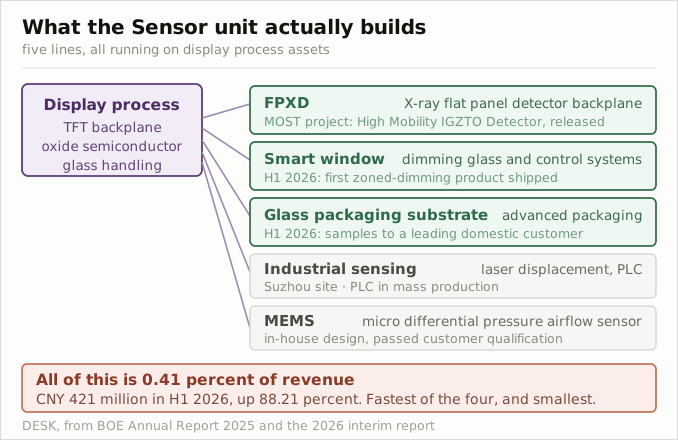
Of the four tracks, the one where display manufacturing processes are used as is is Sensor. The semi-annual report lists five focus areas.
| Area | What it is |
|---|---|
| FPXD | Backplanes for flat panel X-ray detectors |
| Smart windows | Smart dimming windows and dimming systems |
| Industrial sensors | Solutions for consumer electronics and industrial applications |
| MEMS | Micro-electromechanical devices |
| Glass-based packaging substrates | Substrates for advanced packaging |
Three of the five reuse TFT backplane and glass substrate processes as is. An X-ray detector is a pixel array that receives X-rays instead of light, a smart window puts liquid crystal between glass panes to change transmittance, and glass-substrate packaging is the work of drilling holes in glass and embedding electrodes.
Concrete products can be confirmed in the 2025 results as well. FPXD sales rose significantly year over year, and the Ministry of Science and Technology key project “High Mobility IGZTO Detector Development” went all the way to product release. Smart dimming products went into key customers’ flagship vehicle models on schedule. The high-precision laser displacement sensors made in Suzhou were fully introduced at leading customers in the laser measurement industry, PLC products entered mass production, and its self-developed MEMS micro differential pressure airflow sensor passed customer certification.
IGZTO is an oxide semiconductor in the IGZO family. The material whose mobility has been pushed up for driving displays is being used as the readout element in X-ray detectors. The same equipment, the same glass, and the same patterning yield a different product.
Sensor also has its own legal entity. Beijing BOE Sensor Technology Co., Ltd. stands with a 100% stake and 5.779 billion yuan in paid-in capital (about 1.1 trillion won), and there is another entity of the same name in Suzhou. The laser displacement sensors mentioned above come from that Suzhou entity.
The registered business scope of the Beijing entity is broader than what currently generates revenue. Alongside X-ray sensors, it includes microfluidic chips, biochemical chips, gene chips, biosensors, and microwave antennas. A 100% subsidiary with capital on the order of 1 trillion won is generating 0.421 billion yuan in half-year revenue, and that is better read not as a side project but as an investment that revenue has not yet caught up with.
In the first half of 2026, two more things were added. Glass-based advanced packaging substrates delivered samples to a leading customer in China, and smart windows, with revenue rising fast, put zoned control technology into a product for the first time. Instead of dimming the whole window, it adjusts it zone by zone, the same idea as local dimming in displays.
Of these, glass-substrate packaging alone is worth pulling out for a separate look. It is the same thing as the glass core substrates we covered in Issue 4, yet BOE did not appear once in that article, and in Issue 8 we touched on it in only one line.
Why Is a Semiconductor Packaging Substrate in the Sensor Unit?
Glass-substrate packaging is a substrate for advanced semiconductor packaging. In products like AI accelerators, where chips get bigger and several have to go into one package, today’s plastic-based substrates warp and give way to heat, so the trend is to switch to glass. It does use display processes, but it has nothing to do with sensors.
Yet in BOE’s organization, it belongs to the Sensor business unit. Not Display, not MLED, but Sensor.
The filing itself gives the reason. BOE names its three core advantages as follows.
display technology, glass-based processing, and large-scale integrated intelligent manufacturing
“Glass-based processing” is listed as one of the company’s three core competencies. Look again at the five tracks of the Sensor unit with that in mind, and you can see that what they share is not sensing. An X-ray detector is a TFT array on glass, a smart window is PDLC between two sheets of glass, and glass-substrate packaging is drilling holes in glass. Even for MEMS, the annual report lists the goal to “Develop silicon-based and glass-based pressure MEMS chip and device products.”
In other words, the Sensor unit is not an organization that sells sensors but a channel for taking glass and TFT outside displays. The name hides what it does.
Three Names for the Same Thing
More interesting is that this business is called by three different names within the filings.
| Where | What it is called |
|---|---|
| Strategy narrative | Core direction of the “Nth Curve” (第N曲线). Glass-based advanced packaging and optical interconnects |
| Accounting and organization | One of the five tracks of the Sensor business segment |
| Product | Advanced packaging substrate for semiconductors |
In strategy it is N; in accounting it is Sensor. In the “1+4+N” definition we saw earlier, N was “IoT application scenarios in specific segments that it keeps exploring.” But in the filings N has one more meaning. When the company, building on its “Empower IoT with Display” (屏之物联) strategy, points to its next growth axis with the phrase “Nth Curve,” the core directions it names are glass-based advanced packaging and optical interconnects. Perovskite photovoltaics are attached to that.
It has, in effect, put the business it pushes hardest as its future into its smallest business unit.
Corning Has Partnered With Both AUO and BOE
In May 2026, BOE signed a memorandum of understanding on cooperation with Corning. The semi-annual report states this directly, and the scope of cooperation goes beyond conventional displays.
Glass-based packaging substrates, foldable glass, perovskite glass substrates, optical interconnects
According to reports, the term is three years, and at this stage the only legally binding parts are standard clauses such as confidentiality and intellectual property. It is right to read it as an agreement that sets a direction, not a concrete production contract.
Even so, this list deserves attention. When we covered glass core substrates in Issue 4, the companies we saw as the protagonists were AUO and Corning. That same Corning has now partnered with BOE in the same field. The side that holds the glass ties up with several panel makers at once. That is the power of holding the materials position.
And optical interconnects, at the very end of the list, are exactly the field we covered in Issue 8. It is the technology of using microLEDs not for screens but for communication between chips. That glass substrates and optical interconnects sit together in one agreement means the two technologies ultimately meet in the same place: inside the AI accelerator package.
How Far Has BOE’s Glass Substrate Come?
The stages can be followed through the filings.
| When | What |
|---|---|
| 2024 | Pilot line investment (0.993 billion yuan per reports, about 190 billion won) |
| 2025 | Research and pilot line achieves full-process integration. Construction of a materials research institute begins in Yantai |
| May 2026 | Three-year agreement with Corning |
| July 2026 | TGV pilot production line unveiled; cooperation proposed to Korean companies |
| H1 2026 | Samples delivered to a leading customer in China |
The roadmap table in the annual report lists this project’s status as “In progress” and leaves its tasks as follows: “Clarify the glass-based substrate technical route and produce samples; Solve key technical problems and improve product reliability.” The words mass production do not appear yet.
On the technology side, what it says it has secured is TGV micro-hole processing and copper filling. Drilling holes in glass and filling them with copper is the gateway for this technology. It has been reported that it is supplying large-area glass carrier prototypes to AI semiconductor companies for validation.
It is not far from Korea either. In Korea, SKC, Samsung Electro-Mechanics, and LG Innotek are developing with mass-production targets of 2027 to 2028. BOE proposing cooperation with Korean companies when it unveiled its pilot production line in July 2026 should also be read within that landscape. The industry sees who first wins certification from customers such as NVIDIA, Broadcom, and Apple, more than the timing of mass production, as what decides the lead.
Yet All of Sensor Is 0.41% of Revenue
Sensor revenue was 0.587 billion yuan in 2025 and 0.421 billion yuan in the first half of 2026. That is 0.41% of the company’s total revenue.
By growth rate alone, it is the fastest. 52.00% in 2025, and 88.21% in the first half of 2026. It is the only one of the four tracks well beyond double digits.
Size and speed are exact opposites. The business that process assets actually crossed into is the smallest and is growing the fastest. In a company of 200 billion yuan, 0.4 billion yuan is close to a rounding error, but if this pace continues for a few years, the order of magnitude will change.
Smart Engineering Medicine Is Hospitals
The fourth track has almost nothing to do with displays. The filing defines it as a professional service model and writes that it uses hospitals and elderly care as a platform for extracting healthcare IoT capabilities, building a tiered diagnosis and care system.
The 2025 performance narrative makes the content clear. Chengdu BOE Hospital completed its on-site evaluation for Grade 3A status, and its spine surgery team performed the world’s first reverse-folding scoliosis correction surgery. Hefei BOE Hospital performed an artificial heart implantation and received qualification for a trial operation of in vitro fertilization. A regenerative medicine cardiac patch completed patient enrollment for its Phase 1 clinical trial, and a uterine patch and an NK and CAR-NK immune cell pipeline are under way.
Phase 1 clinical trials and CAR-NK appear in a display company’s annual report. Revenue is 1.9 billion yuan with growth of 3.40%, the slowest of the four.
N Is Subsidiaries
The filing writes that the N in “1+4+N” means application scenarios in specific segments, but what actually appears in the narrative is the names of subsidiaries.
BOE Varitronix (京东方精电), which makes automotive displays, expanded overseas markets; BOE Energy released or contributed to 2 national standards in the first half and won two awards at SNEC 2026. Zhongxiangying was selected as a national-level key “little giant” among specialized and sophisticated enterprises, and Zhonglian Chaoqing expanded digital exhibition screens for exhibition halls and government and corporate use while developing in-house an ultra-live-event large screen it claims is the world’s first.
N is closer to a subsidiary portfolio than to a strategy. And most of it is displays again. In accounting terms, too, these are not separate segments but fall under (f) Other, bundled into one line of the revenue table with intersegment eliminations.
Even Within the Core Business, the Weight Is Shifting
Display revenue falling 3.20% does not mean everything inside has stood still. The semi-annual report writes that flexible OLED shipments rose further and it launched several first-to-market products with brand partners. It is natural to read the shrinking side as LCD, but the filing does not give amounts split between LCD and OLED.
The Chengdu Gen 8.6 AMOLED line fits the same context. Construction began in March 2024 with a total investment of 63 billion yuan and a capacity of 32,000 sheets per month, and it entered formal mass production and customer deliveries in June 2026. The target is mid-size OLED for notebooks and tablets.
In other words, BOE is not shrinking displays but shifting its position within displays. The 26% in new businesses is growing alongside, and it cannot yet replace the core business.
Profit Did Not Come From the Core Business
Net profit in the first half of 2026 was 5.248 billion yuan, up 61.62%. When revenue grows 1.83% and profit jumps that much, the reason has to be checked first.
The “non-core business analysis” table in the semi-annual report gives the answer. The table has a separate “sustainability” column.
| Item | Amount | Share of total profit | Sustainable? |
|---|---|---|---|
| Investment income | 1.731 billion yuan | 23.82% | No |
| Gains from fair-value changes | 2.310 billion yuan | 31.79% | No |
| Asset impairment | −0.910 billion yuan | −12.53% | No |
The first two alone make up 55.61% of total profit. The company itself wrote that they are not sustainable. Net profit excluding non-recurring items is 3.008 billion yuan, and the growth rate drops from 61.62% to 31.81%.
Over the same period, R&D spending was 6.833 billion yuan, up 12.35%, and finance costs rose 137.53% as foreign exchange losses grew.
What Remains
Here is what has not been confirmed.
The split between direct view and backlight in MLED has not been disclosed. We cannot tell which side the 47% growth in the first half came from. If it is backlight, it is an extension of the core display business; if it is direct view, it is a new market. The two are entirely different stories, yet they are tied into one number.
The five areas within Sensor are not broken out by amount either. The figure of 88% alone cannot tell whether FPXD or glass-substrate packaging did the pulling.
A figure of 13.98% as the share of the four new businesses in 2021 appears in some materials, but we could not find it in the two original filings we checked this time. So we did not use it in the text.
We also checked the display segment’s past growth rates only back to 2024. The company-wide revenue trend in the 2025 annual report starts from 2023, and segment-level historical figures do not go back further than that. So we did not call the first-half −3.20% a “first.”
Outlook
Read BOE’s “1+4+N” as “a display company diversifying” and you miss half of it. The four tracks split into four different kinds: finished display products (IoT Innovation), next-generation displays mixed with display components (MLED), transplanted processes (Sensor), and a service business unrelated to displays (Smart Engineering Medicine).
Here are three things component makers should be watching now.
First, when will Sensor get past 0.41%? If 88% growth continues for two or three years, it will pass 1% of revenue around 2028. That point is the moment “process repurposing becomes a business,” and from then on it meets Korean materials, parts, and equipment suppliers in the same market. FPXD and glass-substrate packaging are spaces Korean companies have already entered. In the same vein, whether the IGZTO detector goes to mass production should be watched too. Turning oxide TFTs into X-ray sensors is something Korea can also do, but BOE is pushing it as a national project and has its own glass lines.
Second, who will win customer certification for glass-substrate packaging first? This comes before mass-production timing. BOE has started delivering samples, and the three Korean companies are targeting mass production in 2027 to 2028. BOE proposing cooperation to Korean companies should also be read on the same board. Drilling holes in glass is something displays did first, and BOE has gathered those assets in its Sensor business unit.
Third, will the core business’s minus continue? Whether the −3.20% in the first half of 2026 is temporary will only be known from second-half numbers. Still, BOE bringing its Chengdu Gen 8.6 AMOLED line into mass production in June 2026 is a choice to shift weight within the core business toward mid-size IT. The new businesses are still short by an order of magnitude to replace the core, and the company knows it.