Side-Chain Position and the Photostability of Conjugated Polymers
Researchers at the Korea Research Institute of Chemical Technology compared two polymers with exactly the same composition. They differ only in whether the side chain sits at the para or meta position, yet their photostability differed by 5 to 10 times. Oxygen permeability and thermal decomposition temperature are nearly the same, so encapsulation does not explain it. What separated them was whether the chain was coil-like or worm-like, and the one with longer conjugation was actually more stable.
DOI 10.1002/smll.76208There are usually two ways to extend the lifetime of organic emissive materials: change the molecule, or thicken the encapsulation.
The first touches composition. Substituents are swapped and backbones reworked to make molecules less vulnerable to oxidation. The second leaves the material as it is and keeps oxygen and moisture out.
In foldable and stretchable displays, the second way narrows. Rigid encapsulation cannot be wrapped around a place that folds and stretches.
This paper shows a third way. Without changing the composition at all, it shifted only the position where the side chain attaches and changed photostability by 5 to 10 times.
The comparison is between two isomers of the poly(diphenylacetylene) family: pC1, with the side chain at the para position, and mC1, with it at the meta position. Their elemental composition is the same and their molecular weights were matched.
And the point the title makes is that the difference is not explained by encapsulation. The oxygen permeability of the two polymers was effectively the same.
1. How far did photostability diverge at the same composition?
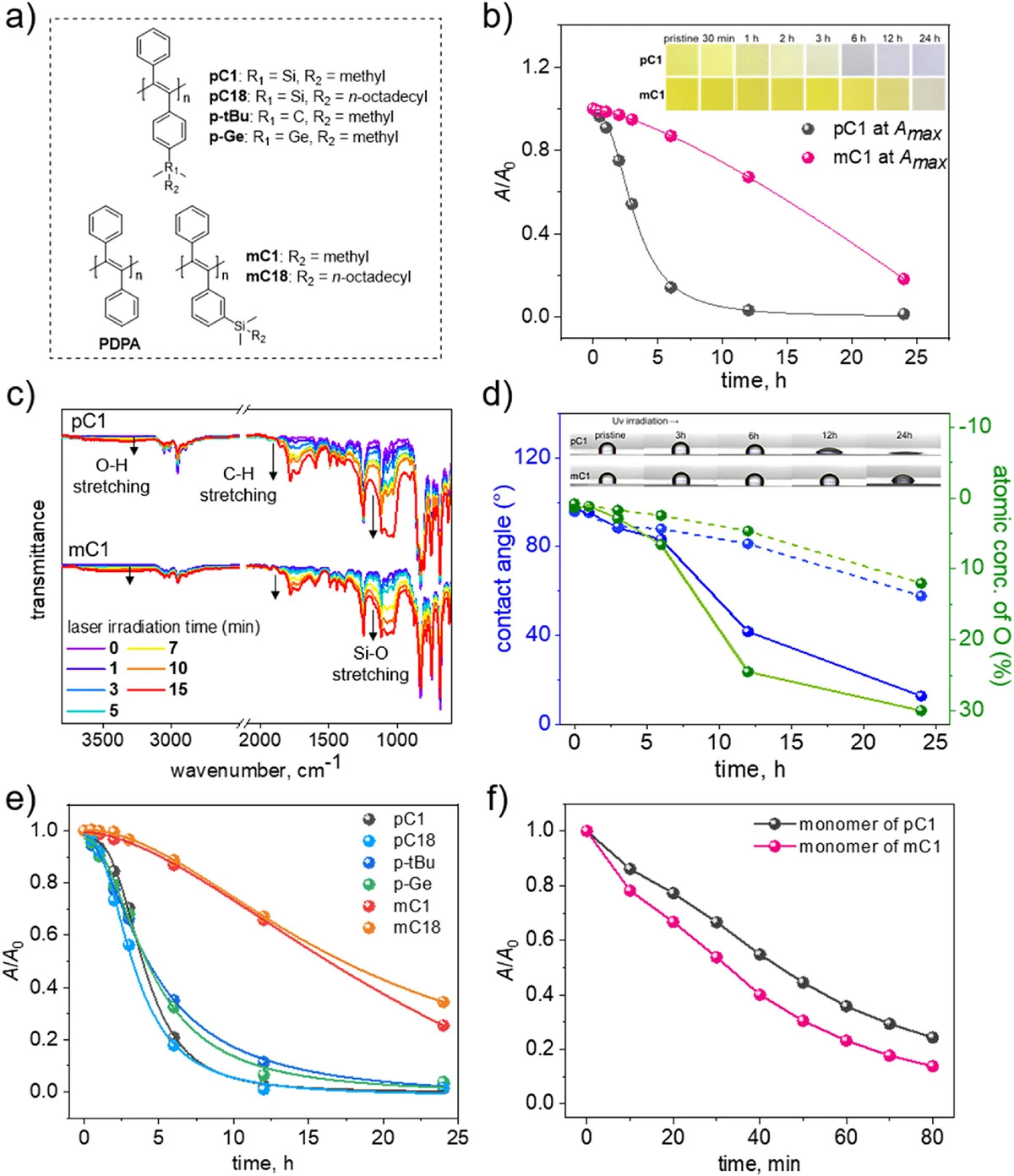
By absorbance, 5 times; by fluorescence, 10 times. Measuring the time for peak absorbance to fall to half its initial value under 365-nanometer ultraviolet light gave 3.12 hours for para and 16.45 hours for meta.
Fluorescence spreads them further. The time for fluorescence intensity at the peak wavelength to halve is 0.72 hours for para and 7.28 hours for meta, about 10 times. It is the difference that would be felt more strongly in use as an emissive material.
This ranking is not a single measurement. The same order held across several polymerization batches with different molecular weights, and the same held in dilute solution. Change the conditions and para still dies first.
2. What is the basis for saying encapsulation does not explain it?
Because their ability to block oxygen is effectively the same. Oxygen permeability is 1,100 barrer for para and 1,200 barrer for meta, almost no difference. It means meta does not last longer because less oxygen gets in.
Other properties match too. In thermogravimetric analysis, the onset decomposition temperature is about 400 degrees for both, and in X-ray diffraction the lamellar spacing is nearly identical at 13.0 angstroms. The average stacking period is the same.
Optics do not tell them apart either. The ultraviolet-visible absorption spectra have similar shapes, a main band at about 420 nanometers with a shoulder at about 380 nanometers. Handed the two materials and looking only at the absorption spectra, they would appear to be the same substance.
The decisive experiment is sealing. The films were sandwiched between quartz glass with the edges sealed to limit oxygen diffusion, then irradiated, and the same ranking held. Even with the oxygen supply blocked, para degrades first.
| Item | Para (pC1) | Meta (mC1) | Difference |
|---|---|---|---|
| Absorbance half-life | 3.12 hours | 16.45 hours | 5 times |
| Fluorescence half-life | 0.72 hours | 7.28 hours | About 10 times |
| Oxygen permeability | 1,100 barrer | 1,200 barrer | Almost none |
| Thermal decomposition onset | About 400 degrees | About 400 degrees | None |
| Lamellar spacing | 13.0 angstroms | 13.0 angstroms | None |
| Main absorption band | About 420 nanometers | About 420 nanometers | Almost none |
The point of this table is that only the items that separated the lifetimes differ, and everything else is the same.
3. A shared degradation pathway with diverging rates
The pathway is the same; only the rate differs. In infrared spectroscopy, the same oxidation peaks rise together in both polymers: O-H stretching near 3,400cm⁻¹, C=O stretching near 1,750cm⁻¹, and Si-O/C-O stretching near 1,100cm⁻¹.
The basis for the interpretation is that oxidation peaks from the backbone and from the side chains appear at the same time. It means both undergo the same photo-oxidative transformation and differ only in speed; it is not a structure in which one part breaks first.
Surface analysis points the same way. Water contact angle and surface oxygen concentration change with ultraviolet exposure, and the speed of that change directly reflects the difference in oxidation rate.
The measurement conditions need care. Under low-intensity 365-nanometer light, oxidation stayed in the outermost surface layer, below the infrared detection limit. So to see it in the infrared, a 405-nanometer, 100-milliwatt laser was used separately as an accelerated protocol. The numbers from the two conditions cannot be compared on the same line.
4. So what set the rate?
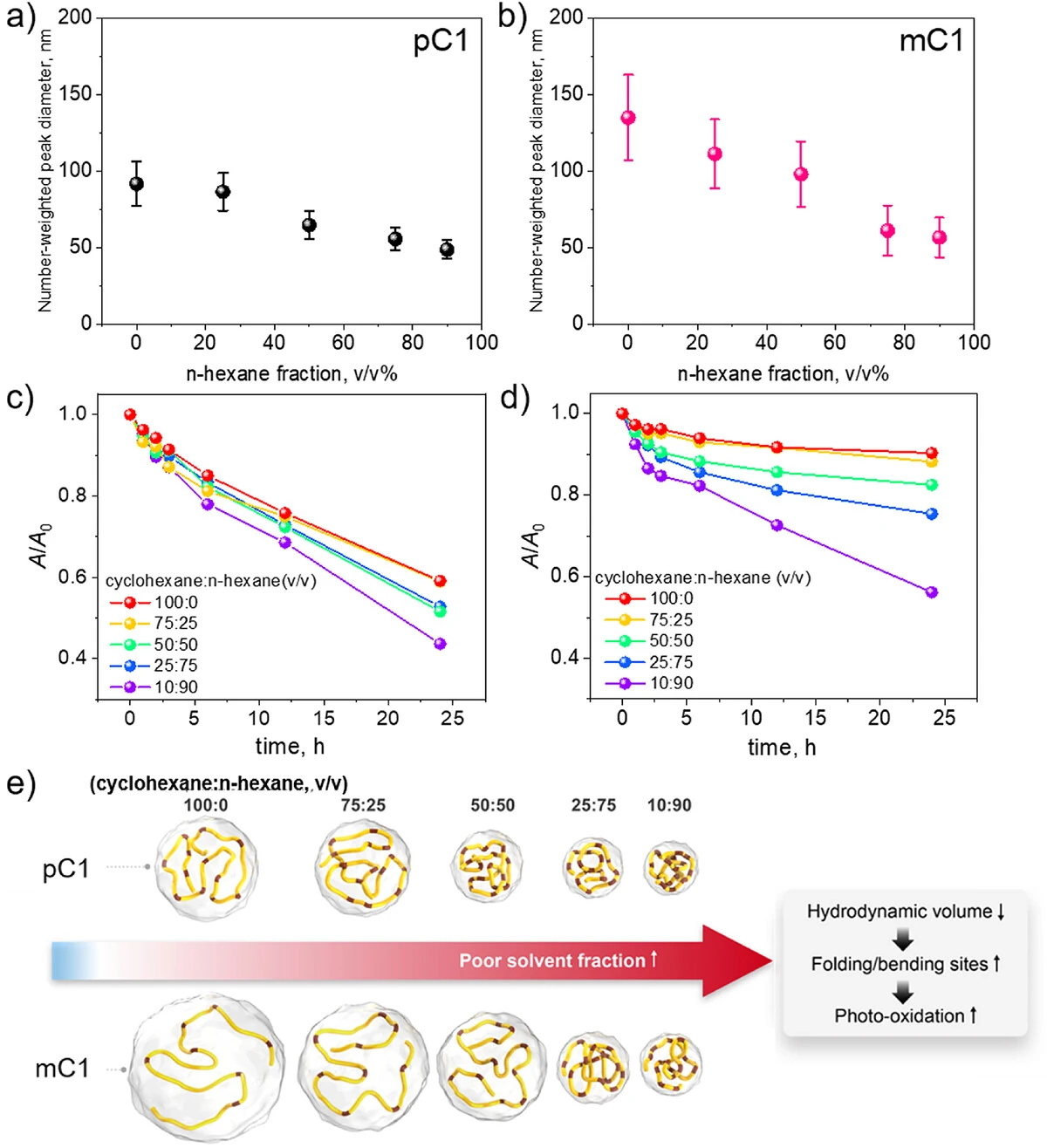
Whether the chain was coil-like (folded) or worm-like (extended). The position of the side chain sets the shape of the chain, that shape sets the density of torsional defects, and those defects become the initiation sites for photo-oxidation.
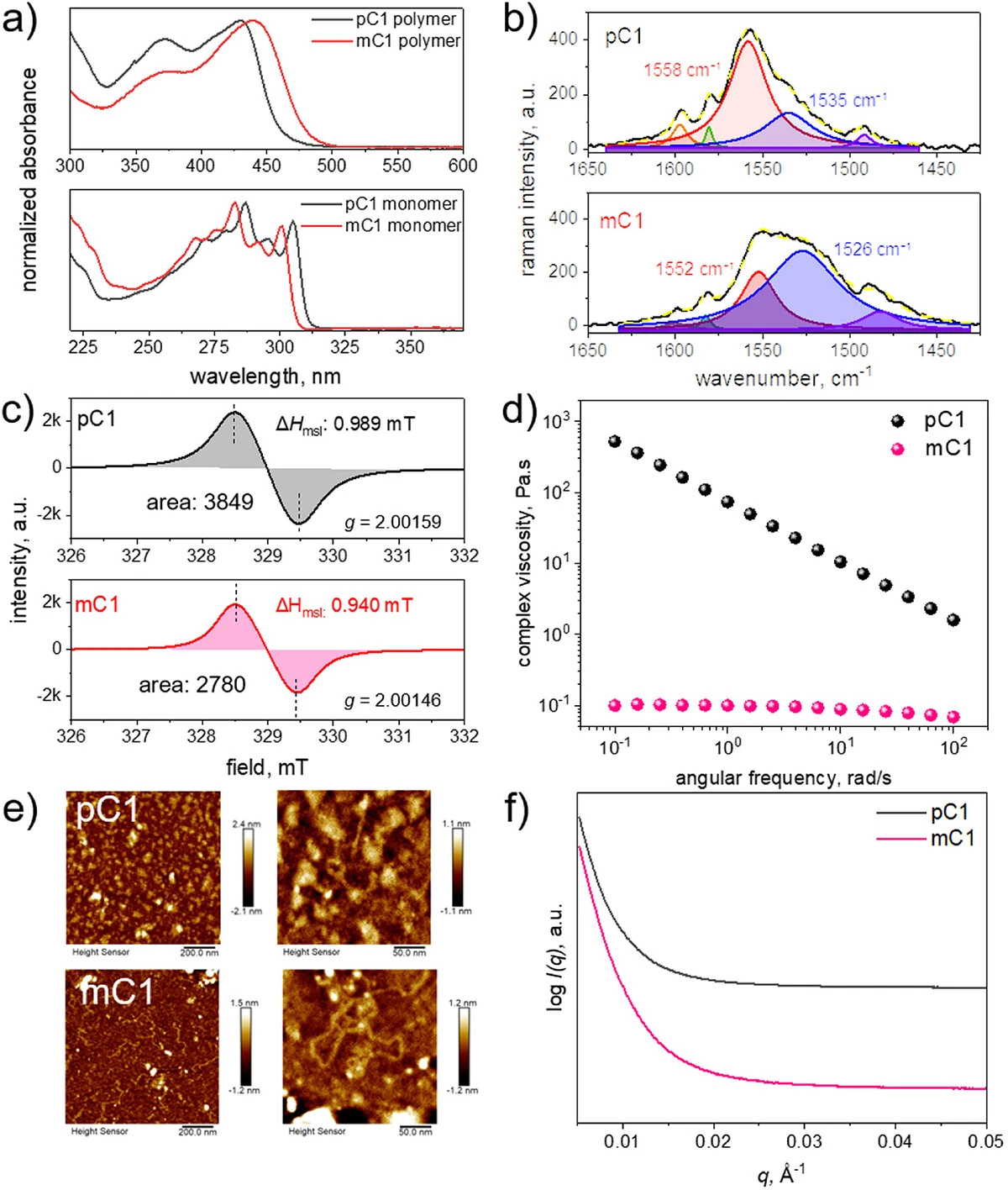
The evidence comes in four layers. In Raman spectroscopy, the intensity ratio of the shoulder to the main peak of the C=C symmetric stretch is higher for meta. In the polyacetylene family, bands in this region shift to lower wavenumbers as effective conjugation length grows, and following that trend, meta reads as having the longer effective conjugation length.
Electron spin resonance counts the defects directly. The g-values are about 2.0015 for both, indicating delocalized π-radicals, but the linewidth is narrower for meta, 0.940 millitesla versus 0.989 millitesla for para. The linewidth narrows as conjugation length grows and broadens with defects such as cis structures or chain torsion. And the radical concentration counted from integrated intensity is 1.38 times higher in para.
Rheology reaches the same conclusion at the macroscopic scale. The para solution shows strong shear thinning and does not reach a viscosity plateau at low frequency, showing gel-like viscoelasticity. Meta has a much weaker frequency dependence. The rheological crossover concentration differs widely, about 4.16 millimolar for para and 24.1 millimolar for meta.
Atomic force microscopy shows the shape directly. Deposited on mica from dilute solution, meta appears as long, extended worm-like chains with the backbone stretched out, while para forms aggregated, coil-like spherical domains, heavily folded within the chain.
The difference in conformation does not apply to light alone. Milling with an ion beam produces the same ranking. Depth profiling of films of about 130 nanometers with argon ions showed that the time for the carbon signal to reach the silicon substrate was 21 seconds for para and 57 seconds for meta, a difference in ion resistance of more than 2.5 times. At the same composition, meta also holds up better against ion damage.
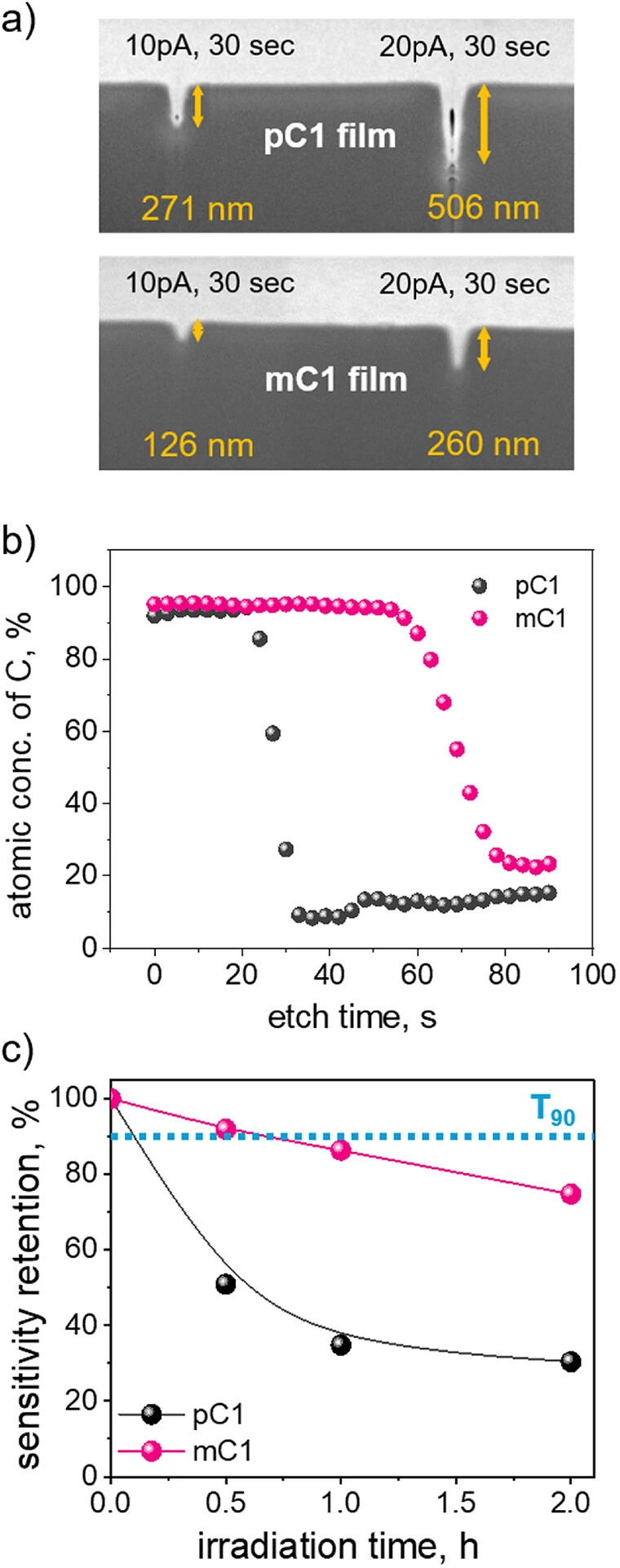
Here there is a point that runs against conventional wisdom. The usual view is that longer conjugation means stronger absorption and longer-lived excited states, and so greater vulnerability to photodegradation. Yet in these two materials, meta, with the longer conjugation, was more stable.
The paper’s explanation is that defects dominate. Localized spins created by torsion and cis structures are the starting points of photo-oxidation, and para, because of its folded conformation, carries more of those defects. Defect density weighs in before conjugation length.
5. Between the abstract and the body
The abstract says intrinsic stability was changed without changing composition. Go into the body and four conditions attach.
First, this is a spectroscopy paper on films and solutions, not on devices. There is no data on operating lifetime measured in a light-emitting device. Photostability and device lifetime overlap but are not the same. In a device, charge injection and Joule heating act as well. Carrying it over as “10 times the lifetime of an emissive material” is an overreading.
Second, the two measurements were made under different conditions. The fivefold absorbance result is under low-intensity 365-nanometer light, and the infrared analysis is under accelerated 405-nanometer, 100-milliwatt conditions. The paper offers no basis for converting accelerated results into real-use lifetime.
Third, the subject is a single family. The ranking was confirmed in poly(diphenylacetylene), and the body gives no basis for expecting the para-meta relationship to point the same way in other conjugated polymers. What this paper shows is “position matters,” not “meta is always better.”
Fourth, the absolute half-lives are short. Even meta’s 16.45 hours is a value under ultraviolet irradiation. It is in different units from the thousands of hours displays demand, and the number should be read as a relative scale for comparing the two materials.
And there is one thing we looked for but did not find: emission efficiency. The degree of chain folding also affects photoluminescence quantum yield and color purity, but a side-by-side comparison of the emission efficiencies of the two isomers is outside the scope. Even at 10 times the lifetime, a correspondingly lower efficiency would make it a trade-off.
6. What’s left for industry
This result does not lead directly to a material swap. There is no device data, and the subject is a single family.
DEEPLE still covered it because it adds one more criterion for judgment.
When looking at the lifetime of organic materials, the usual items are composition, energy levels, glass transition temperature and oxygen permeability. This paper adds chain conformation to that list. And what matters is that it is a variable that does not appear in a composition table. Two materials with the same molecular formula, the same molecular weight and the same absorption spectrum diverged by 10 times in lifetime.
From the encapsulation side, one more direction opens. If oxygen permeability is the same but stability differs, it means there is a share that can be gained by strengthening encapsulation and a separate share that can be gained from the material itself. In places where encapsulation cannot be wrapped around, such as foldables and stretchables, only the latter remains.
The remaining question is clear: what happens to efficiency when folding is reduced? It was confirmed that extended chains have fewer defects and last longer, but how that conformation acts on emission efficiency and color purity, the paper does not answer. If lifetime and efficiency sit at opposite ends of the same handle, design becomes a trade-off problem again.