 DISPLAY NOW 11
Cover simulation A 3D simulation of a foldable screen folding (Claim's piece). At the same bend radius R, a U-fold and a water-drop fold leave the same crease. What the water-drop hinge changes is the gap between the halves when closed, so the closed phone is thinner. Read the other way, at the same closed thickness the water-drop can use a larger R and leave a shallower crease. Each half is fixed at the Galaxy Z Fold8's unfolded thickness of 4.5 mm, and the crease depth is illustrative, not measured.
This issue's lead
Water-Drop Hinge Patents, Filed by Samsung Electronics and Shipped by Huawei
The smaller the radius a foldable screen bends to, the more it stretches, and that stretch is left behind as a crease. Samsung Electronics was the first to write a hinge that tucks the bend into the body as a water drop into its patents, but the first to put it in products were Motorola, Huawei, OPPO and Honor.
Article title Water-drop hinge patents, filed by Samsung Electronics and shipped by Huawei
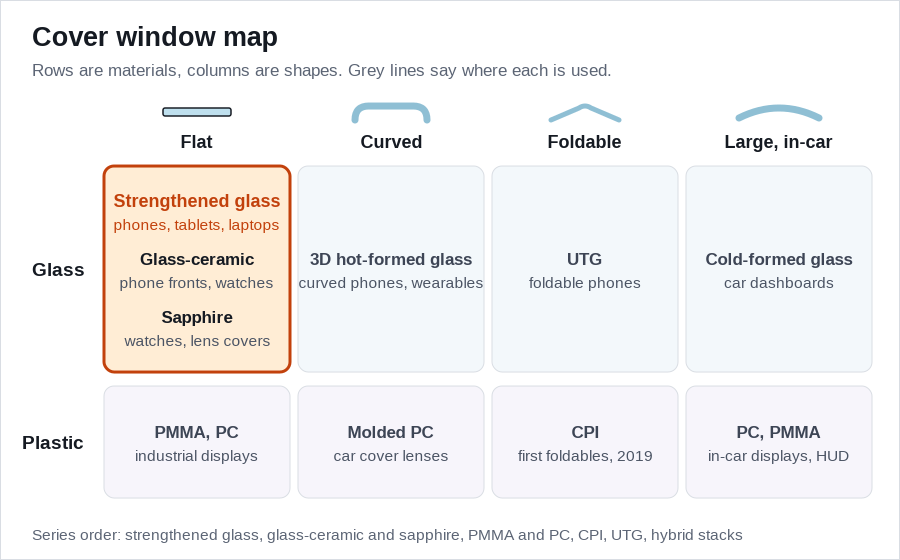
Cover glass is dipped in molten potassium nitrate to put its surface in compression, and the middle of the sheet has to carry an equal area of tension. The thinner the glass, the tighter that margin. In a Corning patent comparing 0.5mm sheets, a lithium glass carried compression from 42 to 90 micrometers deep against a lithium-free glass, yet its central tension fell from 68.3 to 58.6MPa and its drop height onto sandpaper rose from 28 to 75cm. This episode covers how ion exchange works, the frangibility threshold, the gauges and standards that measure it, and the competition among glassmakers.
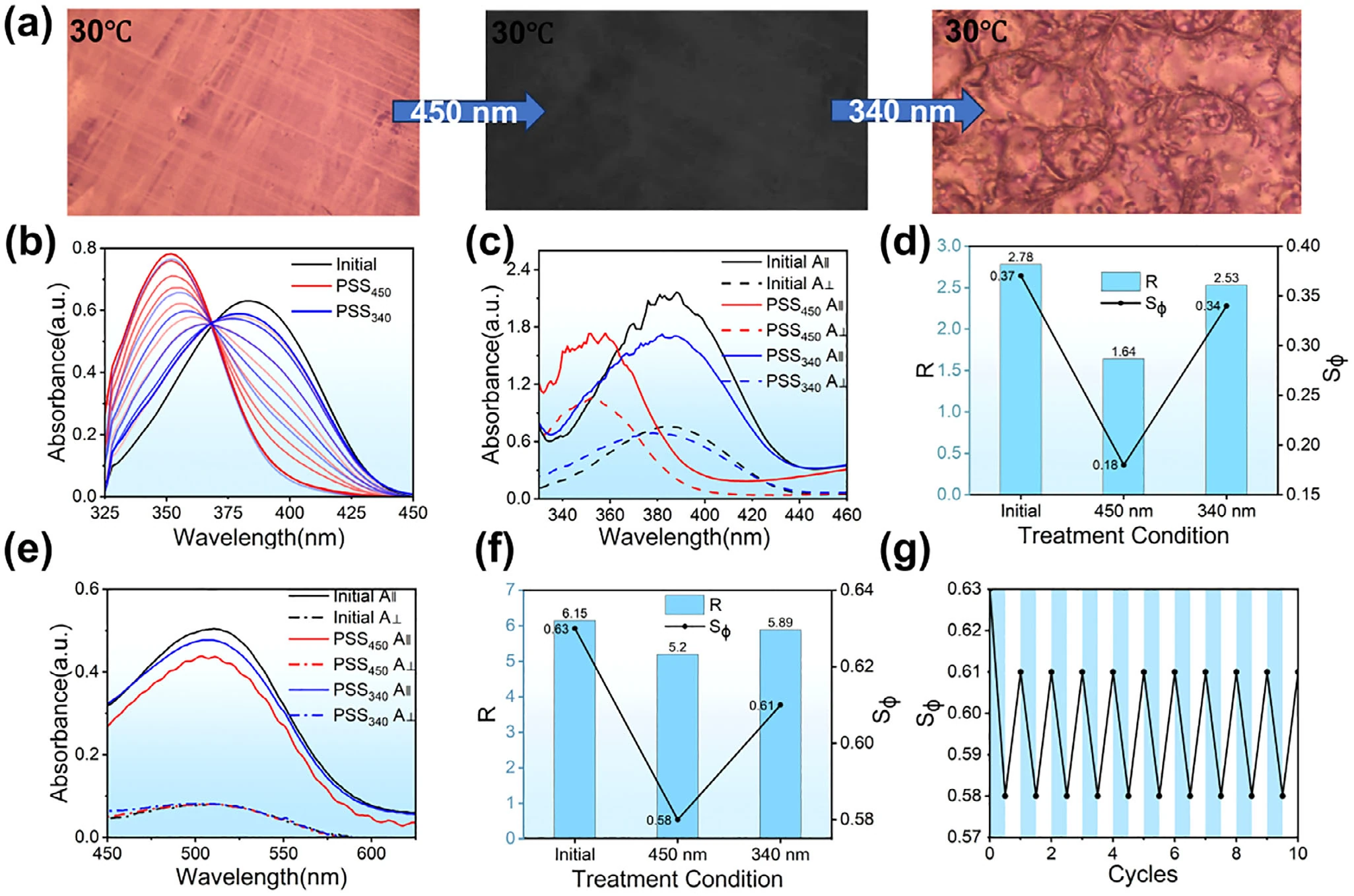
Azobenzene has been used for decades to switch liquid crystal phases with light, but the switched state could not be parked partway. A Chinese and French team replaced the switch with a hydrazone and lowered the phase transition temperature in steps, and each step held after the light was turned off. A bent control molecule shows what makes the difference.
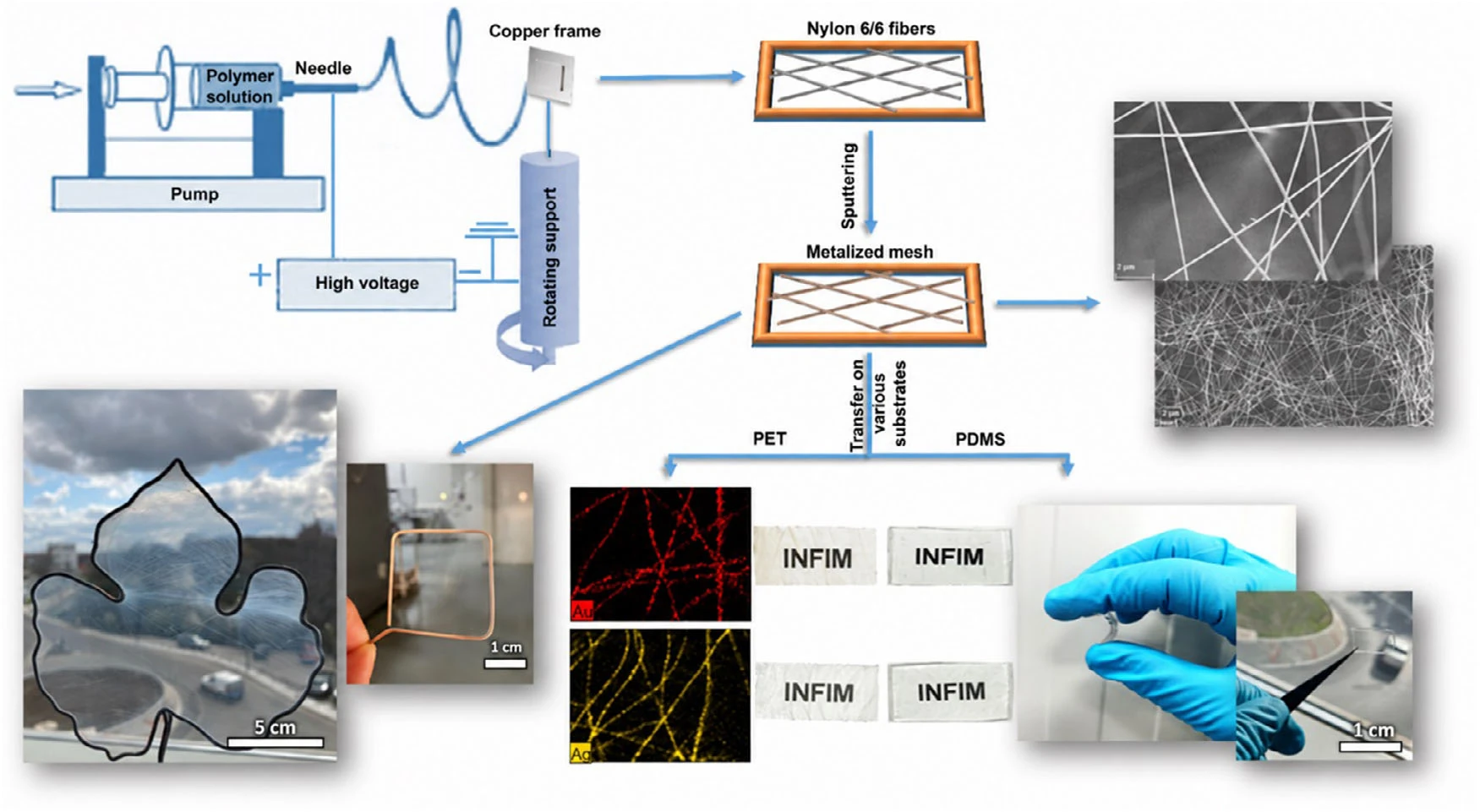
Romanian researchers made transparent electrodes by sputtering metal onto electrospun nylon networks. Samples coated on both sides did worse than samples coated thickly on one side, and a gold sample with all its metal on one side reached a sheet resistance of 3.05 ohms at 89% transmittance. Electrospun reports in the same transmittance range mostly sit at 20 to 50 ohms. The most transparent sample, at 95%, measures 17 ohms.
From October 19 to 25, 2026, 1,240 newly published papers were checked and 19 that lead toward displays were picked. Narrowing was the theme. Emission linewidth down to 13 nanometers, radiation angle, color-mixing distance and crosstalk between pixels were all narrowed in papers that landed in the same week.
Samsung Display plans to spend about ₩150 billion on a single evaporator for 12-inch RGB OLEDoS, according to reports. The figure is an industry estimate, the equipment order is expected in the fourth quarter, and it would be half of an estimated ₩300 billion investment. Yet that machine does not exist yet. Canon Tokki showed ±1 micrometer alignment on 12-inch wafers at SID in June, but as a demo rather than production equipment, while mass production is reported to require 0.1 micrometer. Simple arithmetic shows why the target is so tight. Invar masks and silicon wafers differ in thermal expansion by 1.4 ppm/K, so a 1-degree swing on a 300-millimeter wafer shifts the edge by 0.21 micrometers. Holding 0.1 micrometer means holding the temperature within 0.48 degrees.