Water-drop hinge patents, filed by Samsung Electronics and shipped by Huawei
The smaller the radius a foldable screen bends to, the more it stretches, and that stretch is left behind as a crease. Samsung Electronics was the first to write into patents (2014 to 2015) a hinge that tucks the bent part into a space inside the body in a water-drop shape. Yet the first to put that shape into products were Motorola, Huawei, OPPO and Honor; Samsung Electronics did so only in 2023. This is the first part of the series Foldable Displays Through Patents.
1. Opening the series: foldable displays through patents
1.1 What this series covers
A foldable phone folds one screen in half. That single fact brought a whole set of problems at once that flat phones never had. The screen has to bend at the fold line, glass does not bend, each layer stretches and shrinks by a different amount, and it all has to survive tens of thousands of folds. This series picks out only those problems, that is, the technologies that exist because the device folds, and reads them through patents.
| Axis | Problem created by folding | What this series looks at |
|---|---|---|
| Hinge | Set a bending radius so the folded screen does not kink | This part |
| Crease and support plate | The crease left by repeated folding, the plate that holds up the screen | Next part |
| Cover window | Glass does not simply fold (ultra-thin glass, colorless polyimide) | |
| Stack and adhesive layers | Each layer stretches and shrinks by a different amount when folded | |
| Thinning | Thick stacks do not fold (on-cell touch, removing the polarizer) | |
| Wiring and encapsulation in the bend | Wiring and encapsulation films crack on the fold line | |
| Reliability | How to test hundreds of thousands of folds |
1.2 Read with the same frame
For each axis, three things are looked at in the same order: who wrote it down first (the earliest filing), who took it over (the change of applicants), and what is claimed now. One more thing is checked as well: whether the patent led to an actual product or remained only a right. Every table has a “Status” column, and where a company has said something in a product or a disclosure, that is noted alongside.
The subject of the first part is the hinge and the crease. Unfold a foldable phone and the first thing that catches the eye is the fold mark down the middle, and the best known way of reducing that mark is the water-drop hinge.
2. The crease starts with the folding radius
2.1 The problem was the radius from the start
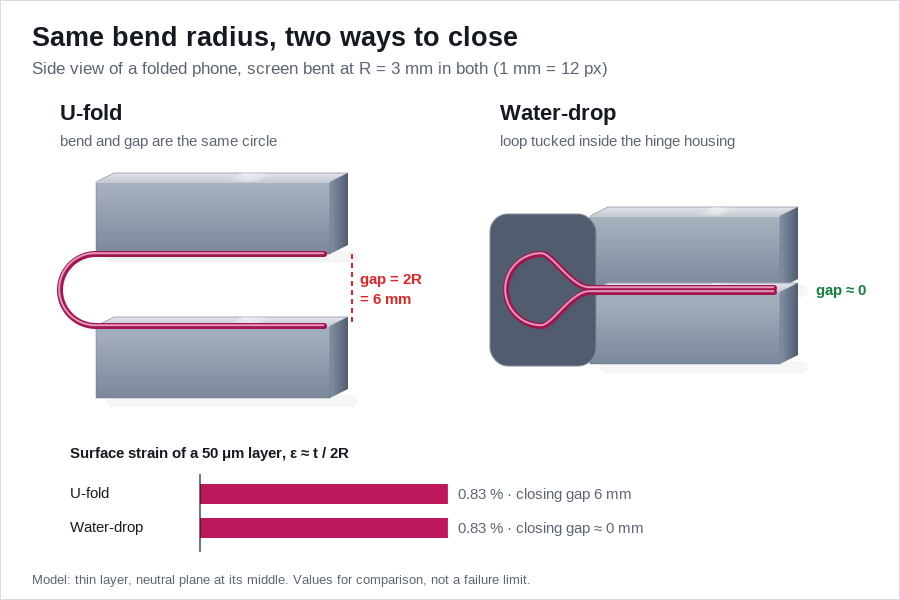
The outer surface of a folding screen stretches when it folds. Bend a single thin layer to radius R and the outer surface stretches by roughly the layer thickness divided by twice the radius (t / 2R). Halve the radius and it stretches twice as much. Fold it too tightly and it breaks, and even if it does not break, the spots that stretched most leave marks in the polymer layers of the screen after it is unfolded.
This problem appeared in patents before foldable phones did. A 2007 filing by KAIST, the Korea Advanced Institute of Science and Technology (KR100867608B1), claimed a terminal that is carried folded, and described the limit of the rolling approach this way: “it has the drawback that it cannot be carried in a small size because it cannot be rolled below the minimum radius of curvature of the flexible display (the smallest radius of curvature at which breakage of the flexible display is prevented).” The same filing also pointed at the approach of joining several LCDs with hinges: “since the LCD panels are not joined as one but are cut off at the hinged portions, this causes visual inconvenience for the user.” To fold one seamless sheet you must keep to the radius, and if you keep to the radius it folds bulky. That is the dilemma.
Nokia’s earlier 2005 patent (US7714801B2) claimed a flexible display spanning two bodies. What this patent cared about was not the crease. The gist of the English original was that bending the unfolded screen slightly makes it stiff enough to stand, and that even when curved it looks flat from above and is easy to read. A 2007 Taiwanese filing by Polymer Vision (TW200921335A) put forward a “hybrid hinge” that uses a rigid hinge and a bending hinge together (gist of the English machine translation).
2.2 A U-fold leaves a gap
The simplest way to fold is a U. The screen folds in a half circle, and the two body halves close with a gap equal to the diameter of that half circle. Here the bending radius and the closing gap come from the same circle. Enlarge the radius to reduce stretch, and the gap grows with it.
Samsung Electronics’ first foldable, the Galaxy Fold (announced February 20, 2019), left a gap when closed instead of the two halves meeting fully. Samsung Electronics explained that the gap kept the two halves of the folded screen from scratching each other (launch report), and the teardown firm iFixit criticized it because dust could get in through that gap.
2.3 The water-drop separates radius from gap
The water-drop hinge pushes the bent part into an empty space inside the body. The two halves close with no gap, and inside them the screen draws a loop shaped like a water drop. The radius can be enlarged independently, as far as the body can hold it. Switch between the two methods in the simulator below to see the difference.
In a U-fold, enlarging the radius from 3 mm to 6 mm halves the strain, but the closing gap goes from 6 mm to 12 mm. Switch to the water-drop and the gap disappears even at the same radius. The loop has to fit inside the body, though, so the larger the radius, the thicker the folded body must be.
Put the other way, the water-drop hinge can use a larger radius at the same folded thickness. To fold thin with a U-fold, the only way is to shrink the radius and narrow the gap, but with the water-drop, as long as the loop fits inside the body, a larger radius does not add folded thickness. The larger the radius, the less the screen stretches, and the shallower the crease.
3. Samsung Electronics wrote it down first (2014 to 2015)
The first to put the water-drop structure into patents was Samsung Electronics.
The February 2014 filing (KR20150096827A). In the US it was granted as US9250733B2, and it is the one covered as prior art in this series’ earlier Lepton and Samsung Electronics hinge suit piece. Claim 1 claimed a support that rotates inside the two bodies. In the folded state it “forms a receiving space so that the folded portion of the flexible display panel is folded while forming a curvature,” and in the unfolded state it is a support “that supports the folded portion of the flexible panel.” Making room for the bent part, then holding it up when unfolded: the skeleton of the water-drop hinge is here. The Korean application lapsed because annuities were not paid; the US patent remains in force.
The June 2014 filing (KR101776262B1). Claim 1 took a structure in which the screen slides over the body as it folds and added a member applying force in the opposite direction “so as to prevent the curved portion of the flexible display from lifting.” The specification wrote that the middle of the folded screen forms “a curved portion having a predetermined radius of curvature.” At this point the problem was the bent part lifting.
The April 2015 filing (KR20160121350A). Here the word “water drop” appears for the first time: “the third portion may be bent from the first and second portions into the interior of the first and second bodies and received in the receiving space in a water-drop shape.” Claim 1 claimed a support part that moves between a support position holding up the middle of the screen and a receiving position creating a receiving space for the bent part. This patent remains in force and led to US, Chinese, European and international filings.
An LG Display filing from the same year (KR102366299B1) came in from another side. It cut slits into the plate supporting the screen so that the slit spacing grows and shrinks on folding and takes up the change in length. The specification stated the purpose as the screen’s crease: the slits compensate for the change in length and make it bend at a set curvature “while preventing the bending display area (BDA) from creasing.” It is an early form of the patterned support plates used in foldables today, and the next part picks it up.
Line these four up in order and the name of the problem the patents wrote down changes. In 2007 it was the minimum radius of curvature without breakage, in 2014 the bent part lifting, and in 2015 the screen’s crease.
4. Products came out in a different order (2019 to 2023)
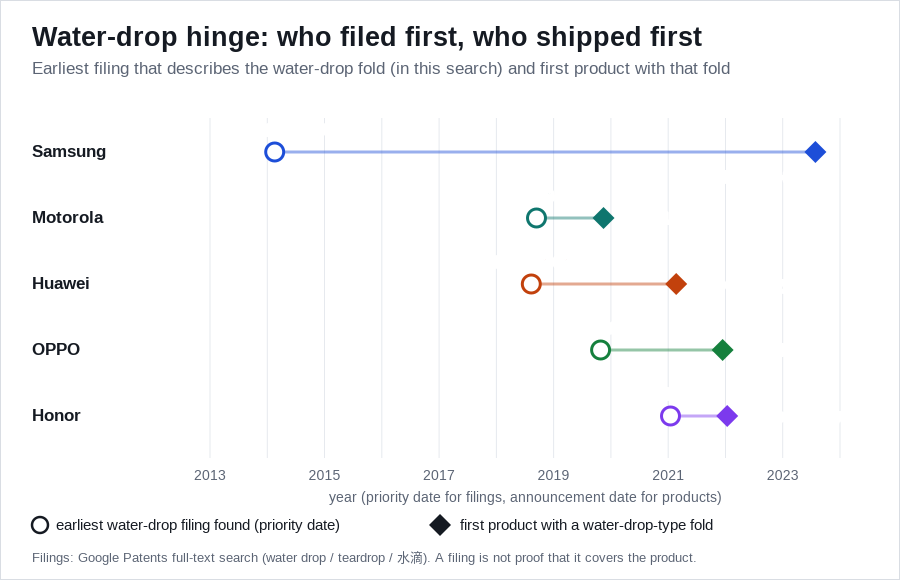
The order of products was the reverse of the order of filings.
Motorola Razr (announced November 14, 2019). The company called this hinge a “zero-gap hinge.” According to hands-on reports, the support plates move aside as it folds and the screen gathers in the space that opens up. It did not use the word water drop, but the structure belongs to that family. Motorola’s filing (US10491725B1, priority September 2018) claimed a cam and support plates that pivot on either side of it.
Huawei Mate X2 (announced February 22, 2021). The two previous generations (Mate X and Xs) folded the screen outward; with the Mate X2 Huawei switched to folding inward and promoted a “dual-rotation water-drop hinge” (gist of launch reports). The company’s explanation was that the folded screen is stowed in a water-drop shape, so it does not fold with a sharp bend like Samsung Electronics’ Fold. Huawei’s filings describing the water-drop structure date from August 2018 (chain-type rotating shaft, CN112369001B) and March 2019 (CN111692196B). The specification of the 2019 filing wrote that when the screen folds, the folding part forms a bend close to a water drop, with no sliding between the screen and the body (gist of the Chinese original).
OPPO Find N (announced December 15, 2021) and Honor Magic V (announced January 10, 2022). OPPO said its “Flexion Hinge” closes with no gap, and Honor named its hinge the “waterdrop hinge.” The two companies’ earliest filings describing the water-drop structure are from October 2019 and January 2021 respectively.
Samsung Electronics Galaxy Z Fold5 and Flip5 (announced July 26, 2023). Samsung Electronics called the new hinge the “Flex Hinge,” and these became its first foldables to close with no gap (press reports).
| Company | Earliest filing describing the water-drop structure | First product (announced) | Filing to product |
|---|---|---|---|
| Samsung Electronics | 2014-02 (receiving space and curvature) · 2015-04 (“water-drop shape”) | Galaxy Z Fold5 and Flip5 (2023-07-26) | About 9 years |
| Motorola | 2018-09 | Razr (2019-11-14) | About 1 year 2 months |
| Huawei | 2018-08 | Mate X2 (2021-02-22) | About 2 and a half years |
| OPPO | 2019-10 | Find N (2021-12-15) | About 2 years |
| Honor | 2021-01 | Magic V (2022-01-10) | About 1 year |
Why Samsung Electronics was late cannot be told from public material. Reports in early 2023 said Samsung Electronics had patented this structure long before without using it, and speculated it may have been to keep its water resistance rating. No reason stated by the company was found.
5. The crease does not make it into the claims
The water-drop hinge is a structure meant to reduce the crease. Yet the word “crease” is absent from the patent claims.
Every claim was read in the 79 Korean applications (2014 to 2024) on Google Patents that hit the hinge classification (CPC G06F1/1681) together with “crease” and “flexible display.” Not one has “crease” in claim 1. The three that have it anywhere in the claims are all about creases made on purpose. Samsung Electronics’ 2014 filing (KR20150096827A) wrote in a dependent claim about a crease formed as the outer fabric cover folds in, and said in the specification that it looks good “as it is formed as a single crease rather than many small creases.” LG Electronics’ 2014 filing (KR102209514B1) claimed the connecting part as “a corrugated plate on which multiple corrugations are formed, or a mesh.” Samsung Electronics’ 2021 filing (KR102582486B1) claimed the folding part of a heat dissipation sheet with “the cross section of the corrugated portion having the form of a plurality of semicircles.”
The crease of the screen appears in the specification only as a problem to be solved. The claims restate that problem as structure: a receiving space forming a curvature, a support that holds up the screen when unfolded, a member that prevents lifting, slits that take up the change in length. That is because a patent claims not the result but the device that produces it. It is why, when this series looks for “patents that reduce the crease,” it follows the radius, the space and the plate instead of the word crease.
6. Comparative analysis
6.1 The patents in this part
| Priority | Applicant | What is claimed | Problem the patent wrote down | Status |
|---|---|---|---|---|
| 2005-01 | Nokia | Flexible display spanning two bodies | Making the unfolded screen stand firm | In force |
| 2007-08 | KAIST | Terminal folding in several stages | Minimum radius of curvature · seams | Lapsed, annuities unpaid |
| 2014-02 | Samsung Electronics | Receiving space forming a curvature + support holding it up when unfolded | (crease of the cover) | Lapsed in Korea · in force in the US |
| 2014-06 | Samsung Electronics | Sliding screen + member preventing lifting | Curved part lifting | In force |
| 2015-04 | Samsung Electronics | Support part moving between support and receiving positions | Stowing in a “water-drop shape” | In force |
| 2015-08 | LG Display | Support frame with slit pattern | Screen crease | In force |
| 2018-08 | Huawei | Plate device of a chain-type rotating shaft | Folding in a water-drop shape to minimize height | In force |
| 2018-09 | Motorola | Cam + pivoting support plates | In force | |
| 2019-03 | Huawei | Rotating shaft mechanism for a foldable terminal | Water-drop bend, no sliding | In force |
| 2019-10 | OPPO | Folding device | In force | |
| 2021-01 | Honor | Folding assembly | In force |
6.2 What set them apart
The patents and products around the water-drop hinge ran on two clocks.
On the patent clock, Samsung Electronics was ahead. In 2014 it claimed a receiving space for the bent part, and in 2015 it even wrote the words “water-drop shape” into the specification. The same year LG Display named the screen crease as the problem and put forward a slit support plate. Filings by Chinese companies describing the water-drop structure appear from 2018.
On the product clock, the order flipped. Motorola brought out a hinge of the water-drop family in 2019, Huawei and OPPO in 2021, Honor in 2022, and Samsung Electronics in 2023. The later a company filed, the shorter its path from filing to product: about 1 year for Honor, about 1 year 2 months for Motorola, about 9 years for Samsung Electronics.
Writing it down first and using it first are different things. That is why this series notes the status and the product alongside every patent.
7. Counterevidence and limitations
“Earliest filing” means within this piece’s search. Filings hitting water drop (water drop, teardrop and the Chinese term) in Google Patents full-text search were scanned in order of priority date. If Chinese phone hinges sit in a different classification or were described in different words, there may be earlier filings. In fact, a search combining the Chinese term for water drop with the hinge classification returned nothing, and the search was redone without the classification.
Filings and products are set on the same row, but there is no evidence that the patents in the table were used in those products. Companies do not disclose which patent went into which product.
Treating the Motorola Razr’s hinge as part of the water-drop family is a judgment based on the structural descriptions in hands-on reports. The company did not use the word water drop. The Samsung Electronics Galaxy Fold’s gap and the Fold5’s “closing with no gap” also follow launch reports.
The “2016 patent” of Samsung Electronics mentioned in early 2023 reports could not be identified. This piece gives 2015 as the earliest Samsung Electronics filing that wrote “water-drop shape.”
The strain in the simulator and Figure 1 is an approximation for a single thin layer. A real screen is a multilayer of cover, polarizer, panel and support plate bonded together, and the position of the neutral plane changes with the layer design. That story belongs to the stack and adhesive layers part.
Chinese and English patents were rendered as gists from the originals. Direct quotations were taken only from Korean originals and are translated here.
8. Conclusion and next part
The problem of the folding screen was the radius from the start. It must bend widely enough not to break, and bending widely makes it fold bulky. In a U-fold the radius and the gap are the same circle, so stretching less meant accepting a gap. The water-drop hinge put the bent part inside the body and separated the two. That made it possible to bend more widely while folding to the same thickness.
The first to write that structure into patents was Samsung Electronics: the receiving space in 2014 and the “water-drop shape” in 2015. Yet the first to put that shape into products were Motorola, Huawei, OPPO and Honor, and Samsung Electronics did so in 2023. In the meantime the “crease” remained only a problem in the specifications, and entered the claims as radius, space and plate.
The next part reads that plate, the support plate behind the screen that holds back the crease. It looks, with the same frame, at what patents the plate LG Display slit in 2015 has led to today, and who is filling that space.