Adhesives for Foldable Displays
Adhesive layers in a foldable stack are five times as thick as the panel. Across 100 patents, the figure companies fight over is not adhesion but storage modulus at -20 °C, a target set after the 2017 shift to multiple neutral planes.
1. Part three of the series: a layer five times thicker than the panel
Part 2 looked at the support plate behind the screen. This part looks at what joins that plate, the screen and the cover to one another: the adhesive layers.
Samsung Display’s 2020 application (KR102356652B1), the source of the support plate dimensions in Part 2, lists the thickness of every layer in the stack. Of the 683 μm total, the light-emitting display panel accounts for 30 μm, or 4 %. The adhesive layers between the others number seven and add up to 161 μm, or 24 %. That is more than five times the panel.
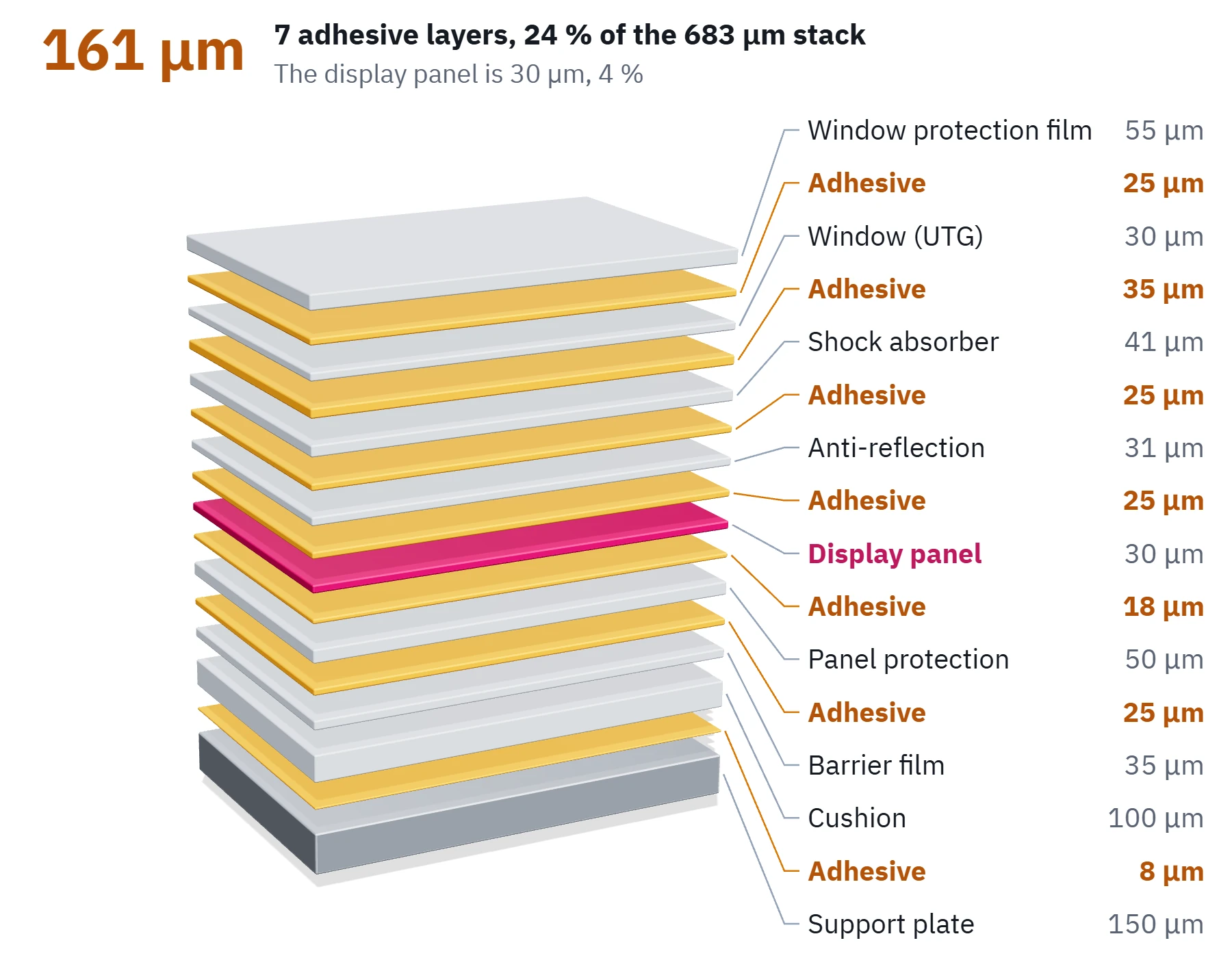
A layer that only bonded would have no reason to be this thick. This part reads the specifications of foldable adhesive patents and asks two questions. How does an adhesive have to change for multiple neutral planes to work? And which of those changes do the patents actually claim?
The answer was in an unexpected place. The figure applicants contest in their claims is the modulus at -20 °C more than adhesion strength.
2. A layer that bonds and also separates
2.1 One neutral plane or several
Bend a sheet and its outer side stretches while its inner side compresses. The surface whose length does not change is the neutral plane, and the farther a point is from it, the more it is strained. Bond several layers rigidly and the whole bends like one sheet, with a single neutral plane. The outermost layer then sits half the thickness of the whole stack away from that plane.
A soft adhesive changes this. The layers slip slightly against each other, each sheet bends within its own thickness, and each layer gets a neutral plane of its own. These are multiple neutral planes. The patent literature calls them “a plurality of neutral planes.”
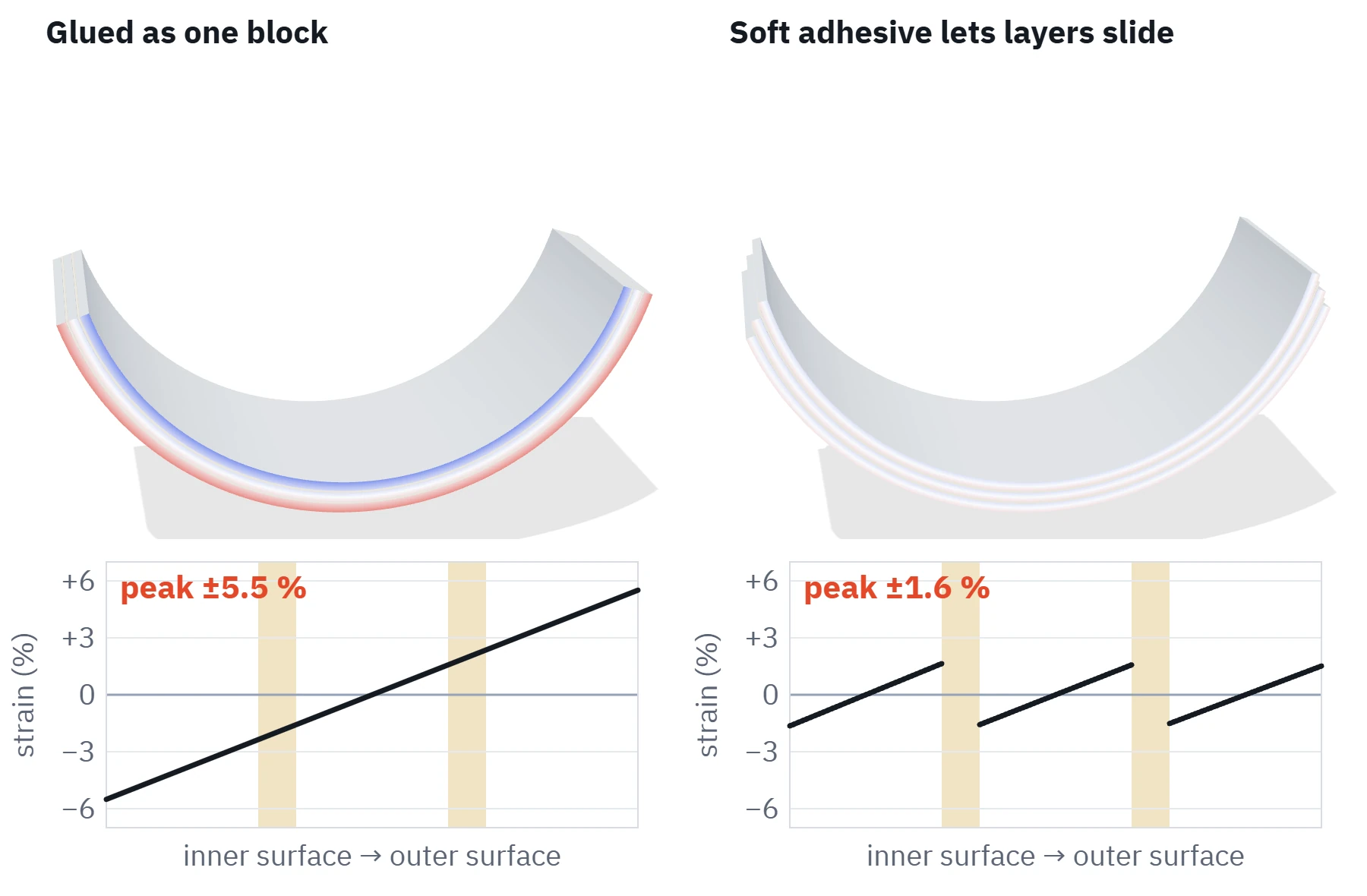
By the model in Figure 2, the strain at the outermost surface falls from 5.5 % to about 1.6 %. The adhesive layer both bonds and separates.
Real adhesive layers lie between those two extremes. The simulator below sets the same three sheets side by side, one stack without multiple neutral planes and one with them, and compares them as they fold from flat. The left stack has a stiff adhesive; on the right you can change the modulus. In this model, with an inner radius of 3 mm and a 25 μm adhesive layer, the single neutral plane splits into three at about 105 kPa. A smaller radius raises that boundary and a larger radius lowers it. The softer the adhesive, however, the more the layers slide, and the larger the shear strain at the edge of the fold.
2.2 2017: from one neutral plane to several
Read in order of priority date, the 42 Korean applications containing all of “neutral plane,” “adhesive layer” and “folding” show the point at which the design thinking shifts.
At first, applicants claimed where to put a single neutral plane. Samsung Display’s 2014 application (KR20160073278A) placed the neutral plane of the bent portion at the touch electrode layer, and Dongwoo Fine-Chem’s 2015 application (KR102069286B1) limited the distance between the neutral plane and the touch panel to 34 % of the total thickness or less. A March 2017 Dongwoo Fine-Chem application (KR20180110924A) likewise claimed placing the neutral plane at the interface between the OLED module layer and the adhesive layer. These are all designs that move a vulnerable layer closer to a single neutral plane.
Over the six months from June to November 2017, three companies filed six applications, and the language changed.
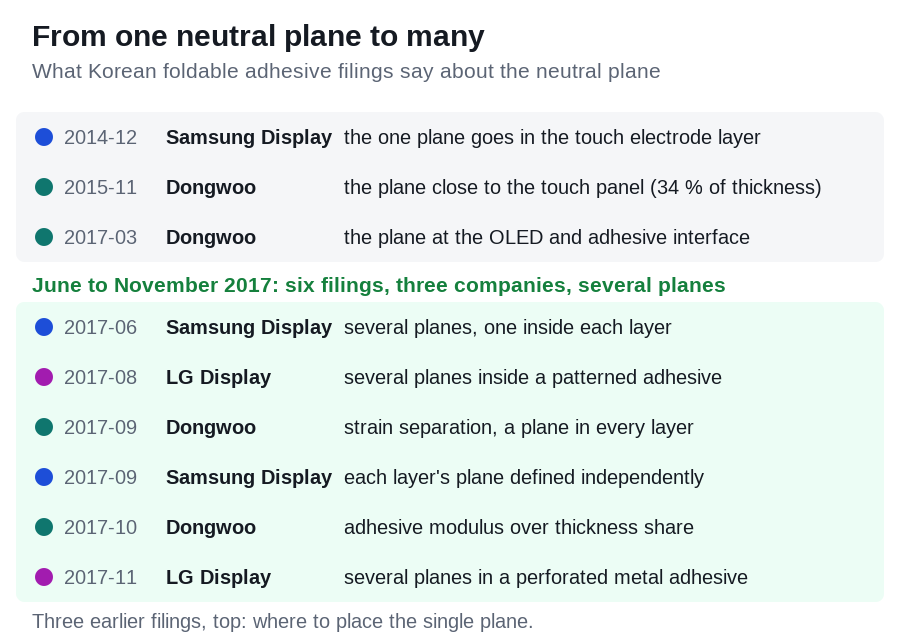
Samsung Display’s June 2017 application (KR20190000967A) states that “a plurality of neutral planes may be defined,” and says that placing a neutral plane inside each of the window, optical member and display member reduces damage from bending stress. Its claims limit the modulus difference between two adhesive members to 0.01 MPa or less. Dongwoo Fine-Chem’s September 2017 application (KR20190030912A) called this “strain separation,” and stated that the adhesive layers cause “a neutral plane to be formed for each layer member.” Its claims limit the adhesive modulus divided by the adhesive layers’ share of the total thickness to 0.02 to 50 MPa.
LG Display created neutral planes somewhere else. Its August 2017 application (KR101888451B1) divides the adhesive layer itself into several deformation layers running along the folding axis, and states that “by having a plurality of neutral planes” it prevents interfacial delamination and recovers easily to its original state. Whereas the other two companies gave each layer its own neutral plane, the neutral planes in this application are inside the adhesive. The term is the same but the location is different.
After that, the term all but disappears from claims. Among filings with a priority date of 2018 or later, only two of the 42 mention a neutral plane in their claims. Samsung Display’s January 2019 application (KR20200088536A) speaks of the “decoupling characteristics” of a high-creep adhesive layer, yet its claims give modulus and creep as numbers. The applications do not say so, but this is one way to read it: multiple neutral planes became part of the design vocabulary, and claims moved to the material numbers that make them possible. What those numbers demand is the core of this part.
3. How an adhesive has to change for multiple neutral planes
An adhesive for a flat screen only had to hold the layers together. With multiple neutral planes, the layers have to move relative to each other. The adhesive layer goes from a material that fixes things in place to one that takes on deformation. Gather the requirements scattered across the patents and there are six.
3.1 Properties: six requirements
| Requirement | Direction of change | Values in the patents | If violated |
|---|---|---|---|
| (1) Soft in shear | Lower the storage modulus, raise creep | About 0.06 MPa or less at 60 °C (Samsung Display 2017), creep of 100 to 800 % (Samsung Display 2019) | The higher the modulus, the greater the bending stress in the adjacent layers |
| (2) Able to take large shear | Design on the assumption of strains of several hundred percent | Stress relaxation rate measured at 300 % strain (Samsung Display 2017) | Not stated |
| (3) Able to recover | Limit stress relaxation, raise the recovery rate | Stress relaxation rate of 70 % or less (Samsung Display 2017), recovery of 95 % or more at -20 °C (LG Chem 2018) | Above 70 %, restoring force falls short and creases form |
| (4) Soft even when cold | Lower the glass transition temperature | Outer layer Tg of -60 °C or lower (LG Chem 2018), modulus at -20 °C | Modulus surges at low temperature and cracks form |
| (5) No flow even when hot | Raise molecular weight, narrow the change with temperature | Weight-average molecular weight above 1.5 million (LG Display 2017), modulus difference across temperature of 13 kPa or less (LG Chem 2020) | Creep accumulates and interfacial adhesion weakens |
| (6) Matched between layers | Match modulus between adhesive layers, adjust with thickness | Modulus difference of 0.01 MPa or less (Samsung Display 2017), modulus/thickness ratio of 0.02 to 50 MPa (Dongwoo Fine-Chem 2017) | Stress in the sandwiched layer changes |
Requirements (1) and (2) are a pair. Lower the adhesive modulus on the right in the simulator above and the strain in the sheets falls, but the shear in the adhesive rises. In this model a 64 kPa adhesive sees more than 500 % shear at the edge of the fold. That is why Samsung Display measures stress relaxation at 300 % strain. Strain taken out of the sheets goes into the adhesive.
Requirements (2) and (3) pull against each other. Stress has to relax for the layers to fold easily, but too much relaxation leaves no force to return. Samsung Display’s 2017 application writes that the higher the stress relaxation rate, “the lower the restoring force for returning to the original state may be,” and draws an upper limit at 70 %. A 2020 application (KR20220075110A, rejected) gives a recovery rate of 92 to 99 % after a fixed torque is applied under high temperature and humidity.
Requirement (6) is unique to multiple neutral planes. The Samsung Display application that sets the modulus-difference limit states that the stress on a layer sandwiched between two adhesive layers varies with the modulus difference between them. If the difference is effectively zero, the neutral plane of the sandwiched layer lies at its center plane. In other words, the two adhesive layers have to release the sandwiched layer equally from both sides for the neutral plane to sit in the middle of it.
3.2 Side chains: long and branched
The mainstream foldable adhesive is an acrylic copolymer. The alkyl side chains on the backbone set the material’s low-temperature behavior. The cleanest experiment on side-chain design is in Dongwoo Fine-Chem’s 2023 application (KR102701685B1). It blends a C8 to C12 alkyl acrylate with a C20 to C30 branched alkyl monomer and varies only the side chains while measuring the modulus at -30 °C and folding performance. The test is a radius of 2 mm for 30,000 cycles.
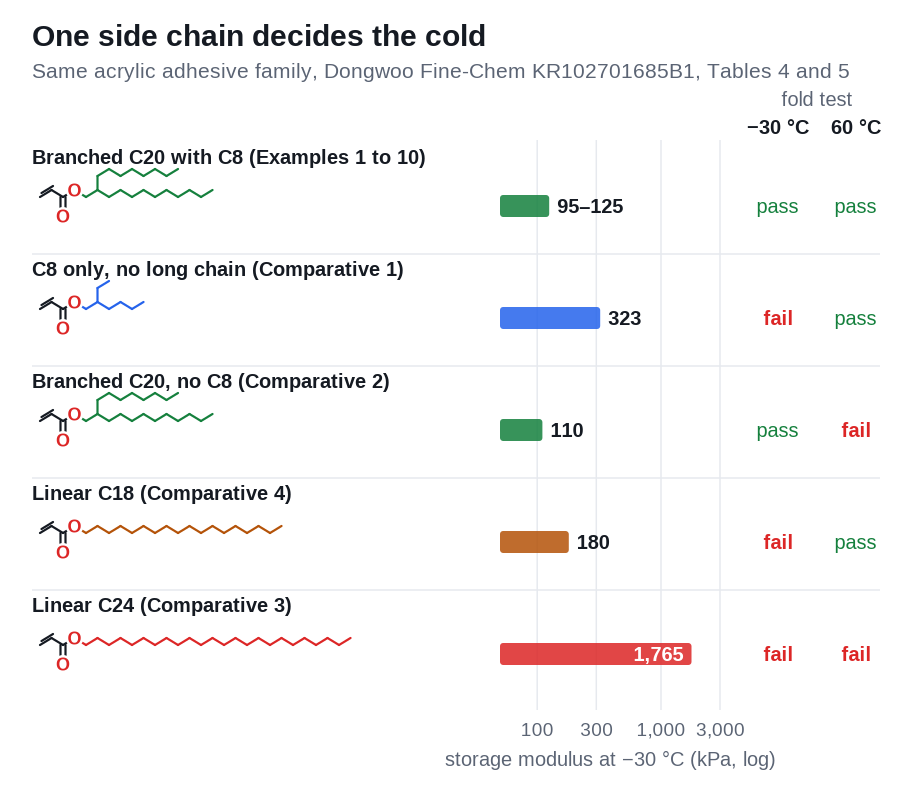
With only short side chains such as 2-ethylhexyl (Comparative Example 1), the modulus at -30 °C rises to 323 kPa and the sample fails sub-zero folding. Adding the long branched chain brings it down to 95 to 125 kPa. In the words of the specification, “the hardness of the adhesive sheet may not increase excessively even at low temperature,” and the storage modulus falls.
What matters is shape more than length. Comparative Example 3, with a linear C24 side chain, jumped to 1,765 kPa and failed every condition. Comparative Example 4, with a linear C18 chain (stearyl), reached 180 kPa and did not pass at -30 °C either. Linear side chains tend to align and crystallize as the temperature falls, and branches disrupt that alignment. This explanation is general polymer knowledge; the patent reports only the results.
Long branched chains alone are not enough either. Comparative Example 2, which leaves out the short monomer, passed at -30 °C but failed folding at 60 °C and in high humidity. So the claims fix the ratio of the two monomers: the weight ratio B/A of long branched chain (B) to short side chain (A) is 0.01 to 0.4, and a dependent claim narrows it to 0.2 to 0.35.
3.3 Ether monomers and polymerization method
LG Chem’s 2020 application (KR20220022811A) shows another axis. The recipe of Example 1 has four monomers.
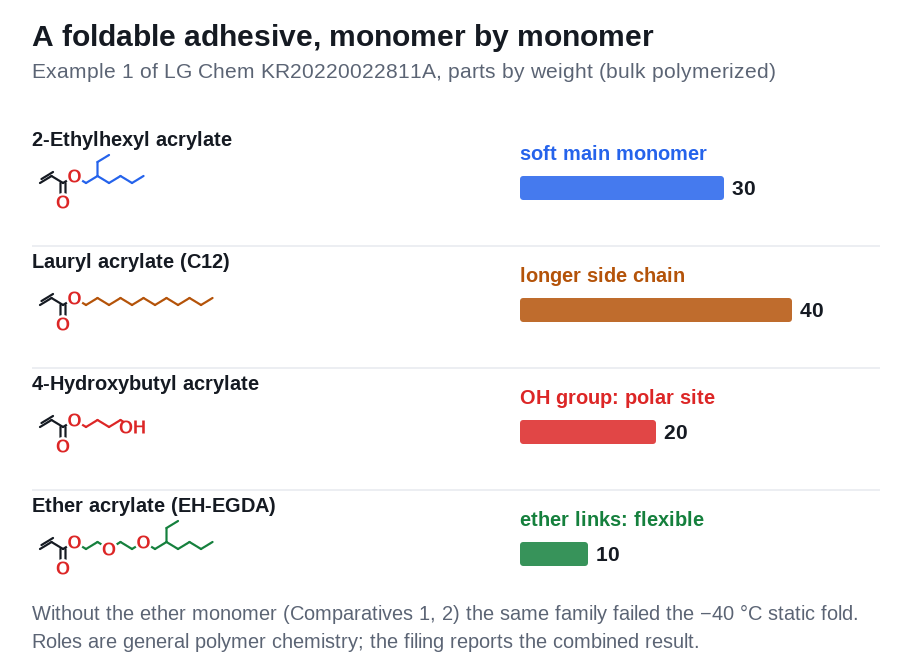
The fourth monomer is the dividing line. The six examples containing 10 to 20 parts by weight of an acrylate with ether bonds in ethylene oxide units kept the modulus difference between -20 °C and 90 °C to 0.6 to 12.3 kPa and passed every test. Comparative Examples 1 and 2, made the same way without the ether monomer, widened the difference to 14.1 and 15.5 kPa and did not pass the static test at -40 °C.
Even with the same composition, the manufacturing method makes a difference. Comparative Examples 1 and 3 have identical recipes (2-ethylhexyl acrylate 40, lauryl acrylate 40, 4-hydroxybutyl acrylate 20) and differ only in polymerization. The bulk sample, polymerized with a photoinitiator and no solvent, had a polydispersity index of 2.3 and a modulus at 90 °C of 21.6 kPa. The solution-polymerized sample had a polydispersity index of 7.8 and a modulus at 90 °C of 11.1 kPa, about half as stiff at high temperature. The specification writes that bulk polymers, compared with solution polymers, “may have a high storage modulus and a low polydispersity index.” One reading is that when chain lengths are uneven, the short chains disentangle first at high temperature.
3.4 Long-chain entanglement and block copolymers
LG Display’s 2017 application builds cohesion physically. It raises the weight-average molecular weight of a linear acrylic polymer above 1.5 million so the chains entangle, and states that this entanglement produces cohesion and storage modulus. At 1.5 million or below, “cohesion is insufficient” and interfacial adhesion weakens when the device is left folded; above 5 million, viscosity rises and the blend phase-separates.
To this it adds a styrene-isoprene-styrene (SIS) block copolymer. The soft isoprene segments lower the low-temperature glass transition, and the hard styrene segments act as physical crosslinks that stop flow at high temperature. A table varying the ratio of a linear polymer of molecular weight 2 million to SIS shows the effect. As the share of linear polymer rose (from 1:9 to 9:1), adhesion rose from 545 to 1,455 gf/inch and recovery from 32 % to 95 %, while the height of the fold mark (ΔH) fell from 27.4 μm to 14.6 μm. The claimed range is 6:4 to 9:1.
3.5 Plasticizers and crosslinking
A plasticizer is the easiest way to lower the modulus, but it has a cost. Dongwoo Fine-Chem’s 2021 application (KR20220126955A, withdrawn) writes that ordinary plasticizers cause “the problem that not only the modulus but also the adhesion decreases.” Its solution is a fatty-acid plasticizer with polar functional groups. To a recipe such as urethane acrylate oligomer 40, 2-ethylhexyl acrylate 40 and 4-hydroxybutyl acrylate 15, it added 5 parts by weight of castor oil, dimer acid or ricinoleic acid. Without plasticizer, the modulus at -20 °C was 98.5 kPa with damage at 1,000 cycles; a nonpolar plasticizer (diisononyl adipate) gave 90.8 kPa and 1,200 cycles, with lower adhesion as well. The examples with a polar plasticizer dropped to 68 to 75 kPa and passed 50,000 cycles.
Crosslinking is kept loose. LG Chem’s 2018 application says that to lower the glass transition temperature of the soft outer layers, silicone adhesives should have a lower cure density or MQ resin at 30 % or less, and urethane adhesives should also have a lower cure density. Too loose, however, and the adhesive loses requirement (3) in the table, the force to return.
3.6 What changes when the molecular structure changes
| What changed | Comparison within one application | Change | Application |
|---|---|---|---|
| Short side chains → long branched chains added | Comparative Example 1 → Examples | -30 °C: 323 → 95 to 125 kPa | Dongwoo Fine-Chem 2023 |
| Linear C24 → branched C20 | Comparative Example 3 → Examples | -30 °C: 1,765 → 95 to 125 kPa | Dongwoo Fine-Chem 2023 |
| Ether monomer 0 → 10 to 20 parts | Comparative Examples 1 and 2 → Examples | Modulus difference across temperature 14.1 to 15.5 → 0.6 to 12.3 kPa | LG Chem 2020 |
| Solution → bulk polymerization (same recipe) | Comparative Example 3 → 1 | Polydispersity index 7.8 → 2.3, 90 °C: 11.1 → 21.6 kPa | LG Chem 2020 |
| Linear polymer : SIS 1:9 → 9:1 | Comparative Example 1 → Example 4 | Recovery 32 → 95 %, fold mark 27.4 → 14.6 μm | LG Display 2017 |
| No plasticizer → polar plasticizer | Comparative Example 1 → Examples | -20 °C: 98.5 → 68 to 75 kPa, 1,000 → 50,000 cycles | Dongwoo Fine-Chem 2021 |
In sum, the direction converges. Side chains are made long and branched so the material does not stiffen in the cold, the backbone is made long and uniform so it does not flow in the heat, and crosslinks and physical entanglement are applied only to the extent that some force to return remains. Multiple neutral planes are the language of mechanics; what makes them possible in practice is this molecular design. Of the items in the earlier table, the one patents claim most is (4), softness below zero.
4. The most-claimed condition: -20 °C
How soft a polymer is changes greatly with temperature.
4.1 The same at room temperature, different below zero
Before foldable products appeared, filings aimed at curved and flexible screens had already described the problem. Samsung SDI’s November 2014 application (KR20160065030A) claimed a storage modulus at -20 °C of 500 kPa or less. Storage modulus is how much a material resists deformation elastically; in plain terms, its stiffness.
The numbers behind the reason come from Dongwoo Fine-Chem’s November 2015 application (KR101579710B1). The specification says the adhesive “must have excellent flexibility not only at room temperature but also at lower temperatures,” and that bending crack evaluation “is usually performed also at low temperature (for example, -20 °C).” Table 1 lays out the difference.
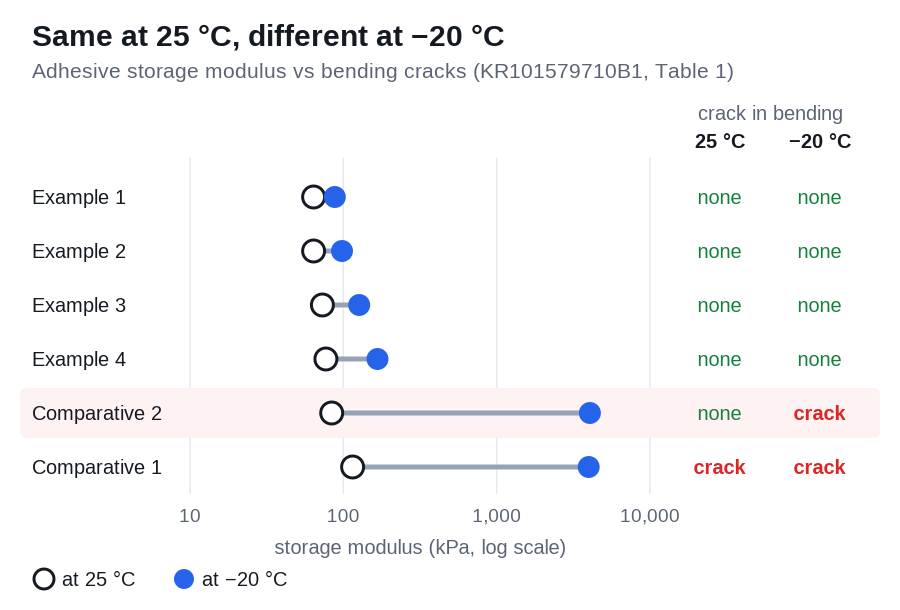
Comparative Example 2 would have passed a room-temperature-only test. Below zero the same adhesive layer becomes 48 times stiffer, turns into a rigid layer itself and stops separating the layers. In the right-hand stack of the simulator above, alternate between the Comparative 2 buttons for 25 °C and -20 °C and you can see three neutral planes merge into one. That is why the claims of this application require not a single absolute value but a modulus at -20 °C no more than three times that at 25 °C.
4.2 Modulus below zero ahead of adhesion
The full text of 100 Korean applications on Google Patents containing all of “folding,” “adhesive layer,” “storage modulus” and “display” was read. By applicant, Dongwoo Fine-Chem leads with 35, followed by Samsung Display with 22, LG Chem with 6 and Mitsubishi Chemical with 5. In this sample the earliest priority date is 2014, and the year with the most filings is 2022 (18).
The claims were then counted on their own: 40 applications state an elastic condition on the adhesive layer at -20 °C or below, while 25 give a number for adhesion strength or peel force. Stiffness in the cold appears in the language of the rights more often than bonding force.
Set out in priority order the numeric upper limits aimed at foldables among those 40 (33 points) and a boundary appears.
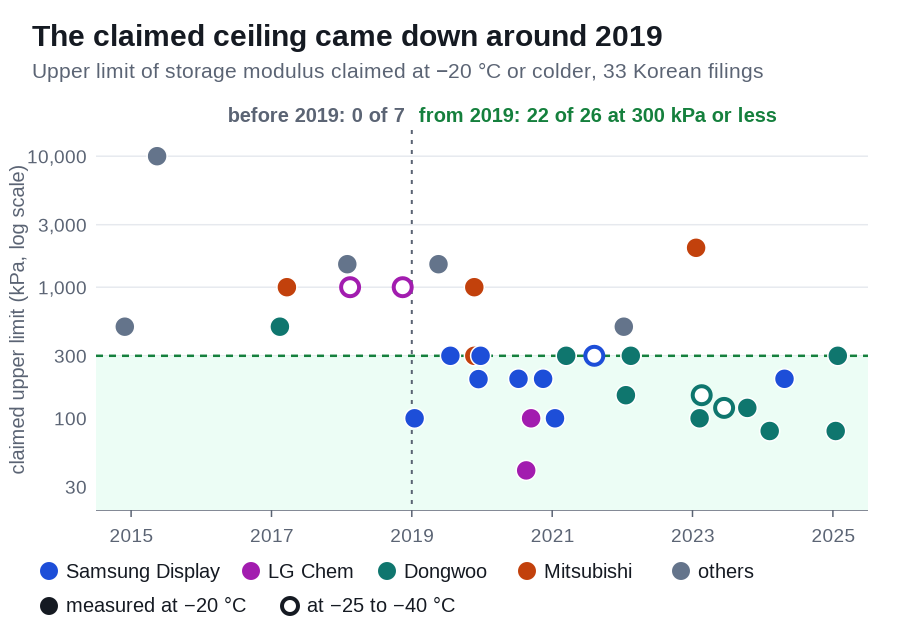
All seven filings before 2019 have upper limits of 500 kPa or more. From 2019, 22 of 26 came down to 300 kPa or less. Dongwoo Fine-Chem’s filings from 2023 onward narrow the range itself, to 50 to 80 kPa or 40 to 80 kPa, and some lower the measurement temperature to -30 °C. The Galaxy Fold was announced in February 2019. The timing only coincides, and patents cannot prove causation. Still, it is clear that the claimed ranges narrowed from the point when screens actually began to be folded.
4.3 Between 0.1 and 0.09
A table in Samsung Display’s December 2019 application (KR20210082296A) shows how sharp that number is. It concerns the adhesive layer of a protective tape applied on the window.
| Sample | Storage modulus at -20 °C (MPa) | Creep at 60 °C (%) | Low-temperature folding | High-temperature, high-humidity folding | Accelerated |
|---|---|---|---|---|---|
| Comparative Example 1-1 | 0.2 | 103 | NG | NG | NG |
| Comparative Example 1-2 | 0.1 | 110 | NG | OK | NG |
| Example 1-1 | 0.09 | 110 | OK | OK | OK |
| Example 1-2 | 0.08 | 160 | OK | OK | OK |
Comparative Example 1-2 and Example 1-1 have the same creep of 110 % at 60 °C. What separates them is a modulus at -20 °C of 0.1 MPa versus 0.09 MPa. With four samples, the boundary cannot be generalized. But this one table explains why a panel maker writes the value at this temperature into its claims.
5. Fix the cold end and the hot end gives way
Making the adhesive softer does not settle it. LG Display’s December 2017 application (KR20190081480A) sets out both problems in one paragraph. Raise the modulus and repeated folding causes “interlayer delamination,” and acrylic pressure-sensitive adhesives see “the shear storage modulus (G’) increase sharply at low temperature (-40 °C or below).” Lower the modulus and, when the device is left folded at high temperature and humidity, “shear creep deformation” accumulates and the layers do not recover on unfolding.
The adhesive has to stay soft in winter without flowing in summer. The target becomes not how high or low the modulus is but how much it changes with temperature. Claims changed accordingly. Toray Advanced Materials Korea limited the ratio of the modulus at -20 °C to that at 60 °C to 1 to 30, Dongwoo Fine-Chem limited the ratio of -20 °C to 25 °C to 1.5 to 4.0, and Mitsubishi Chemical gave the ratio of -30 °C to 80 °C as 1 to 65.
The sharpest form is LG Chem’s August 2020 application (KR20220022811A). In addition to a modulus at -20 °C of 40 kPa or less, it limits the difference between the moduli at -20 °C and 90 °C to 13 kPa or less. Tables 2 and 3 give test results for 13 formulations.
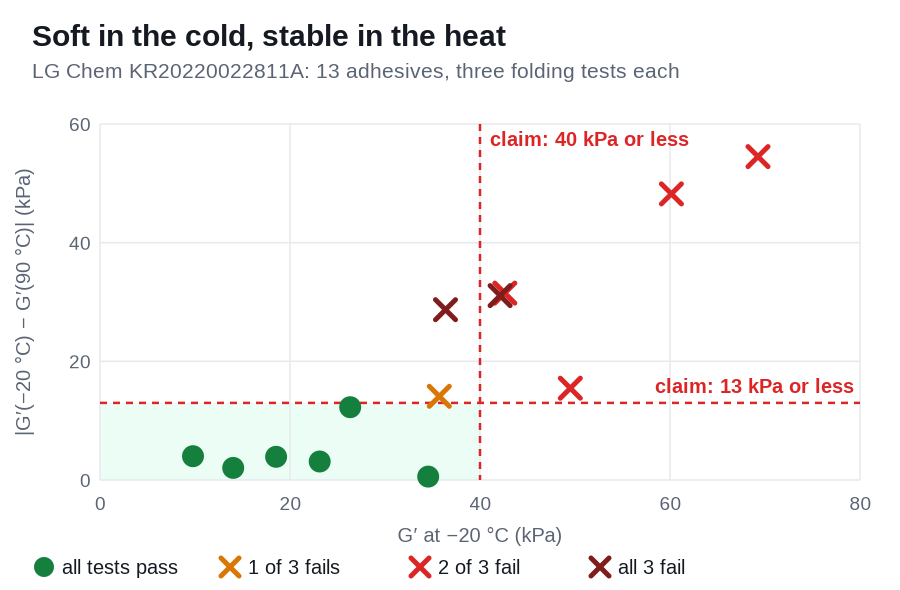
The claimed range follows the boundary of the test results. Example 5 (26.3 kPa, difference 12.3 kPa) passed, while Comparative Example 1 (35.7 kPa, difference 14.1 kPa) passed the dynamic test but failed the static test at -40 °C. On modulus alone, Comparative Example 1 is also within 40 kPa. The difference value is what screens it out.
6. When one layer is not enough, split it, and treat fast deformation separately
When one material cannot resolve every contradiction, the answer moves to structure. Applicants went in three directions.
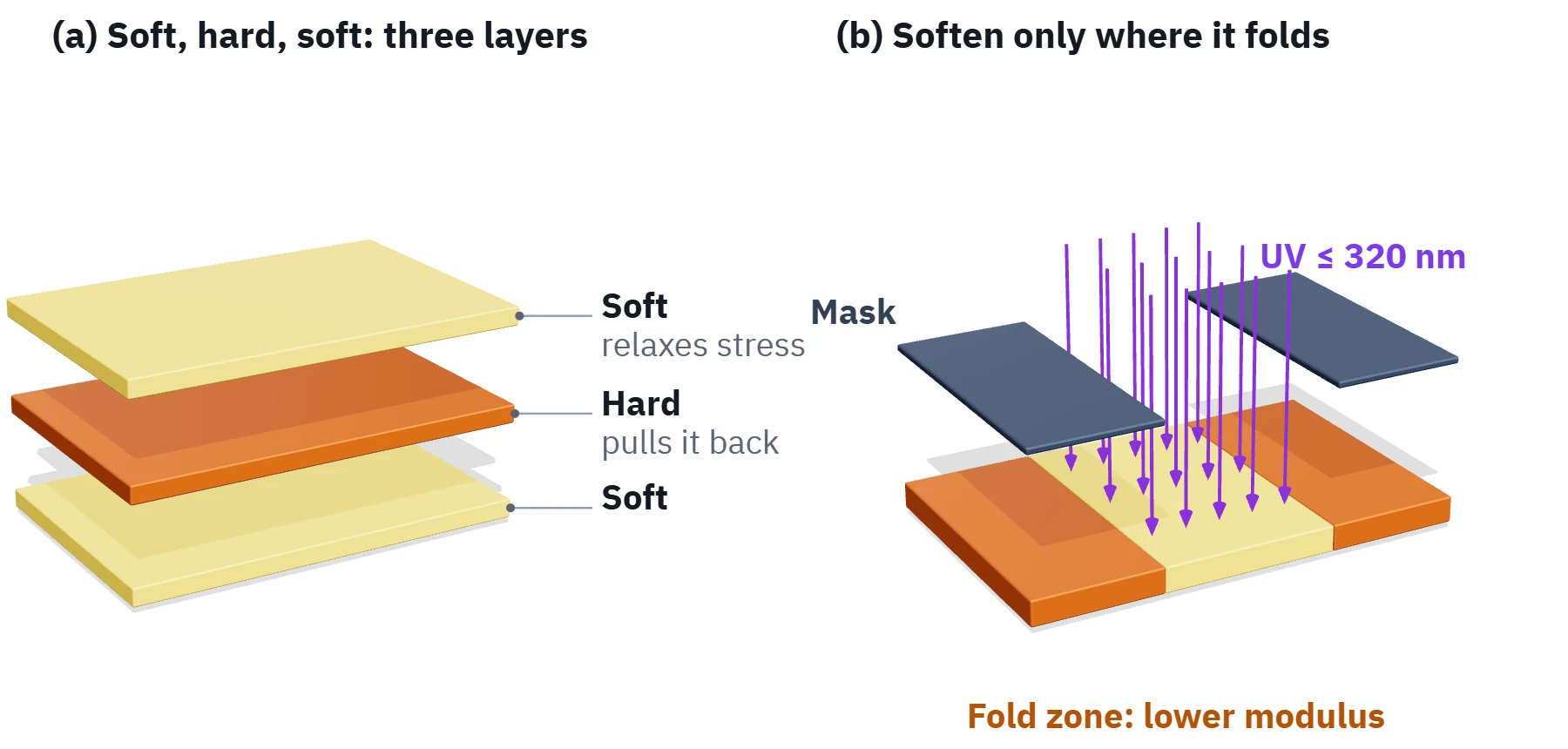
First, divide through the thickness. LG Chem’s February 2018 application (KR20190098435A) stacks a soft layer, a hard layer and a soft layer, each 5 to 10 μm and 15 to 30 μm in total. It states that the soft outer layers have “excellent relaxation and minimize the stress generated during folding,” and that the hard middle layer reduces fold marks by “aiding recovery during unfolding.” It also gives the basis for its test condition, putting the strain on the adhesive at about 12 % when folded to a radius of 2.5 mm.
Second, divide across the plane. Dongwoo Fine-Chem’s November 2021 application (KR20230063601A) incorporates photodegradable units into a sheet and selectively irradiates it with light at 320 nm or below, lowering the modulus only where it is exposed. In Example 1 the modulus fell from 27 kPa before irradiation to 13 kPa after. Comparative Example 1, whose modulus did not fall under irradiation, first showed damage such as streaks or delamination at 1,000 cycles, while Example 1 showed none up to 50,000 cycles. The idea is to soften only the folding band. The thinking that put holes in only the folding band of the support plate in Part 2 has reached the adhesive layer as well.
Third, divide by speed. For a polymer, fast deformation is equivalent to low temperature. Mitsubishi Chemical’s November 2019 application (KR20220103723A, withdrawn) says the adhesive sheet “needs to be soft at the folding speed (frequency)” and explains the low-temperature modulus through time-temperature superposition. Samsung Display’s August 2021 application (KR20230020600A) pushes this axis toward impact. It measures the frequency in each layer during a pen drop test and claims a Tan δ of 1.7 to 2.5 at 30,000 to 100,000 Hz and 25 °C for the adhesive layer under the panel. At the slow folding speed of 1 Hz the layer must be soft, with a modulus at -25 °C of 0.3 MPa or less, while at the speed of a falling pen it must dissipate the impact as heat. Two speed requirements apply to the same layer.
7. Comparative analysis
7.1 The patents in this part
| Priority | Applicant | What is claimed | Adhesive layer value | Status |
|---|---|---|---|---|
| 2014-11 | Samsung SDI | Adhesive composition for curved and flexible use | 500 kPa or less at -20 °C | In force |
| 2015-11 | Dongwoo Fine-Chem | Adhesive layer between two substrates | 100 kPa or less at 25 °C, modulus at -20 °C no more than 3 times that at 25 °C | In force |
| 2017-06 | Samsung Display | A plurality of neutral planes, two adhesive members | Modulus difference 0.01 MPa or less, stress relaxation rate 70 % or less | In force |
| 2017-08 | LG Display | Patterned adhesive with divided deformation layers | Deformation layers 0.1 to 90 MPa | In force |
| 2017-09 | Dongwoo Fine-Chem | Adhesive layer creating a neutral plane for each layer | Modulus/thickness ratio 0.02 to 50 MPa | In force |
| 2017-12 | LG Display | Two pressure-sensitive layers of block copolymer blend | G’ of the first layer greater than that of the second | In force |
| 2018-02 | LG Chem | Soft, hard, soft three-layer structure | Outer layers 10 to 1,000 kPa from -40 to 60 °C | In force |
| 2019-01 | Samsung Display | Protective tape adhesive layer | 30 to 100 kPa at -20 °C, creep 100 to 800 % | In force |
| 2019-11 | Mitsubishi Chemical | Flexible adhesive sheet | 300 kPa or less at -20 °C, 10 kPa or more at 60 °C | Withdrawn |
| 2019-12 | Samsung Display | Protective tape adhesive layer | Below 0.3 MPa at -20 °C, creep at 60 °C of 50 % or more | In force |
| 2020-08 | LG Chem | Acrylic adhesive composition for foldables | 40 kPa or less at -20 °C, difference 13 kPa or less | In force |
| 2021-08 | Samsung Display | Impact absorption by the adhesive layer under the panel | Tan δ 1.7 to 2.5 at 30,000 to 100,000 Hz | Pending |
| 2021-11 | Dongwoo Fine-Chem | Adhesive sheet with selective light irradiation | Lower modulus in the irradiated area | Pending |
| 2023-02 | Dongwoo Fine-Chem | Acrylic copolymer composition | 50 to 150 kPa at -30 °C | In force |
7.2 What set them apart
The applicants stand in different positions. Dongwoo Fine-Chem, LG Chem and Mitsubishi Chemical claim compositions and report the modulus as the result. Samsung Display claims the panel and states the properties of the adhesive inside it as conditions. Materials companies write that making it this way yields this number; panel companies write that without this number it does not fold. The same -20 °C value is where the two sides meet.
In time order it reads as four stages. In 2014 to 2015, low-temperature modulus first appeared in claims. In late 2017 the design vocabulary shifted from the position of one neutral plane to multiple neutral planes, and around 2018 the balance with high temperature was added to claims. From 2019 the upper limits came down, and after 2021 the conditions expanded to in-plane division and high-frequency impact.
8. Counterevidence and limitations
The search query includes “storage modulus.” Applications that claim using some other metric instead of modulus lie outside the 100, so “40 versus 25” is a comparison within this sample. The 25 adhesion filings were counted by a text pattern in which adhesion or peel force appears close to a number in the claims, and should be read as an order of magnitude rather than an exact count. Of 45 filings with a sub-zero elastic condition, the 5 that gave only a value for a non-adhesive film or only a glass transition temperature were removed after reading the originals.
Only Korean applications were examined. Japanese materials companies may have written more in their domestic or US filings. There were no 3M applications among these 100.
The 42 neutral-plane filings catch only those that use the Korean term for “neutral plane.” Filings that say neutral axis or neutral layer may be missing, and the statement that the first multiple-neutral-plane filing dates from 2017 holds only within this sample. Linking the 2017 shift to the 2019 fall in upper limits is the author’s interpretation, not a causal claim made in the filings.
The comparisons in Sections 3.2 to 3.5 are among samples chosen by the applicants. Some of the applications cited in the table in Section 3.1 and in Section 3.5 have been rejected or withdrawn, so they should be read for technical content only. The explanations linking side-chain crystallization and chain-length distribution to high-temperature behavior are the author’s interpretation based on general polymer knowledge; the patents mostly report only compositions and results.
Measurement conditions in Figure 7 differ between applications. Shear versus tension, frequency and sample thickness are not the same, so the values cannot be compared directly. The test results in the tables are for samples chosen by the applicants, and the properties of adhesive layers used in actual products are not public. Nor can patents tell which application went into which foldable.
Figure 2 is a teaching model comparing the two extremes of free sliding and full bonding. Real adhesive layers lie between them, and the deformation of the adhesive itself is not included. For hysteresis and recovery data on adhesive layers, see PEER’s September 1 piece on OCA.
9. Conclusion and next part
A foldable’s adhesive layer both bonds and separates. In 2017, applicants turned from choosing the location of a single neutral plane to creating several. Multiple neutral planes require a soft adhesive layer, and that softness is easily lost in winter. So adhesives were reworked in side chains, crosslinking and molecular weight into materials that are soft yet recover, and across the claims of the 100 filings the modulus at -20 °C appears more often than adhesion strength. After 2019 the upper limit came down, and a temperature difference guarding the summer end was added to claims alongside it. When one material was not enough, applicants divided the layers, divided the plane and divided by speed.
Lay Part 1’s hinge, Part 2’s support plate and this part’s adhesive layer over one another and they have something in common. A foldable patent solves one folding motion, then the next claim records where that solution breaks under other conditions.
The next part reads the panel itself beneath the adhesive layers: plastic substrates, thin-film transistors, wiring and pad bending. The order of parts may change as the series proceeds.