Cover window: Chemically Strengthened Glass
Cover glass is dipped in molten potassium nitrate to put its surface in compression, and the middle of the sheet has to carry an equal area of tension. The thinner the glass, the tighter that margin. In a Corning patent comparing 0.5mm sheets, a lithium glass carried compression from 42 to 90 micrometers deep against a lithium-free glass, yet its central tension fell from 68.3 to 58.6MPa and its drop height onto sandpaper rose from 28 to 75cm. This episode covers how ion exchange works, the frangibility threshold, the gauges and standards that measure it, and the competition among glassmakers.
Part 3 goes down from the surface coatings covered in Part 2 to the cover window just beneath them. Cover windows can be sorted into two rows by material, glass and plastic, and four columns by form: flat, curved, folding and large-area automotive. Each episode takes one cell of this map.
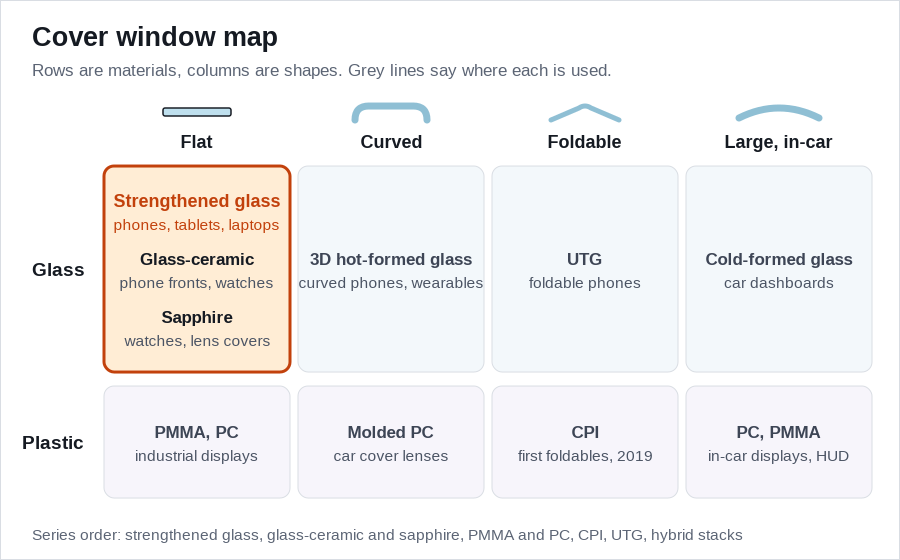
The first cell is chemically strengthened glass. The phone, tablet, laptop and e-reader covers that the ASTM standard names as its scope are this glass, and the glasses in the other cells stand on the same principle. This episode looks at how ion exchange lets glass hold up, where the cost of that piles up, and how the industry got past the limit.
Breakage starts at a surface flaw
Glass breaks from flaws on its surface. When the tip of a flaw is pulled, a crack grows; when it is pressed, the crack does not grow. So strengthening cover glass is not about making the glass harder. It is about putting compression into the surface in advance to keep flaw tips pressed.
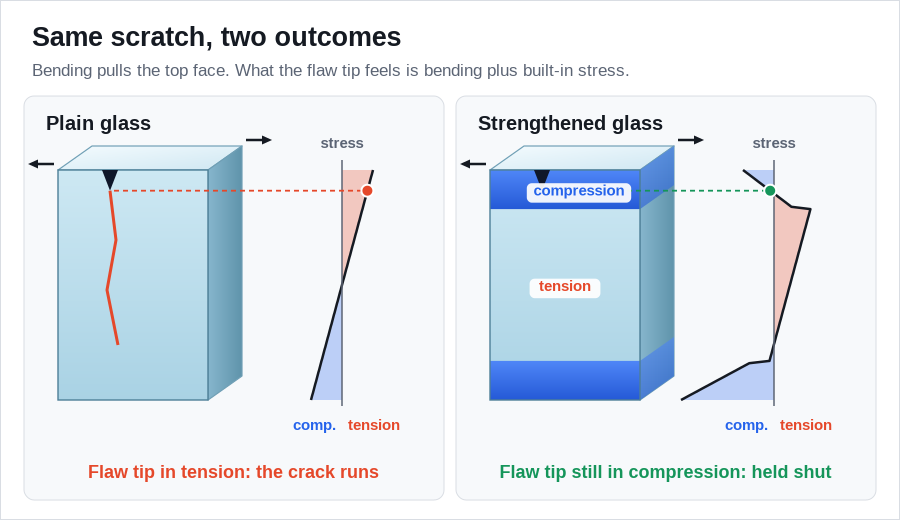
In a 2013 presentation, Corning researchers named sharp contact as the main cause of failure in ion-exchanged cover glass, explaining that the glass breaks as flaws made by contact penetrate past the depth of the compressive layer. A 2017 Corning filing described this as the sharp indentations made when a device falls onto rough surfaces such as asphalt or concrete.
A 2014 Corning filing wrote that flaws made by such impacts can reach about 200 micrometers below the surface.
Strengthening barely raises hardness. As we saw in the Part 2 HC episode, the nanoindentation hardness of ion-exchanged glass is about 8.3GPa, lower than quartz. Chemical strengthening is not a technology that stops scratches. It is a technology that keeps a scratched spot from spreading into a fracture.
Why strengthen with ions instead of heat?
Cover glass is too thin to be strengthened with heat. Building and car glass is strengthened by heating a sheet and rapidly cooling its outside with air. The outside sets first and the inside shrinks later, leaving compression on the outside. This works only when a large enough temperature difference develops between outside and inside.
In a 2014 filing, Corning wrote that thermal tempering is limited to thicknesses of about 3mm or more. The same filing said the compressive layer of thermally tempered glass reaches about 21% of the total thickness. It goes deep, but only in thick sheets.
Asahi Glass (now AGC) also wrote in a 2011 filing that sheets thinner than 2mm, like cover glass, do not develop a temperature difference between outside and inside, which makes a compressive layer hard to form. Phone cover glass is in the 0.5-0.7mm range.
So the ions are swapped instead. Dip a sodium-containing glass in molten potassium nitrate (KNO₃), and small sodium ions leave the glass surface while larger potassium ions take their place. Because the swap happens while the glass stays solid, the surface layer, with large ions wedged into cramped sites, is squeezed.
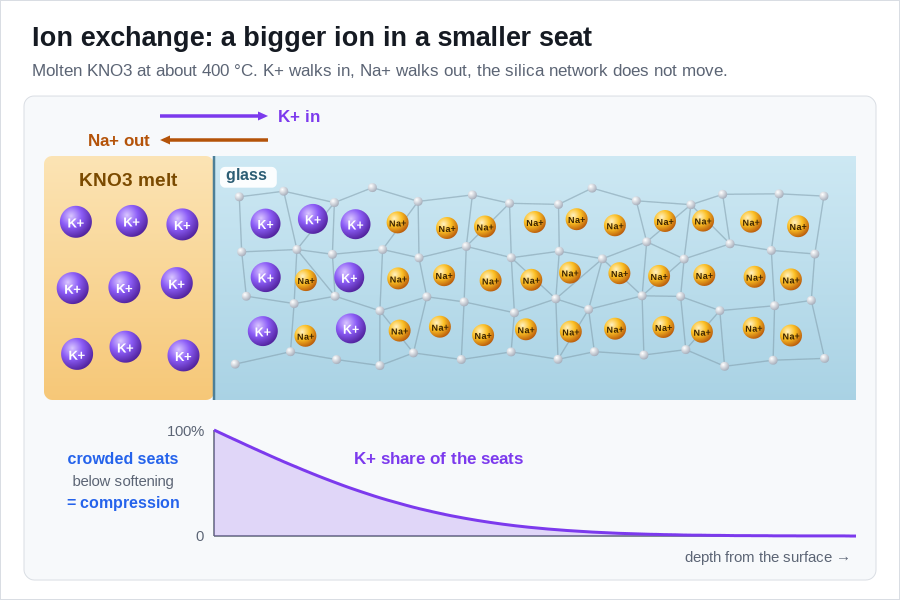
Corning’s 2008 filing gave bath temperatures of typically 380-450℃ and immersion times from 15 minutes to 16 hours. The resulting compression is 200-800MPa at the surface, with a depth of layer (DOL) from 10 micrometers to over 50 micrometers. An AGC filing gave a range of 350-550℃ for 2-20 hours.
Which glass goes into the bath decides the depth. Corning’s 2013 presentation compared two sheets 0.7mm thick. Alkali aluminosilicate reached a surface compression (CS) of 753MPa at a depth of 45 micrometers, and soda-lime reached 536MPa at 14 micrometers.
The same presentation noted that when the compressive layer is shallow, as with soda-lime, the cracks that set strength already extend past it. An AGC filing also wrote that the compressive layer of earlier soda-lime cover glass was about 9 micrometers.
In a 2018 filing, Corning wrote that adding alumina to the silicate network speeds up the interdiffusion of monovalent cations during ion exchange. This should not be read as a general rule, though.
A 2022 Frontiers in Materials paper, reviewing earlier studies, noted that in the three-component system of sodium, alumina and silica, adding alumina reduced the effective diffusion coefficient. The direction depends on what the alumina replaces.
Raising the temperature speeds things up, but something is lost in return. In a 2011 filing, Corning wrote that glass undergoes stress relaxation during ion exchange, and that lowering the temperature reduces relaxation but also lowers exchange speed and depth. The compression put in relaxes by itself at high temperature.
Chinese researchers strengthening ultra-thin aluminosilicate in pure potassium nitrate in 2023 reported that beyond 400℃ and 2 hours, surface compression and Vickers hardness dropped sharply due to stress relaxation. The process window is a choice made between depth and surface compression.
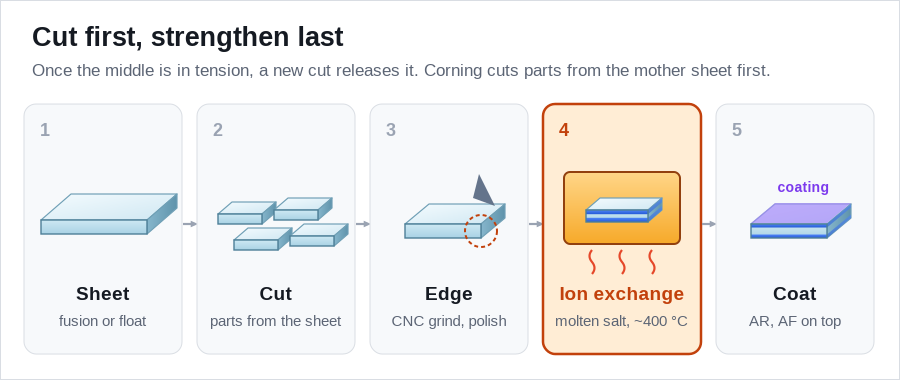
The order is fixed too. Corning explains that parts are cut from the mother sheet first and then dipped in the molten salt. As the next section shows, a strengthened sheet has its middle in tension, so cutting it afterward lets that tension escape through the new cut face.
How the mother sheet is made differs by company. Corning uses a fusion process, overflowing molten glass from a trough called an “isopipe” so that the two films flowing down either side join at the bottom. Corning explains that in this method the glass surface touches nothing, neither hands nor anything else, so no flaws form.
When it launched Dragontrail, AGC said it is made by the float process, which floats the glass on molten tin to spread it. If the surface is where glass breaks, so are the edges.
Launching Dragontrail Pro in 2016, AGC said that cases of the rounded edge taking the impact directly in a drop had increased, and named a strengthened rounded edge as a feature.
Why does squeezing the surface pull the middle?
To squeeze the surface with no outside force pushing on it, the same amount has to be paid back as tension in the middle of the thickness. For a sheet to stay at rest without bending or stretching, compression and tension across its section must be equal in area. This tension is called central tension (CT).
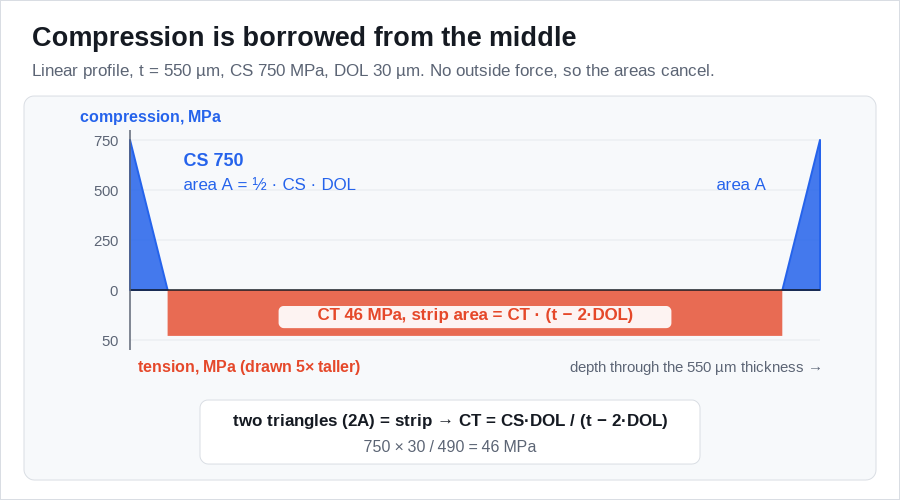
Corning’s 2008 filing assumed that compression falls linearly from the surface to depth DOL, and wrote this relation as an equation. Put 750MPa to a depth of 30 micrometers in a 0.55mm sheet, and about 46MPa of tension forms in the middle. Put the same compression to 40 micrometers, and it becomes 64MPa.
If central tension is too high, the glass bursts when it breaks. The same filing defined this as frangibility: breaking into small fragments of 1mm or less, cracks branching in multiple directions, or fragments flying about 5cm or more. In a 2015 paper, Corning refined this test using more than 2,000 specimens.
The paper flawed sheets 0.4, 0.7 and 1.0mm thick, let them break after a delay, and proposed calling a sheet frangible if it produced five or more fragments. The approach looks only at the tensile energy stored in the sheet, not at the impact energy.
The threshold depends on thickness too. The same filing said that a relation considered linear for thicknesses of 2mm or more is not linear in thin sheets, and put forward a new logarithmic threshold covering the range that does not burst even at tensions above the linear threshold.
| Thickness | Old linear threshold (−15.7·t + 52.5) | New threshold (−38.7·ln t + 48.2) |
|---|---|---|
| 0.75mm | 40.7MPa | 59.3MPa |
| 0.5mm | 44.7MPa | 75.0MPa |
By the new threshold, a 0.5mm sheet can carry central tension up to 75MPa. The threshold rises as glass gets thinner, but the tension that a given compression creates grows faster, because the remaining thickness (t − 2·DOL) shrinks.
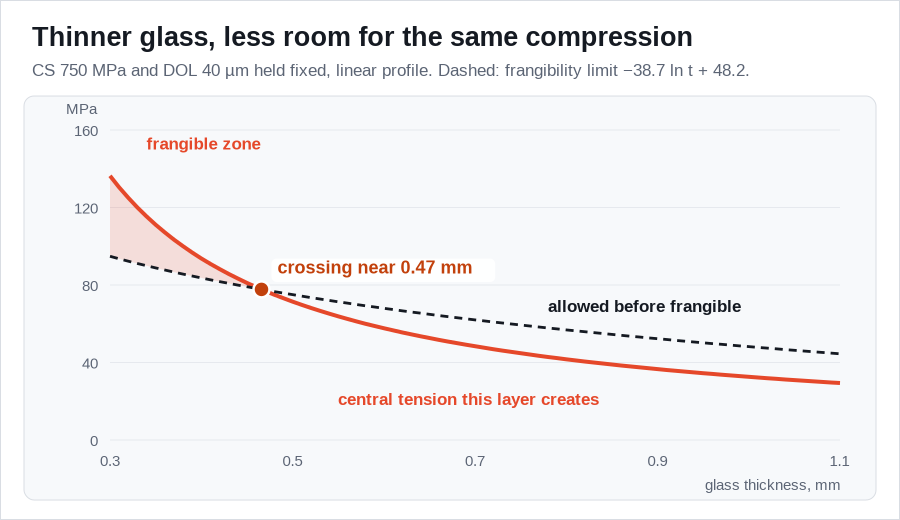
This is the first half of the question this episode sets out to answer. To survive drops, compression has to go deeper than the flaws, but the deeper it goes, the larger the central tension, and the thinner the sheet, the tighter that margin. In the simulation below, if you increase the depth to bring the flaw tip inside compression, a 0.7mm aluminosilicate sheet crosses the threshold before compression reaches the tip of a 60μm flaw.
How is a depth that survives drops obtained?
Use a lithium-containing glass and mix sodium into the bath, and compression can be carried deep without raising central tension. Here the name for depth splits in two. Depth of layer (DOL) is the value a surface stress meter reads as the depth of the layer that potassium has entered, and depth of compression (DOC) is the depth at which stress changes from compression to tension and passes through zero.
In sheets with potassium only, the two values are close, but in lithium glass they diverge widely. In a 2014 filing, Corning wrote that the depth of the flaws that caused failure matched DOC better than DOL.
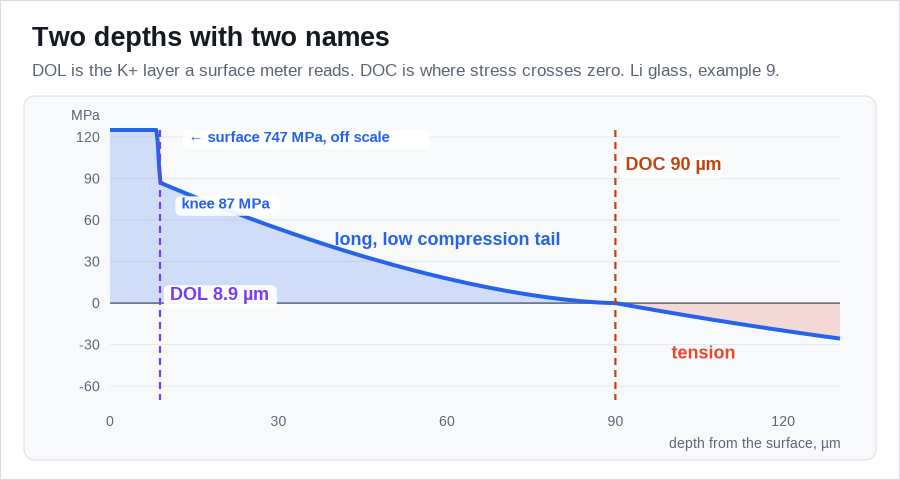
In lithium glass, sodium enters the small lithium sites and continues deep into the sheet. In a 2015 filing, Corning wrote that the depth of compression (DOC) obtained this way reaches about 20% of the thickness.
Corning’s 2018 filing measured two kinds of 0.5mm sheet side by side. A lithium-free alkali aluminosilicate dipped at 420℃ for 330 minutes in a bath of potassium nitrate alone had a surface compression of 857MPa, a depth of 42 micrometers and a central tension of 68.3MPa.
A glass containing 6.24mol% lithium, dipped at 380℃ for 80 minutes in a bath with 15% sodium nitrate mixed in, had a surface compression of 747MPa, which is actually lower. But its compression reached 90 micrometers, and its central tension was smaller at 58.6MPa. These are the values of the one specimen, out of three under the same conditions, whose central tension was also measured.
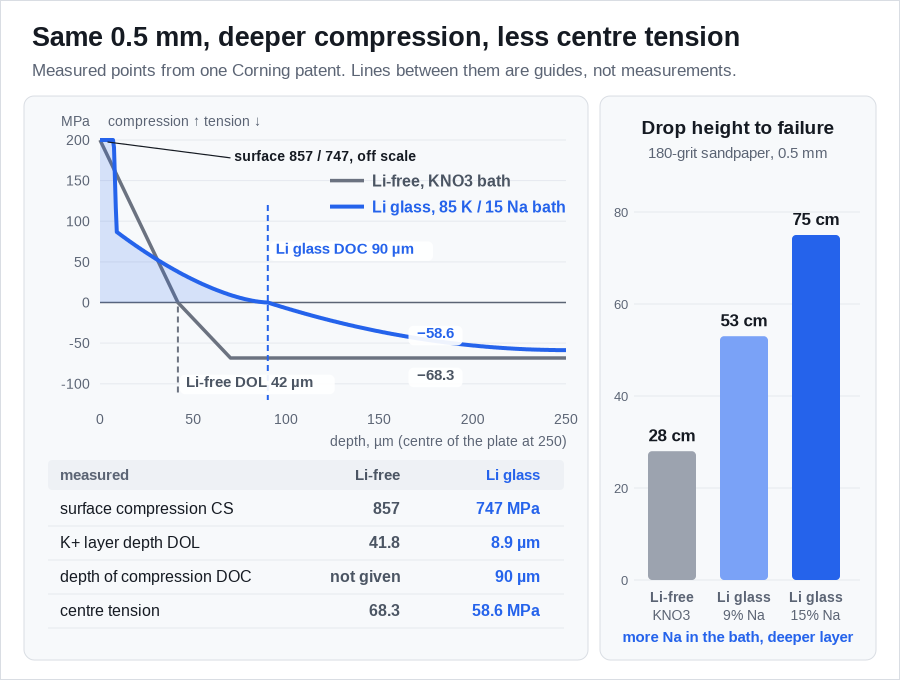
In the drop test, each sheet was attached to a phone-sized puck and dropped onto 180-grit sandpaper, with the height raised in 10cm steps until it broke. The lithium-free sheet broke at 28cm, the lithium glass strengthened in a 9% sodium bath at 53cm, and the one strengthened in a 15% bath (another specimen under the same conditions) at 75cm.
For 0.7mm sheets as well, 49cm rose to 74-76cm.
The secret is the shape. The lithium glass sheet puts a thin potassium layer in the top 8.9 micrometers to carry high compression, and below it draws a low compression of a little over 87MPa all the way to 90 micrometers. Spending the area of compression on depth instead of height leaves the middle less pulled.
That said, this table compares cases in which glass composition and bath conditions changed together. Among the lithium glasses alone, depth of compression changed only slightly, from 84 to 90 micrometers, yet drop height differed widely, from 53 to 75cm. Depth alone cannot be read as what sets drop height.
Even so, 90 micrometers falls short of the 200-micrometer flaw depth seen earlier. Putting compression deep does not cover every flaw. It widens the range of flaws whose tips stay pressed, out to deeper ones.
These specimens were strengthened in one step, in a single bath mixing potassium nitrate and sodium nitrate. There is also a method that splits it into two steps.
Corning’s 2014 filing set out conditions in which the first step builds depth in a mixed bath of 5-90% potassium nitrate and 10-95% sodium nitrate, and the second step presses the surface again by dipping in pure potassium nitrate for 15 minutes to 8 hours.
In that filing’s worked examples, extending the second step from 4 hours to 8 hours lowered both surface compression and central tension. Here too, stress relaxation takes its share.
In later filings, Corning wrote that the earlier frangibility criterion holds only when the compressive layer is much shallower than the thickness. In other words, the safety of a deep profile can no longer be judged by a single central tension from the linear approximation.
Gauges for the potassium layer and the sodium tail
The surface potassium layer and the deep sodium tail are measured with different instruments. The layer that potassium enters has a higher refractive index and becomes a thin path that traps light. Surface stress meters such as the Orihara Industrial FSM-6000 read surface compression and layer depth from the fringe pattern of the light traveling along this path.
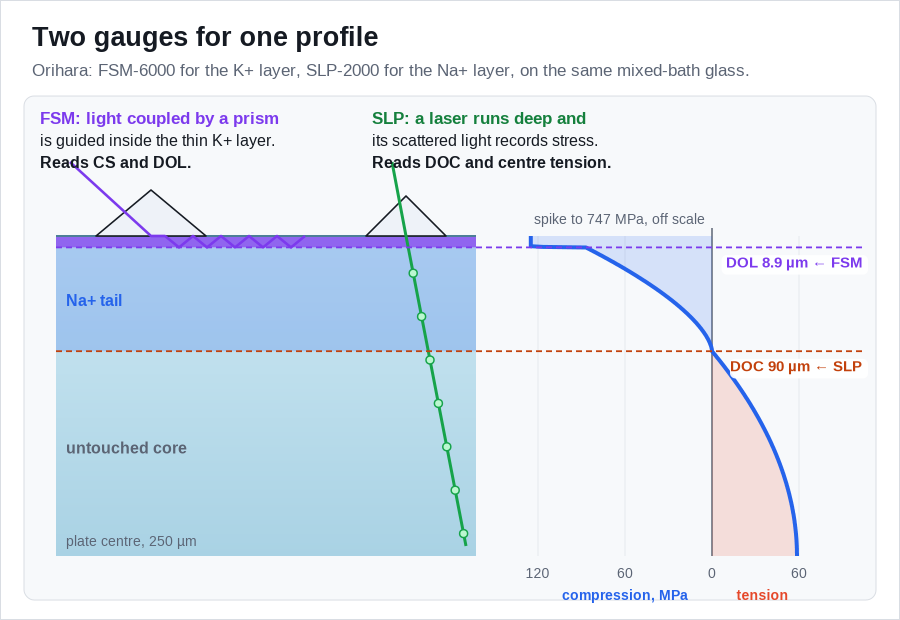
The tail where sodium replaced lithium does not raise the refractive index, so this method cannot see it. A Corning filing also wrote that the FSM cannot determine the depth of sodium exchange into lithium sites. So a scattered light polariscope, which looks at the polarization of light scattered inside the glass, is used. The Orihara Industrial SLP-2000 measures to a depth of 600 micrometers.
| What | Method · standard | Notes |
|---|---|---|
| Surface compression, potassium layer depth | FSM surface stress meter (guided light) | 0-1,000MPa, depth 5-200μm (FSM-6000X) |
| Deep compression, central tension | Scattered light polariscope (SLP) | Depth 10-600μm (SLP-2000) |
| Grade classification | ASTM C1422 | Classified by surface compression and depth of compression. Does not address end-use performance |
| Surface strength | ASTM C1499 ring-on-ring | Two concentric rings load the sheet in even biaxial tension |
| Drop | Each maker’s own sandpaper drop | 180-grit and 80-grit sandpaper, height raised step by step |
With sandpaper grit, a smaller number means rougher. On the Victus 2 product sheet, Corning listed both 1m on 80-grit sandpaper and 2m on 180-grit. The same glass survives half the height when the floor gets rougher, which is why the floor is the first thing to check when reading a drop height.
What matters is that the standards do not define drops. ASTM C1422 covers chemically strengthened glass for phones, tablets and laptops, but states itself that its classification criteria are surface compression and depth of compression and that it does not address end-use performance. ASTM C1279, a photoelastic standard for thermally tempered glass, explicitly says it cannot be used for chemically strengthened glass.
Drop heights are values each glassmaker measured under its own conditions.
Glassmakers’ competition moved to drop height
Glassmakers came to compete on drop height onto rough surfaces, and competitors’ glass moved to lithium aluminosilicate. Corning says it launched Gorilla Glass in September 2007. The 2013 announcement of Gorilla Glass 3 led with scratch resistance, and the 2014 announcement of Gorilla Glass 4 put drops onto rough surfaces into numbers. Later generations raised that height.
| Product | Announced | Figure the company claimed (in-house tests) |
|---|---|---|
| Gorilla Glass 4 | 2014-11 | Up to 80% survival when dropped from 1m onto a rough surface |
| Gorilla Glass 5 | 2016-07 | Up to 80% survival when dropped from 1.6m onto a rough surface |
| Gorilla Glass 6 | 2018-07 | Survives an average of 15 drops from 1m. Competing glass broke on the first drop |
| Gorilla Glass Victus | 2020-07 | 2m onto a hard, rough surface. Competing aluminosilicate under 0.8m |
| Gorilla Glass Victus 2 | 2022-11 | 1m onto a surface simulating concrete. Competing glass 0.5m or less |
| Gorilla Glass 7i | 2024-06 | 1m onto a surface simulating asphalt. Competing lithium aluminosilicate 0.5m or less |
These figures cannot be ranked against one another, because the test surface and pass criteria differ by generation. Corning itself, in a product timeline document, lists Gorilla Glass 5 at 1.2m and Gorilla Glass 6 at 1.6m, which differ from the press releases.
A copy of the Gorilla Glass 3 product sheet listed “50 micrometers at 950MPa,” but the sheet Corning now offers for download only says to ask a sales representative about strengthening conditions.
The supply chain is narrow. Announcing its investment in Corning in 2021, Apple introduced the plant in Harrodsburg, Kentucky as “where glass for every generation of iPhone has been made.” OPPO was announced as the first customer for Gorilla Glass 7i in 2024.
Competitors moved toward lithium too. SCHOTT introduced its lithium aluminosilicate glass Xensation to Chinese phone makers in 2011, and in 2021 released Xensation α with added boron.
AGC classifies Dragontrail and Dragontrail Pro as alkali aluminosilicate, and its STAR series as lithium aluminosilicate.
The same glass is used where screens grow larger. Launching products for automotive interiors in 2019, Corning said existing cover materials could fail industry reliability tests about one time in three, while its 2D cover glass was optimized to pass 99% of the time. It also released 3D products bent and attached at room temperature.
This story returns in the curved and automotive cells of the map.
And in December 2025, AGC announced that it would exit its business in specialty glass for chemical strengthening. It cited falling prices and weak orders for a business it started in 2009, and production ends in the third quarter of 2026. One of the main suppliers in this cell is leaving.
What remains in the strengthened glass cell
The competition in chemically strengthened glass comes down to how deep, and in what shape, compression can be put in without raising central tension. Reduced to this episode’s numbers: by Corning’s 2008 threshold, the central tension a 0.5mm sheet can carry is 75MPa. Lithium glass carried compression to 90 micrometers at a lower 58.6MPa.
This cell leaves two problems unsolved. One is scratching. Ion exchange barely raises hardness, so the problem of being scratched by quartz sand remains. The other is the limit of holding up through stress. Once the compression budget is spent, the next step is to raise the toughness of the glass itself.
Corning’s product sheets listing the fracture toughness of Victus at 0.76 and of Victus 2 at 0.82MPa·m^0.5 point in that direction.
The next episode takes that road. Apple introduced the Ceramic Shield of the iPhone 12 in 2020 as raising drop performance 4 times by including nano-ceramic crystals. Glass-ceramic, which grows crystals inside the glass, and sapphire, the same crystal as corundum, are the next cells.