Glass-Ceramic and Sapphire Cover Windows
Glass-ceramic grows crystals under 150 nm inside glass, raising fracture toughness from 0.82 to 1.15 MPa·m^0.5, but hardness stays near glass at 6.5 GPa. Sapphire is over three times harder at 22.5 GPa, yet cannot be ion-exchanged and reflects 7.7% per surface.
Episode 1 ended with two problems left by chemically strengthened glass. One is that ion exchange does not raise hardness, so scratches remain as they are. The other is that there are limits to how compression can be introduced, so the next step must be raising the toughness of the material itself. This episode looks at two materials, in the same flat cell of the glass row on the map, that each tried to answer one of those problems.
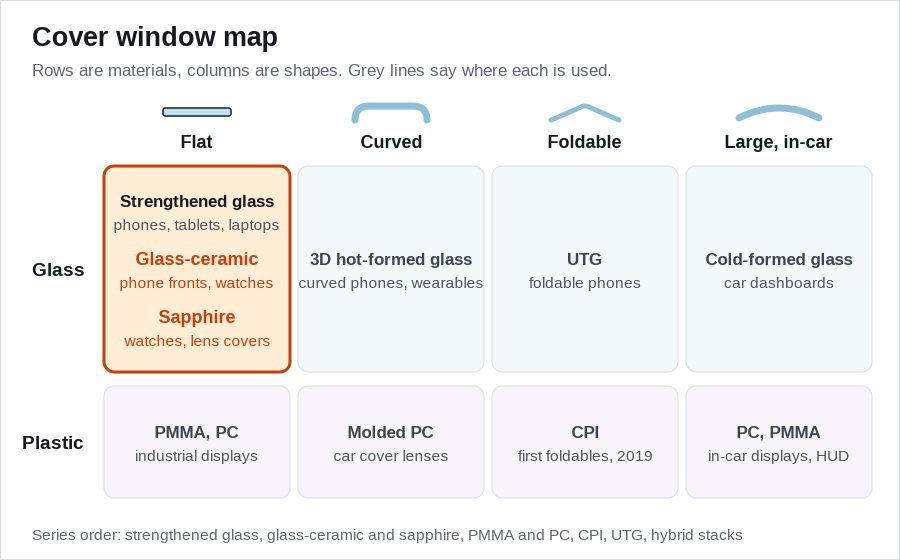
Glass-ceramic is a material in which small crystals are grown inside glass; sapphire is a single crystal from the start. Both use crystals, but they gain different things. Glass-ceramic became tougher, and sapphire is hard. This episode looks in numbers at where that difference comes from and what it costs.
What changes when crystals are grown inside glass
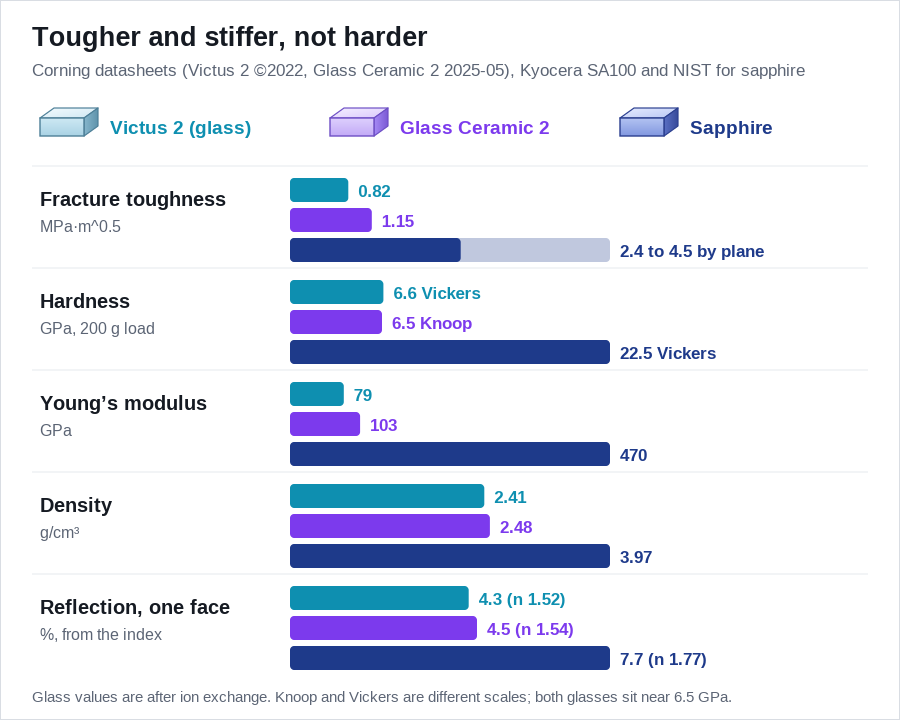
What growing crystals gained was toughness and stiffness, not hardness. The Gorilla Glass Ceramic 2 product sheet Corning released in May 2025 lists fracture toughness at 1.15 MPa·m^0.5. The same company’s aluminosilicate glass Victus 2 is 0.82. That is 1.4 times higher.
Young’s modulus also rose from 79 to 103 GPa, a factor of 1.3. Hardness, however, barely changed. The two sheets use different scales, so they cannot be compared directly, but after strengthening Victus 2 is Vickers 670 and Glass Ceramic 2 is Knoop 660 kgf/mm², both near 6.5 GPa.
Corning patent applications show the same range. An application with a 2018 priority date lists fracture toughness of 1.0 to 2.0 MPa·m^0.5 and Young’s modulus of 95 to 110 GPa as embodiments. Another application from the same period measured 1.32 by double cantilever beam testing and 1.1 MPa·m^0.5 by chevron notch testing.
The crystals are a phase distinct from the glass. The 2018 application specifies more than 20 wt% each of two crystals, lithium disilicate and petalite, with the remaining glass at 5 to 30 wt%. Another application cites a range in which crystals make up 70 to 99%. It is closer to a little glass left between crystals than to crystals mixed into glass.
The rise in toughness connects to the compression budget of Episode 1. The same application lists embodiments with a maximum central tension of more than 90 MPa. Applying the frangibility threshold equation for glass from Episode 1, the threshold for a 0.75 mm plate is 59 MPa. The range includes tension on the side where glass would shatter.
Apple introduced this material in 2020 on the iPhone 12 Pro under the name Ceramic Shield. Apple said that adding nanoceramic crystals greatly increased toughness and that drop performance was 4 times better than the previous iPhone generation. It said nothing about hardness or scratches at the time.
Ceramming heat treatment and ion exchange
The crystals are grown after the plate is fully formed. Molten glass is formed into a plate, and that plate is heated twice. Announcing its 2021 investment in Corning, Apple described this as a “high-temperature crystallization step that creates nanocrystals within the glass matrix.”
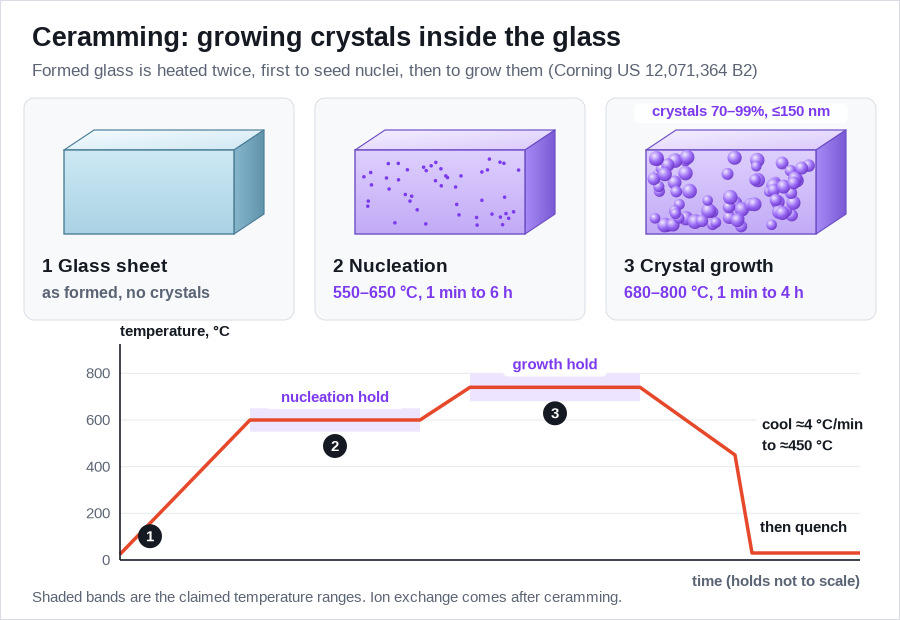
Corning’s 2018 application specifies nucleation at 550 to 650℃ for 1 minute to 6 hours and crystal growth at 680 to 800℃ for 1 minute to 4 hours. The plate is then cooled slowly at about 4℃ per minute to about 450℃ and quenched.
Ion exchange is still performed after the crystals are grown. Lithium and sodium in the residual glass and in the crystals become the ions to be exchanged. An example in the lithium disilicate-petalite application from the same year immersed the plate at 500℃ for 16 hours in a bath of 80% potassium nitrate and 20% sodium nitrate with 0.1% lithium nitrate added.
The depth of compression given in this application is 80 to 300 micrometers, about 0.18 to 0.25 times the thickness. In the same direction as the lithium glass of Episode 1, which reached 90 micrometers at a thickness of 0.5 mm, the range extends deeper.
Why is it transparent if it contains crystals?
Because the crystals are much smaller than the wavelength of light, and the refractive indices of crystal and glass are nearly equal. Either alone is not enough. Corning’s 2001 application for transparent glass-ceramics states this condition, citing a 1969 paper by Beall and Duke.
If the refractive index difference between crystal and glass is large, the crystals must be smaller than 50 nm to be transparent, and reducing them to 10 nm is better. If both the index difference and the crystal birefringence are small, crystals larger than 50 nm can also be transparent. Corning’s 2018 application setting crystal size at 150 nm or less takes this second route.
The Glass Ceramic 2 sheet lists the refractive index of both the interior and the compressive layer as 1.54. At 0.6 mm thickness, haze is 0.15% or less, and transmittance is 90% or more above 500 nm and 88% or more from 400 to 500 nm. Slightly less passes at the blue end.
The simulation below treats the crystals as small spheres and calculates haze from Rayleigh scattering. In this model, if crystals occupy 80% of the volume at a size of 150 nm, the index difference between crystal and glass must be held within about 0.001 to meet the sheet’s 0.15%. Reducing the crystals to 50 nm widens the tolerance fivefold to about 0.005.
That blue light scatters more follows from the same equation. Rayleigh scattering is inversely proportional to the fourth power of wavelength, so 450 nm scatters about 2.2 times more than 550 nm. This matches the direction of the sheet’s lower transmittance floor at the blue end, 2 percentage points lower.
Drop numbers are hard to rank across sheets. The Glass Ceramic 2 sheet states that a 0.6 mm plate survived a 1 m drop onto 80-grit sandpaper, while competing lithium aluminosilicates usually broke at 0.5 m or less. Yet the Victus 2 sheet seen in Episode 1 also lists 1 m on 80-grit sandpaper.
In January 2025 Samsung used Corning’s glass-ceramic Gorilla Armor 2 on the Galaxy S25 Ultra, stating that it survived a 2.2 m drop onto a surface simulating concrete while other glass-ceramics broke at 1 m. All of these are in-house tests under conditions set by the companies.
Why did sapphire stay in watches?
Sapphire is the hardest and toughest of the three, but it cannot be given compression by ion exchange, and it is heavier and more reflective. Sapphire is single-crystal aluminum oxide. Kyocera’s data list a purity of 99.99% or more and a Vickers hardness of 22.5 GPa, more than three times harder than the 6.5 GPa of strengthened glass.
Its toughness is also high in numbers. In measurements compiled in data from the US National Institute of Standards and Technology (NIST), the fracture toughness of sapphire is 2.4 to 4.5 MPa·m^0.5 depending on the crystal plane along which the crack runs. That is roughly two to four times that of Glass Ceramic 2.
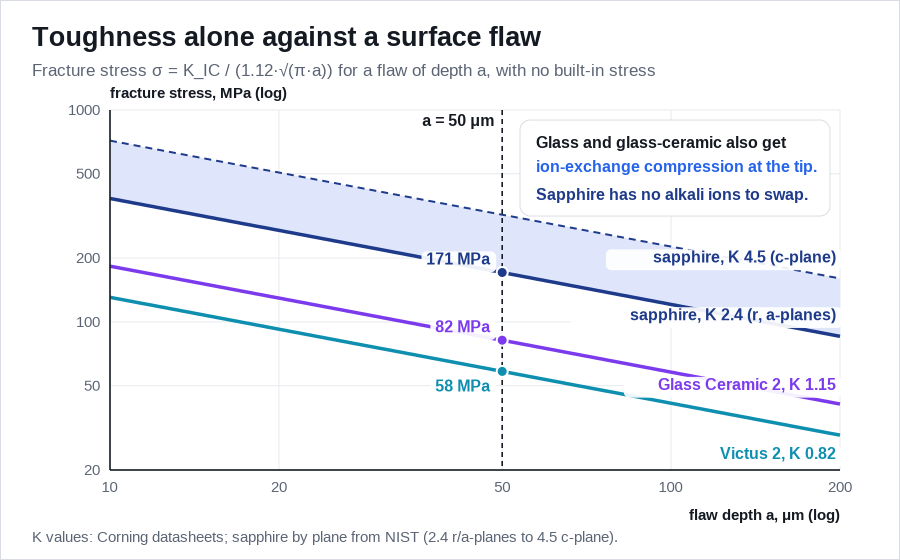
When the surface has a flaw of depth a, the stress the material can withstand is roughly the toughness divided by a value proportional to √(πa). For a 50 micrometer flaw, sapphire withstands 171 MPa even at the low end of its toughness, Glass Ceramic 2 82 MPa and Victus 2 58 MPa.
But glass and glass-ceramic add ion-exchange compression on top of this. If the flaw tip lies within the compressive layer, tensile force must first cancel that compression. The lithium glass in Episode 1 kept compression down to a depth of 90 micrometers. Sapphire has no alkali ions to exchange.
In a 2013 company article, Corning wrote that after similar abrasion, breaking Gorilla Glass took about three times more force than sapphire. Test conditions were not disclosed, and it is a company claim about a competing material. The same article stated that sapphire is 67% heavier by volume. Comparing Kyocera’s density of 3.97 with Victus 2’s 2.41 confirms the number.
It also loses on light. The refractive index of sapphire is about 1.77, higher than glass, so without coating each surface reflects 7.7%. Glass Ceramic 2 reflects 4.5%. With both surfaces combined, that is 14.3% versus 8.6%, a difference of about 6 percentage points.
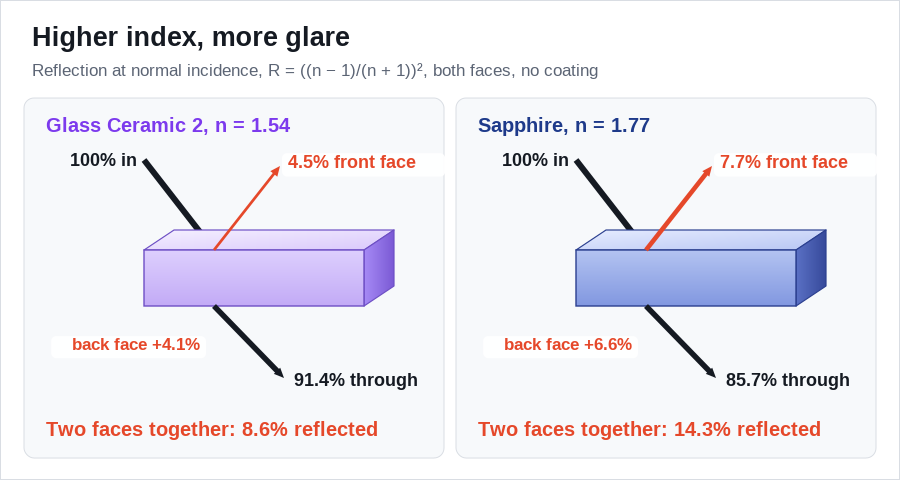
That is the same magnitude as Corning’s 2013 statement that sapphire transmits about 6 percentage points less light. A sapphire cover needs the anti-reflection coatings seen in the Part 2 AR episode even more than glass does.
Manufacturing differs as well. Glass is melted and drawn into sheets, but sapphire must be grown as a crystal boule, then sliced and polished. The same Corning article claimed that sapphire takes more than 4,000 times longer to make than glass and that processing a cover costs more than ten times the price of Gorilla Glass.
There were attempts aimed at mass production. In May 2014 sapphire furnace maker GT Advanced Technologies announced a furnace that grows a 165 kg boule in one run, a boule 40% larger than the previous model.
The company ran a sapphire plant in Mesa, Arizona, on prepayments from Apple. According to a March 2015 filing, it received 439 million dollars of the 578 million dollars in prepayments it could have received.
Of the 2,138 tools in Mesa, 2,036 were tied up in the settlement with Apple, and about 3,500 boules remained. The sapphire operations in Mesa and Salem entered wind-down.
So sapphire remained on small surfaces. According to Apple’s specification pages, Apple Watch Ultra 4 uses a flat sapphire front, and Series 12 uses sapphire only on its titanium and ceramic cases. The aluminum case of the same Series 12 uses Ceramic Shield 2.
| Material | Where it is used now (per company announcements) |
|---|---|
| Glass-ceramic | Ceramic Shield from iPhone 12 Pro onward, Gorilla Armor 2 on Galaxy S25 Ultra, Apple Watch Series 12 aluminum |
| Sapphire | Apple Watch Ultra 4, Apple Watch Series 12 titanium and ceramic |
In a 2012 application, Apple filed a cover made by bonding several sapphire layers with different crystal orientations. The aim is to stack mechanical properties that differ by orientation. The directionality of a single crystal is both a design variable and a problem.
What remains from the glass-ceramic and sapphire cell
Reduced to the numbers in this cell, glass-ceramic raised fracture toughness from 0.82 to 1.15 MPa·m^0.5 while keeping a refractive index of 1.54 and haze of 0.15%. Sapphire resists scratches with a hardness of 22.5 GPa but has no ion-exchange compression and reflects 14.3% from two surfaces.
Of the two problems from Episode 1, glass-ceramic solved toughness, while scratching ultimately passed in this cell not to a material but to a coating. Apple stated that on the iPhone 17’s Ceramic Shield 2 in 2025 its own coating design raised scratch resistance 3 times. Samsung’s Gorilla Armor 2 likewise promoted scratch resistance together with anti-reflection.
The next episode leaves the glass row for the plastic row. In the same flat cell, it looks at what PMMA and PC give up in exchange for not breaking, and why the hard coats seen in Part 2 started there.