AI Glasses in Korea's College Entrance Exam: How Waveguide Displays Put Text on a Lens
Ahead of Korea's College Scholastic Ability Test (CSAT), debate grew over whether AI glasses could serve as cheating tools. Using public sources, we explain how a waveguide display floats text on a lens and compare the approaches of Meta, Rokid, Samsung and others.
Among display industry news from November 16 to 22, the most widely covered story was the debate, ahead of the November 19 College Scholastic Ability Test (CSAT), over whether AI glasses could become a tool for exam cheating. Taking that debate as a starting point, this piece uses public sources to set out the optical principle that makes text visible on an eyeglass lens and how the approaches of different companies differ.
Issues the Press Covered, November 16 to 22
First, the debate over bringing AI glasses into the 2027 CSAT (November 19) continued. The detailed administration plan of the Korea Institute for Curriculum and Evaluation bans items with communication functions, including smart glasses. On November 19, ZDNet Korea reported that an experiment solving a mock CSAT Korean section with Ray-Ban Meta scored 0, and Segye Ilbo reported scoring 90 in math and 84 in Korean with Rokid Glasses. The Ministry of Education announced 98 cheating cases involving electronic devices on test day (including one smart glasses case). On November 17, Korea Economic Daily reported on companies and the military restricting smart glasses, and Digital Daily reported the same day that Meta’s display model is not sold in Korea. Newspim reported that Samsung Electronics built blocking features, such as protection against covering the recording indicator, into its display-less AI glasses launching on December 10. These are covered in the body below.
Second, TheElec reported that LG Display announced in a November 19 regulatory filing that it had withdrawn its plan to invest 3 trillion won in a Gen 10.5 OLED production line at its Paju P10 plant. The withdrawal comes seven years after the investment decision in 2019, and the investment was originally to end in March 2028. LG Display said that executing a new Gen 10.5 investment for ultra-large panels as originally planned conflicts with its strategy of maximizing profitability. The same day, it reorganized its three business units (large, medium and small) into two, medium-large and small, and CEO Jeong Cheol-dong remains in his post.
Third, news on Apple’s IT OLED continued. Citing reports from Korea, OLED-Info said on November 19 that Apple is adjusting the development schedule for an OLED iMac with Samsung Display and that delay or cancellation is under consideration. The article names no original outlet, and there is no confirmation from Apple. The same day, Counterpoint analyzed that for an 11.1-inch iPad Pro OLED panel, Gen 8.7 manufacturing costs about 39% less than Gen 6. The gap comes from differences in labor, depreciation and overhead, and assumes the two generations have the same component and SG&A costs. AP Systems said on November 17 that it is discussing application of its spatial ALD equipment for HMO to large-area OLED mass production processes, news that connects to the HMO deposition methods covered in Issue 13.
Fourth, OLED monitor market news. According to OLED-Info, in TrendForce’s tally for the third quarter of 2026, ASUS ranked first at 21.7%, MSI reached second place for the first time at 14.5% (previously 12.8%), and Samsung was third at 11.3%. Samsung Display exhibited 92 QD-OLED monitors at G-STAR 2026 in Busan from November 19 to 22.
The lead issue for November 16 to 22 is “the debate over bringing AI glasses into the CSAT and the principle of the lens display.”
What Became a Problem at the CSAT
According to NoCut News, the Institute’s detailed administration plan for the 2027 CSAT, announced on June 30, bans bringing into the test site any item with a communication function (mobile phones, smartwatches, smart glasses, tablet PCs, earphones, etc.), regardless of whether it is used during the test. A test taker who has unavoidably brought one must submit it to a proctor before the first period begins; failure to submit it is treated as cheating. Citing the Institute’s guidelines for test takers, iNews24 reported on October 15 that merely wearing smart glasses during the test without submitting them voids that test and suspends eligibility for the following year’s CSAT. In a September 27 article, The Fact wrote that a Ministry of Education official said the inspection manual was still under discussion, and that an expert pointed out that AI glasses are almost impossible to tell apart from ordinary glasses by appearance.
Actual detections came first outside the CSAT. Citing data from HRD Korea, Digital Daily reported that through October this year, five smart glasses cheating cases were detected in national qualification exams run by the agency, one of them involving a Meta product. The specific method of use was not confirmed. In a November 17 article, Korea Economic Daily reported that affiliates of the four largest business groups and shipbuilding and defense companies are restricting smart glasses or requiring prior approval, and that the Ministry of National Defense put a guideline strengthening security screening into effect on November 1.
On test day, the Ministry of Education announced interim results tallied up to 5 p.m. on November 19. According to Kyunghyang Shinmun’s Weekly Kyunghyang and YTN, 98 test takers were caught cheating with electronic devices and the like, including 49 identified through emergency alert messages, 44 found carrying electronic devices by other means and five cases of smart device use during the test. The five cases include one smart glasses case (Cheonan, South Chungcheong); the rest are possession of a small camera and wireless earphones (Yongin, Gyeonggi), photographing the test paper with a smartphone (Seoul) and two cases of smartphone use in a restroom (Seoul and Gyeonggi). Neither article says that AI provided answers through these glasses. All 98 were processed as cheaters, with final penalties to be decided by the cheating review committee. YTN reported that the 98 cases were 14 more than last year, but not a large increase considering that supervision had been greatly strengthened.
Two hands-on articles published on test day produced very different results depending on the type of glasses. ZDNet Korea wore Ray-Ban Meta and solved a printed copy of the Institute’s Korean test paper. This model shows no information on a screen inside the lens, so communication was by voice only; calling up the AI with “Hey Meta,” the reporter worked through six questions in 50 minutes, gave up partway and got none right. Segye Ilbo used Rokid Glasses from China’s Rokid. The glasses have a camera and display, and AI linked to a smartphone (ChatGPT) analyzes captured images and shows the answers. Math, 30 questions, took 15 minutes for 90 points; Korean, 45 questions, took 45 minutes with seven wrong for 84 points. Segye Ilbo wrote that in Korean there were cases where passages were cut off or captured blurry and the AI did not recognize the text properly. The two experiments differ in glasses, AI, input method and subject, so they cannot be compared as an effect of having a display or not. Each was also a single trial.
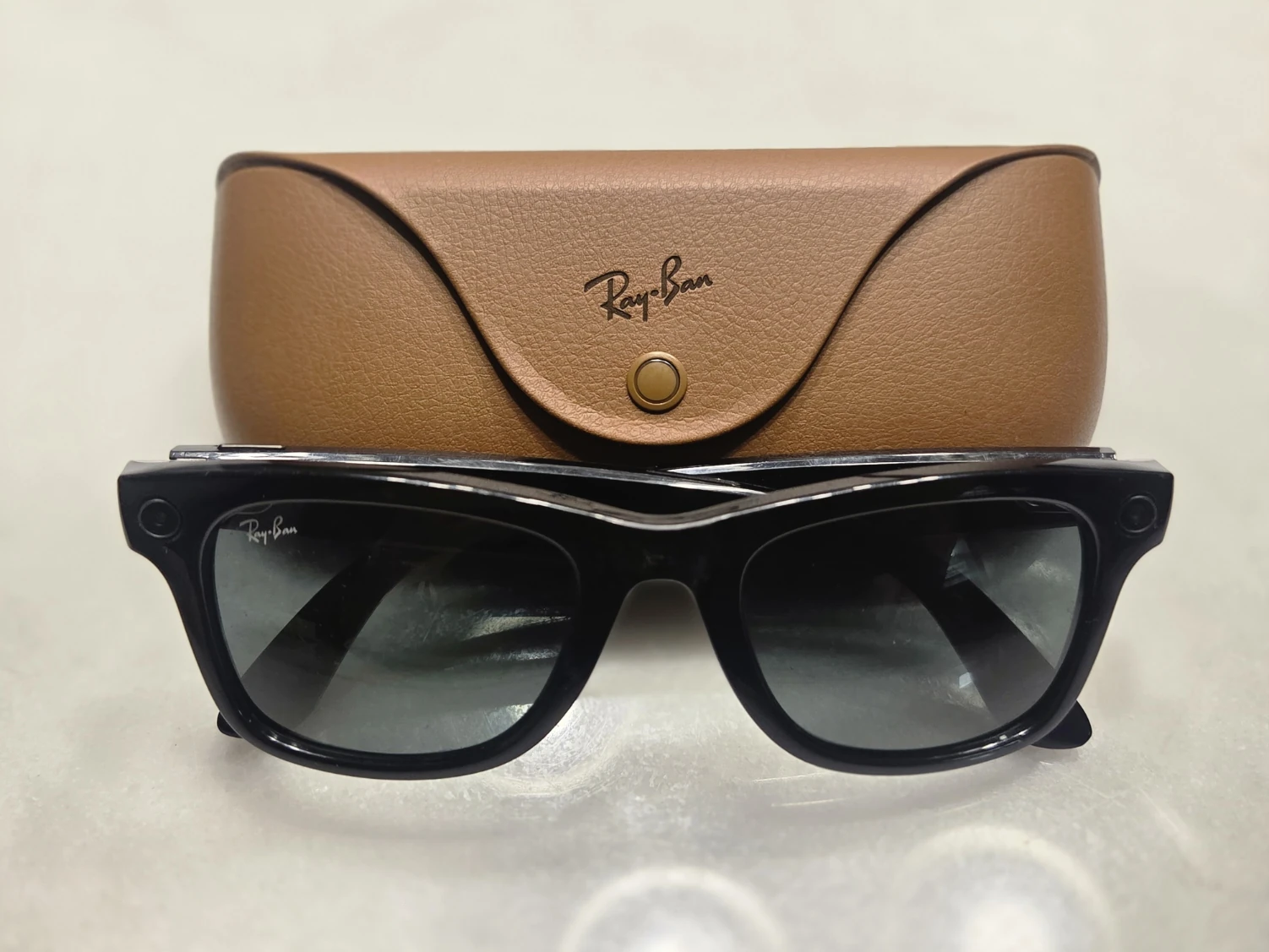
In the Korean market, display models are a different story. According to Digital Daily, Meta does not sell its display model in Korea, citing the impossibility of domestic radio certification for overseas purchases and the lack of service support in Korea. The Meta AI glasses currently sold in Korea have no screen in the lens. Samsung Electronics’ Intelligent Eyewear also has no display, and Newspim reported features that turn off the camera when the recording indicator is covered and when the glasses are taken off. This description is attributed to “the electronics industry,” and it is not stated in any official Samsung press release.
How Text Appears on an Eyeglass Lens
Glasses without a display see and hear through cameras and microphones and return answers as sound. To float text on a lens, the glasses need a device that forms the image and optics that carry that light to the eye.
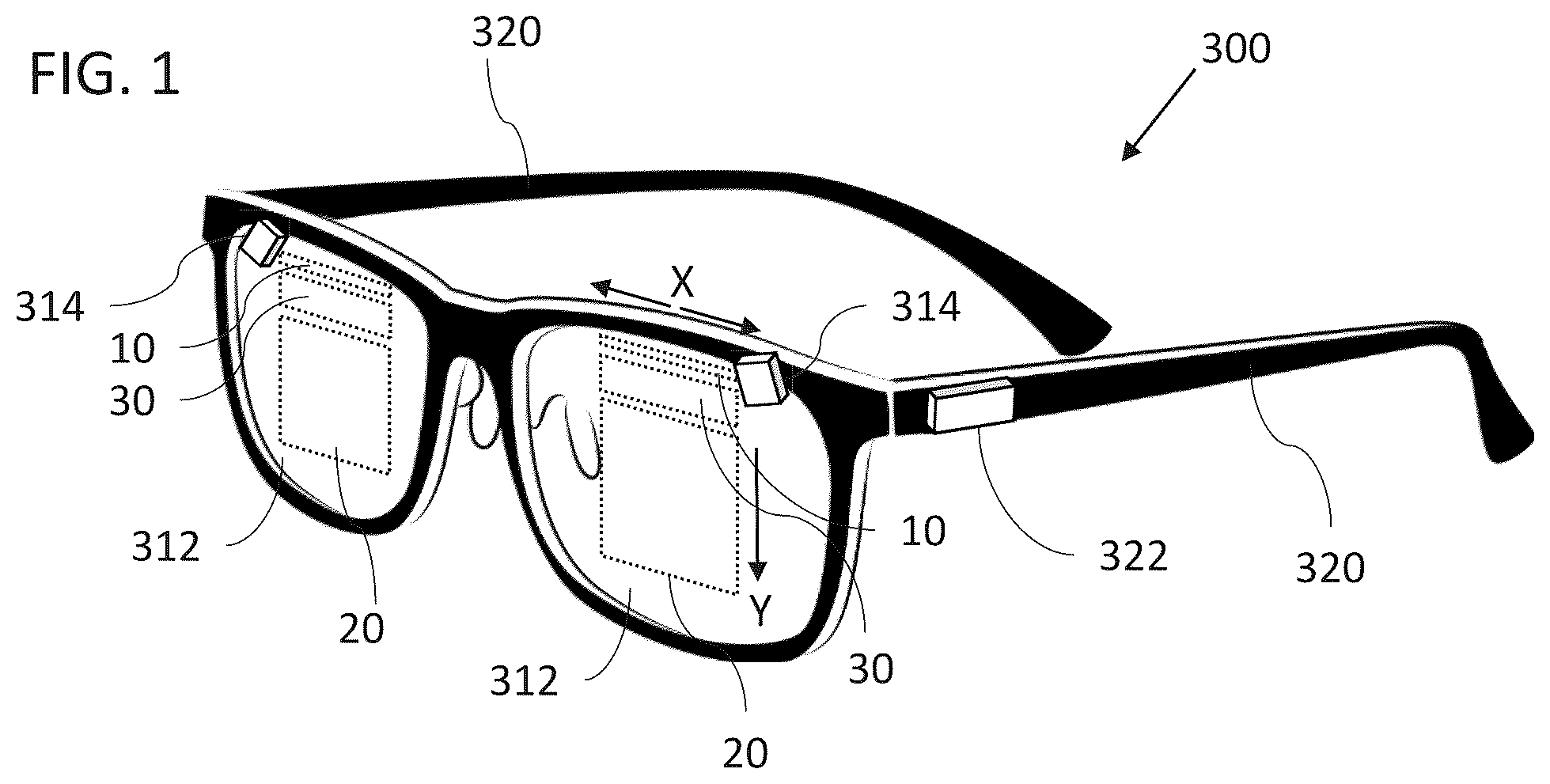
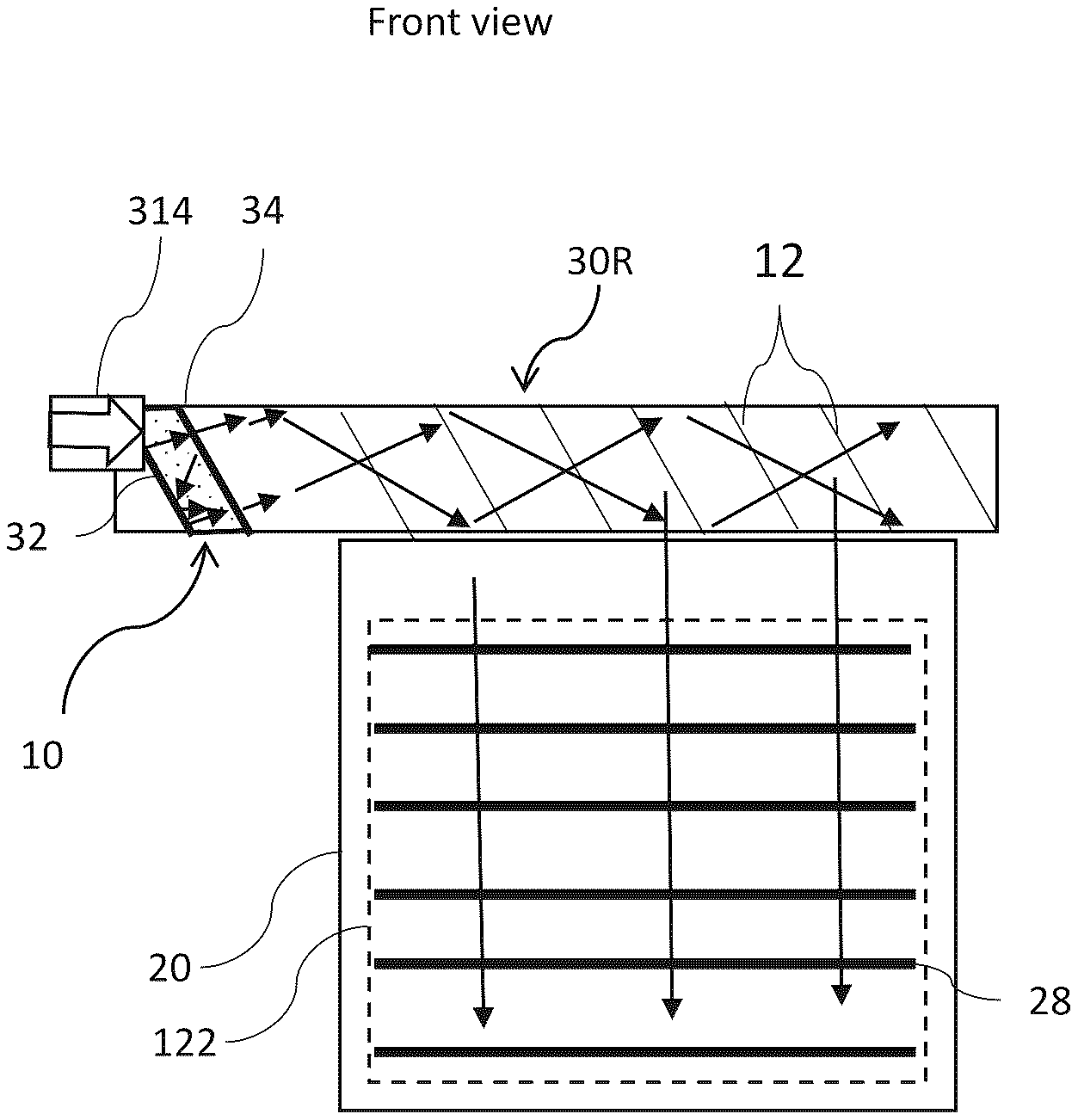
The principle of the published reflective waveguide approach is set out in Lumus’s patent US 12,352,974 B2. The specification describes an image projector producing a collimated image, in which the light from each pixel is a parallel beam. This light propagates inside a transparent light guide by repeated total internal reflection, and claim 1 specifies that the light is gradually coupled out toward the user via partially reflective coatings and partially reflective surfaces. SCHOTT’s description of the same approach states that an array of tiny mirrors sits inside the lens and directs light by controlled reflection rather than diffraction. SCHOTT announced in September 2025 that it had achieved serial production of this reflective waveguide and said it was jointly developed with Lumus. How collimated light forms an image in the eye is a general principle of optics, not a statement in the cited sources. Collimated light enters the eye like light from a distant object, so the text appears to float in front rather than on the lens surface.
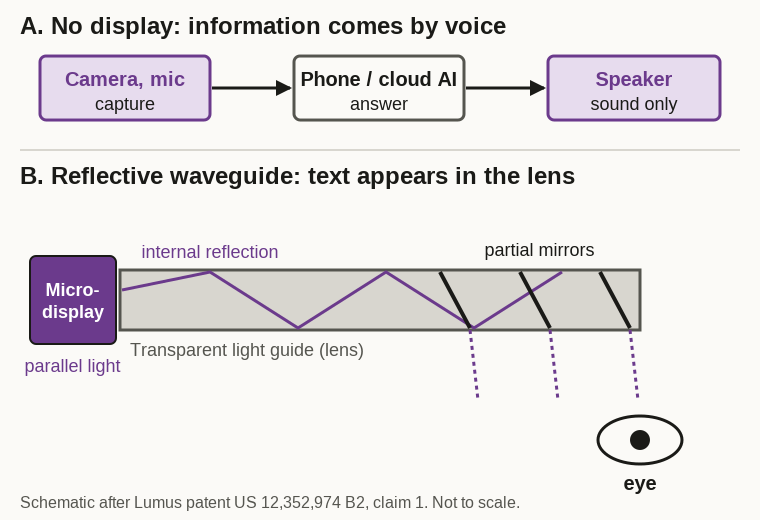
The image-forming devices also differ by approach. According to MicroLED-Info, Meta Ray-Ban Display uses a 5,000 nits LCoS (liquid crystal on silicon) panel in the right lens only, with a resolution of 600×600 and a field of view (FOV) of 20 degrees. Road to VR also gave a 0.36 MP (600×600) display and a 20° field of view; these figures are the outlets’ descriptions, not official specifications released by Meta. MicroLED-Info wrote that the waveguide is supplied by Lumus, while Road to VR wrote that SCHOTT likely made it together with Lumus and noted that Meta has not confirmed this. Some products use micro LEDs: LEDinside reported that Zhidongli’s Skynea binocular full-color waveguide glasses reach 1,500 nit with a micro LED light engine and weigh within 50 g, and that TOZO AIVU uses a monochrome green micro LED with a 30° field of view, 640×480 and up to 2,000 nit. All are company claims. In Segye Ilbo’s hands-on test of Rokid glasses, the solution steps and answers appeared in green on the waveguide.
There are also non-waveguide approaches. Counterpoint classifies video-centric AR glasses as typically using birdbath or flat prism lenses. According to VR/AR Wiki, a birdbath reflects light from a microdisplay off a beam splitter set at about 45 degrees toward a concave curved mirror, which sends part of the light back through the beam splitter to the eye. The wiki states that the components are thin plastic, so the design is cheap with good image quality, but light efficiency is low, ghost images and light leakage occur, and the lenses look like dark sunglasses. It names the Xreal Air series and Rokid Max as products using it and notes that XREAL switched to a flat prism from the XREAL One Pro onward. The XREAL One Pro product page lists a 0.55-inch Sony micro OLED and a 57° field of view. The wiki is a secondary source.
Comparison by Company
The table below summarizes each company’s display approach based on public sources.
| Company | Product | Display approach | Source |
|---|---|---|---|
| Meta | Ray-Ban Meta, Oakley Meta | No display, voice | ZDNet, Digital Daily |
| Meta | Meta Ray-Ban Display | LCoS 600×600, 20 degrees, right lens, reflective waveguide | MicroLED-Info, Road to VR |
| Samsung Electronics, Google | Intelligent Eyewear | No display | Counterpoint, TheElec |
| Rokid | Rokid Glasses | Camera and display, waveguide (answers shown in green) | Segye Ilbo, Counterpoint |
| Even Realities | G2 | Binocular micro LED display up to 1,200 cd/m², no camera or speaker, 36 g | Electronic Times, Omdia |
| Alibaba | Quark AI Glasses | Classified in the waveguide segment | Counterpoint |
| RayNeo, XREAL, VITURE | Video-centric AR glasses | Classified as birdbath or flat prism lens. XREAL One Pro uses a 0.55-inch Sony micro OLED | Counterpoint, XREAL |
| Vuzix | Ultralite Color (OEM reference platform) | Binocular full-color micro LED waveguide, under 40 g (company claim) | LEDinside |
| Zhidongli Skynea, TOZO | Binocular waveguide glasses, AIVU | Micro LED waveguide, full color or monochrome green | LEDinside |
In Korea, Meta launched Ray-Ban Meta (Gen 2) and Oakley Meta on May 25 starting at 690,000 won and does not sell the display model. Electronic Times reported that Even Realities has been selling the Even G2 with charging case on its Naver brand store since August for 1,099,000 won. Newsis listed Rokid at 440,000 won for the model without a display and up to 960,000 won for the display model, and XREAL in the 550,000 to 820,000 won range. Samsung’s glasses launch in Korea and the US on December 10.
Market share figures are not combined because the firms and categories differ. Counterpoint said AI glasses shipments in the first half of 2026 rose 263% year on year and that 96% were products without a display; display models grew 449% but account for 4% of the total. Meta held about 94% of the display-less segment, and Rokid, Even Realities, Alibaba and INMO were named as leaders in display models, without figures. Omdia counted Meta at 3.4M units (81.3%) out of 4.2M in the same period and second-place Even Realities at 102,000 units (2.4%), without disclosing its category definition. By optical approach, in Counterpoint’s tally of AR glasses for the second half of 2025, waveguides took 38%, and in the video-centric category RayNeo held 42% and XREAL 28%.
Next Step: Samsung’s Review of a Display and the 0.2-Inch Panel
Among reports that preceded this news, one provides background. TheElec wrote on September 9 that Samsung Electronics asked Samsung Display in August to develop a microdisplay for AI glasses, and that it is reportedly set to receive proposals for panels meeting its requirements, such as OLEDoS (OLED on silicon) or LEDoS (LED on silicon), and evaluate their performance and price. It said ultra-small panels of 0.2 inches or smaller to fit in the frame were under review, with launch expected in the second half of next year or the first half of 2028. The party making the request and the evaluation is Samsung Electronics; Samsung Display is the proposing side. An anonymous source in the same article said that RGB OLEDoS carries heavy price and yield burdens, so a realistic response is more likely to be white OLEDoS. All of this is at the level of press reports, with no official confirmation from Samsung. At AWE in June 2026, Samsung Display exhibited a 40,000-nit 1.3-inch RGB OLEDoS and prototype smart glasses using a 0.62-inch RGB OLEDoS; the prototype’s resolution and PPI, and whether it will be used in Samsung Electronics products, are not in the article.
What a size of 0.2 inches or smaller demands can be calculated from public figures. Assuming square pixels, pixel density (PPI) is the number of pixels along the diagonal divided by the diagonal length in inches, and pixel pitch in micrometers is 25,400 divided by PPI. The values below are this article’s calculations and not any company’s specifications.
| Resolution | 0.2-inch diagonal | 0.62-inch diagonal | 1.3-inch diagonal |
|---|---|---|---|
| 600×600 (Meta glasses resolution) | about 4,243 PPI, 5.99 µm | about 1,369 PPI, 18.6 µm | about 653 PPI, 38.9 µm |
| 640×480 | 4,000 PPI, 6.35 µm | about 1,290 PPI, 19.7 µm | about 615 PPI, 41.3 µm |
| 1280×720 | about 7,343 PPI, 3.46 µm | about 2,369 PPI, 10.7 µm | about 1,130 PPI, 22.5 µm |
Fitting the same 600×600 as Meta’s glasses into 0.2 inches requires about 4,200 PPI. Making the same resolution at the size of the 0.62-inch AWE prototype gives about 1,370 PPI, but the prototype’s actual resolution is not known, so this is an example based on size alone.
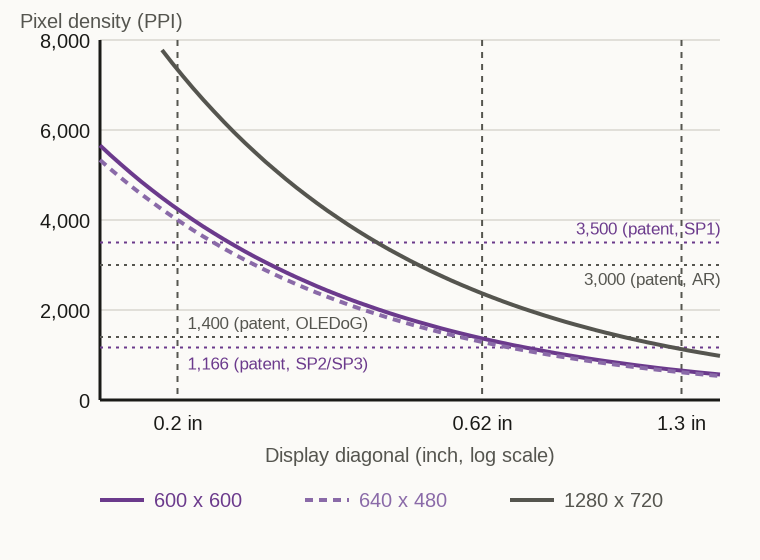
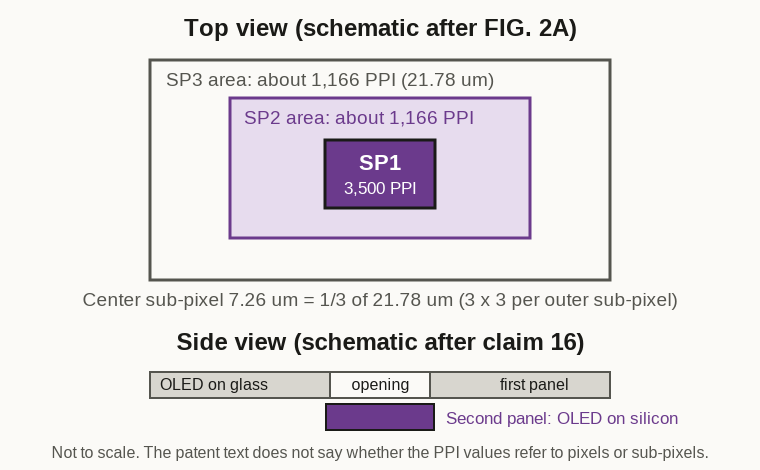
In its background section, LG Display’s patent US 2025/0151563 A1 writes that display devices for AR are small and may have high resolutions of 3,000 PPI or more, and states that it is difficult to make panels of 1,400 PPI or more with OLED on glass (OLEDoG). It also states that the price of AR display devices using OLEDoS is more than 10 times that of existing products. These statements are the applicant’s, not industry-standard values. To reduce that cost, the patent proposes a structure with small pixels of 3,500 PPI (7.26 µm) only in the center and large pixels of 1,166 PPI (21.78 µm) outside; because the ratio of the two pitches is exactly 3, three central pixels across and three down fit in the space of one outer pixel. The patent mentions both AR and VR but does not describe any connection to Samsung’s glasses.
Outlook
The variables that determine the cheating risk of AI glasses appear to be whether the lens has a display and whether the product is sold in Korea. The only direct evidence for this judgment is the two hands-on tests by ZDNet Korea and Segye Ilbo (0 for the display-less Ray-Ban Meta, 84 to 90 for Rokid Glasses with a display), but the two experiments differ in conditions, so no causal conclusion can be drawn. In Korea, Meta’s display model is not sold because of radio certification and service issues, and Samsung’s first glasses also have no display, but the Segye Ilbo test (a one-off experiment outside an exam hall) shows that questions can be solved with glasses that have a display.
Three things would show whether this judgment holds. First, how the cheating review committee rules on smart glasses cases and whether the Institute makes its criteria for identifying glasses more specific. Second, whether Meta’s display model obtains domestic radio certification and goes on sale. Third, whether Samsung officially discloses the panel size and resolution of glasses with a display. If any of these is confirmed, this article’s judgment will need revising.