iPhone Duo Foldable OLED Line Defect: Apple Replaces Screens but Discloses Neither Count nor Cause
Apple acknowledged the iPhone Duo inner screen problem three days after launch and began replacements, but has still not said how many units are affected or why. The two public hypotheses, from iFixit and ColorScale, both point to the center of the hinge, and neither is confirmed. We lay out where they diverge and what would settle it.
From October 26 to November 1, the issue the display industry covered most was the inner screen of the iPhone Duo. Reports kept coming in that Apple’s first foldable iPhone, released on October 23, developed lines along the fold or cracked screens.
This column last covered the iPhone Duo in the September 15 piece on creases. Again this time, we do not assert why the screens crack. We set out what the public statements say and what they do not, with names and dates attached, and explain the two hypotheses offered as causes with diagrams.
News the Press Covered, October 26 to November 1
First, Apple launched two new OLED products. On October 26 it unveiled the iPad mini. The screen is a 21.6-centimeter (8.5-inch) Super Retina XDR OLED with bezels 24 percent thinner, and the chip is the A20 Pro on a 2-nanometer process. On the 28th it released the MacBook Pro 14 and 16. They use PROLED XDR, a tandem OLED, and are the first Macs to support touch. The figures Apple gave are peak partial brightness of 2,000 nits, a contrast ratio of 10,000,000 to 1 and up to 24 hours of battery. Both products reach customers from November 6 (the iPad mini in some countries and regions), and Apple’s announcements do not name the panel supplier.
Second, Samsung Display disclosed its third-quarter results and Asan investment. Per the October 29 conference call, revenue was 8 trillion won and operating profit 1.1 trillion won. Compared with the same quarter a year earlier, revenue fell about 1.2 percent and operating profit 8.3 percent; compared with the previous quarter, they rose 6.7 percent and 57.1 percent, respectively. For 2027 the company expects “continued uncertainty and weak market demand.” On the 30th it announced that it will resume, after 5 years, construction of Asan Complex 2, halted in 2021. The plan is to break ground on the new fab (A7) early next year and complete it in 2028; the investment amount is not in the announcement.
Third, Seoul Semiconductor and Seoul Viosys announced they will mass-produce and supply white micro-LED chips that use no rare earths from the fourth quarter. According to the company, a 25×10-micrometer chip delivers 0.015 lumens, and first-production efficiency is close to 100 lumens per watt. The target is 200 lumens within 2 years. Customers and target products have not been disclosed.
Fourth, Samsung Electronics is buying Samsung Display’s stake in China’s CSOT. According to Seoul Economic Daily, Samsung Electronics disclosed on October 30 that it will buy, for 1.2718 trillion won, the entire 10.16 percent stake that Samsung Display received when it handed its Suzhou LCD fab to CSOT in 2020. The purpose Samsung Electronics disclosed is “strengthening strategic cooperation”, and the article attaches an industry reading that the aim is to reduce cost pressure on finished products that use LCD panels. The article does not say where Samsung Display will use the money.
Fifth, LG Display announced on October 28 that cumulative sales of its large WOLED (white OLED) panels have passed 50 million units. That comes 13 years after it began mass-producing 55-inch Full HD OLED TV panels in 2013. It passed a cumulative 10 million units in 2020, 20 million in 2021 and 30 million in 2023, and reached 40 million last year. This figure is cumulative sales since 2013, not this year’s annual sales or third-quarter shipments. For gaming monitors it supplies sizes from 24.5 inches to 45 inches.
The lead issue for October 26 to November 1 is the line defect on the iPhone Duo’s inner screen.
What Came Out Three Days After Launch Were User Reports
The iPhone Duo launched on October 23, at a Korean retail price of 3.29 million won for the 256-gigabyte model. Right after launch, posts appeared on overseas forums saying cracks had formed at the fold or white lines had appeared.
The Australian user’s claim reported by Yonhap News on October 26 was that the inner screen broke within 6 hours of receiving the phone, after fewer than 20 folds. The user described a catching sensation inside the hinge and a breaking sound, with no visible signs of impact. This is not a fact the article verified but a user account relayed by overseas media and a tipster.
One word needs attention here. Reports and user posts mix “crack” and “white line”. In its October 25 teardown article, iFixit wrote that the CT images show one row and one column of damaged pixels. It also noted that a local defect in a tiny electrical contact can affect an entire row or column. Cracked glass and a dead line of pixels may be different things. But iFixit offered this only as a possibility, and within what we checked through November 1, we found no public verification determining whether the lines are glass or contacts.
Apple Spoke of Acknowledgment and Replacement, Not Counts or Cause
Apple issued a statement on October 26 local time. As reported by 9to5Mac, Apple is “aware of an issue affecting the inner display on a small number of iPhone Duo units,” and users with display problems should contact AppleCare for a replacement. The article was timestamped 10:14 a.m. local time on the 26th, which is 2:14 a.m. on the 27th Korean time.
That AppleCare+ enrollment is not required is a statement added by the 9to5Mac author. In Korea, Joongang Economy News reported, “according to Apple and the industry”, that units qualify for replacement regardless of enrollment or purchase channel (unlocked or carrier), but gave no source. We could not confirm whether Apple stated these conditions in an official document. On October 31, Digital Daily pointed out that Apple Korea had not posted an apology or replacement criteria on its official channels.
Apple left two things unsaid: how many units are affected, and the cause. The statement’s “small number” is all there is, with no count or rate. The remark in 9to5Mac that AI-generated fakes are mixed into the Reddit cases is also the author’s statement, not Apple’s claim.
Out-of-warranty repair costs came from two places. 9to5Mac reported on October 14, citing the price list on Apple’s website, a US inner display repair cost of 999 dollars, and Apple noted that authorized service providers may set their own fees. In Korea, Yonhap News reported the inner main display repair cost announced by Apple as 1.649 million won. That is about half the price of a 3.29 million won device.
Deliveries are also delayed. Newspim reported that right after pre-orders, delivery dates on the official US and Korean stores slipped to January next year.
Statements on the Cause Are Either Anonymous or Possibilities
Here is who said what about the cause, and on what basis.
| Who | What they said | Nature of the basis |
|---|---|---|
| Apple | Nothing on the cause | The statement has no cause item |
| iFixit (October 25) | In a closing simulation of a 3D model built from teardown video, patents and CT images, offered “one possible answer”: the center support part does not drop far enough, so the folded screen can be pressed against it; left other possibilities such as cable damage open | Named · simulation · states itself that it is not confirmed |
| Teardown channel ColorScale (video “Will it break here?”) | Followed the order in which a deliberately back-bent device fails and explained that the hinge frame bent and pressed on the screen. Speculated that the same could happen if the gears had been misaligned from assembly | Named · one device · presented as speculation |
| Three industry sources (ZDNet, October 26) | Two cited different causes (design, assembly stage) and one did not claim a cause | Anonymous · contradictory |
| One teardown YouTuber (cited by Newspim, October 27) | Reportedly found a broken hinge part at the point where the crack starts | Unnamed · one device |
There are three named statements, and none of them confirms a cause. Apple said only “a small number”, and iFixit and ColorScale each offered one unconfirmed possibility.
Both Public Hypotheses Point to the Center of the Hinge
The hinge structure and the two hypotheses can be seen first in a DISPLAY NOW video (3 minutes). The text follows the same content across four diagrams.
iFixit and the teardown channels point to the same place: the center of the folding axis. iFixit matched reported damage locations against its 3D model and found that the damage concentrates near where the gap through which the display cable runs transitions to the center support. The diagram below is a schematic DISPLAY NOW drew from ColorScale’s 3D model and iFixit’s CT images. It does not reproduce actual dimensions or part layout.
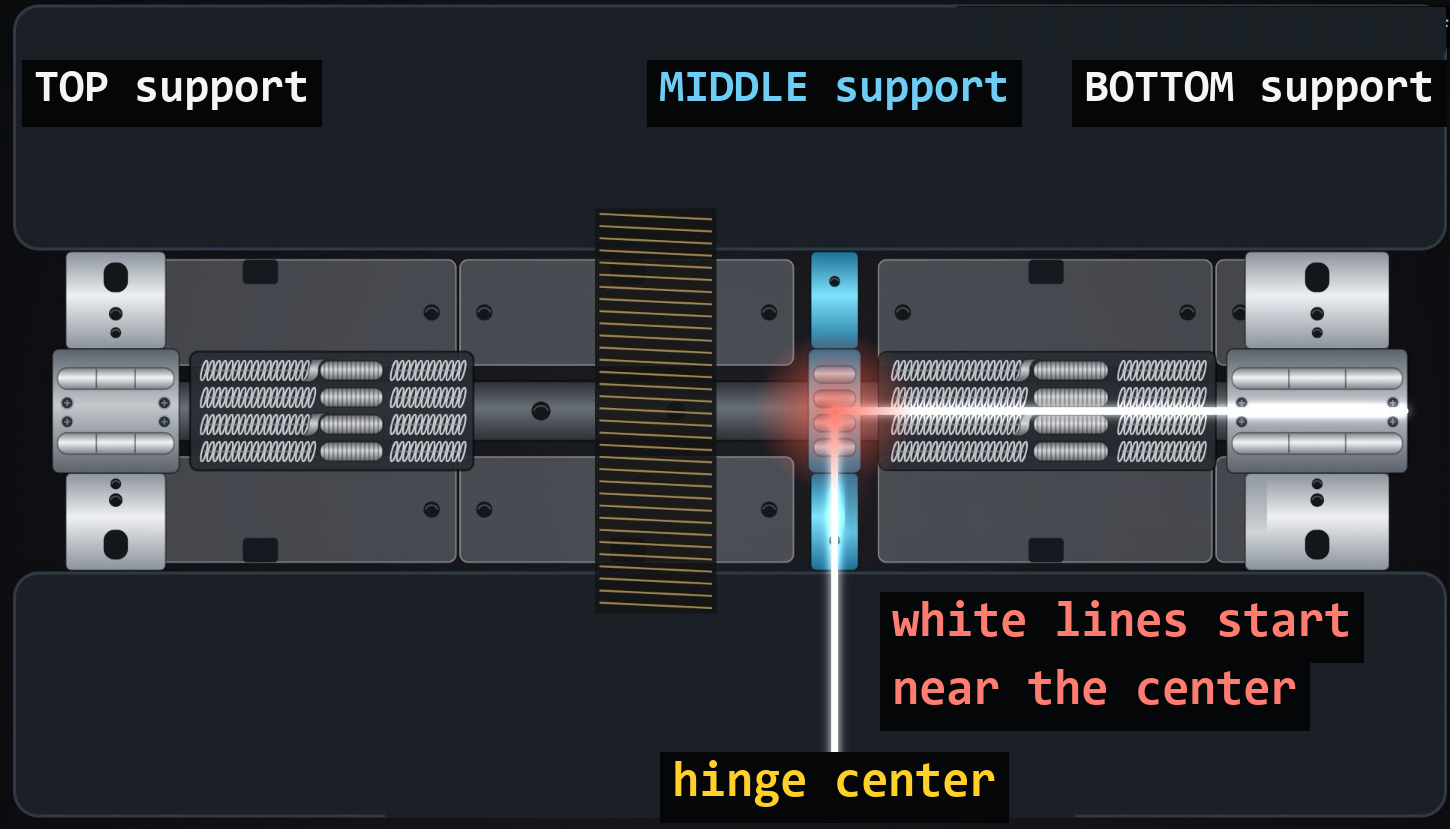
The first is iFixit’s hypothesis. The folded screen curls inside the hinge in a teardrop shape. iFixit suggested that if the center support does not drop far enough when closing, the folded screen can be pressed against it. This is “one possible answer” from a closing simulation of the 3D model, and iFixit left other possibilities such as cable damage open.
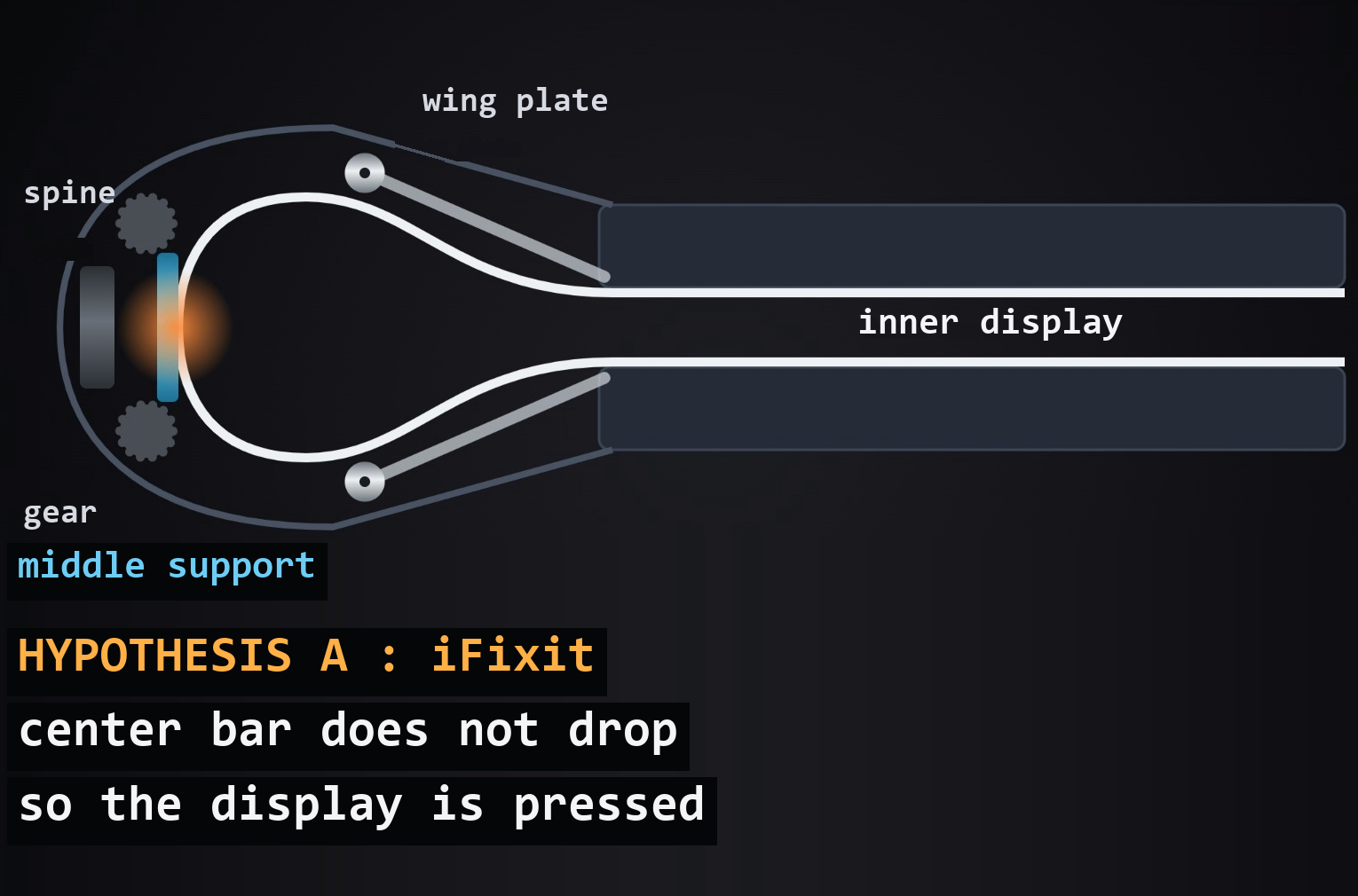
The second is ColorScale’s explanation. ColorScale traced the failure sequence based on the CuriousHagi channel’s teardown of a deliberately back-bent device. The explanation is that as only the lower side bends further back, the lower gear rotates further, leaving the upper and lower gears at different angles.
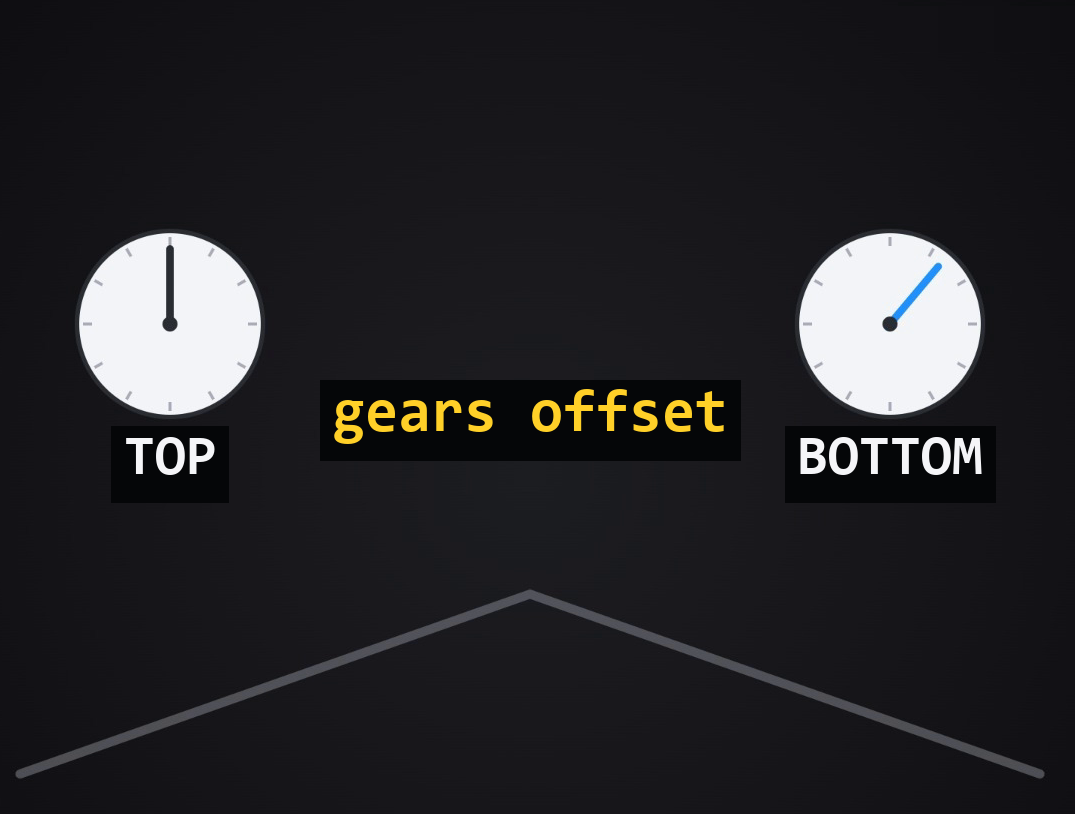
Folded in this state, the device catches in several places, and the spring mechanism that closes it falls out of step and does not close fully. The spring mechanism is the part that converts the spring’s pushing force into rotational force to close the screen at the last moment.
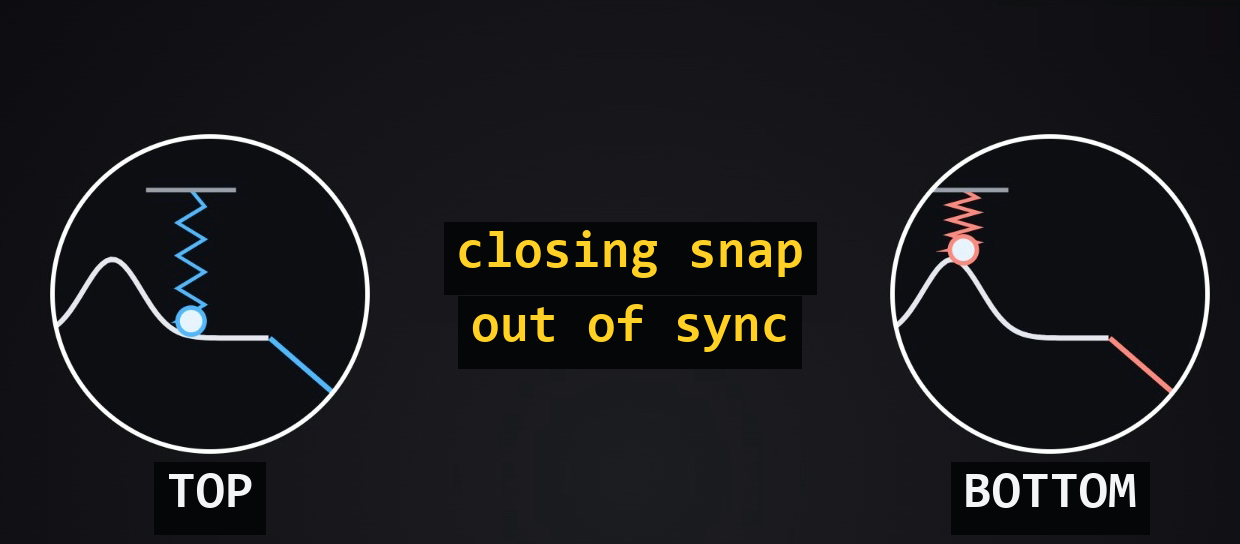
ColorScale speculated that devices that broke with a popping sound after only a few folds may have had gears misaligned from assembly, leading to the same thing. This is speculation, not a confirmed fact.
The two hypotheses do not confirm each other. One is a simulation inside a model, and the other is a sequence traced by tearing down a single deliberately bent device. The only overlap is that both point to the center of the hinge; which one is right, or whether neither is, has not been settled. Through November 1 we found no public verification of whether the sequence seen in the deliberately bent device was the same in the devices of users whose screens broke right after launch.
There Are Numbers but No Names
Numbers that suggest the scale of the problem have also appeared, but none has a named source. Newspim reported on October 27, “according to the smartphone industry”, that Apple asked to raise its 12-month shipment target from 9.7 million to 14 million units, an increase of about 44 percent. The reading that the added volume includes parts secured against assembly defects was attributed only to “the industry”. The statement that Foxconn’s final assembly yield in September was around 60 percent is only “reported”, with no source given.
Whether these numbers are right or wrong cannot be determined now. What is clear is that the two blanks, count and cause, are being filled by unnamed numbers and possibilities.
Outlook
Only one judgment can be made from what is public now. The fact that there is a problem and the promise to replace units are confirmed; why it happened and how many units are affected remain blank. The cause has not been disclosed. Whether this judgment is wrong can be told from the three things below.
First, whether Apple discloses a count or rate. Once the size of “a small number” is known, the weight of every hypothesis now in circulation changes at once.
Second, whether replacement conditions and out-of-warranty repair costs are set out in official documents. If a Korean policy document appears, it will settle whether the conditions relayed only “according to the industry” are true.
Third, whether an objective, technical verification of the cause is published. If teardown and inspection results come out under a name, the unnamed statements will be filtered out there.