
Y-OCTA: The LG Display Claim That Outlived Samsung Prior Art
Of the 7 patents LG Display asserted against Tianma, the only one Tianma tried to invalidate at the US Patent Office was a Y-OCTA structure patent. That patent was granted on the two lines left after Samsung prior art stripped away the rest, and when Tianma came back armed with Samsung documents again, its petition never reached a technical hearing. What shut the door was an ownership structure that brought AVIC in back in 2011.
1. Overview
1.1 Seven patents, and one of them
On June 13, 2025, LG Display sued China’s Tianma in the US District Court for the Eastern District of Texas. The complaint asserted 7 patents: 4 on LCD and 3 on OLED. The 4 LCD patents targeted panels in vehicle instrument clusters such as the Chevrolet Equinox EV and in the Motorola Moto G Stylus; the 3 OLED patents targeted panels in the Motorola edge+ and the Xiaomi 13T. The damages theory in the complaint also rested on automotive LCD. LG wrote that the two companies had gone head to head in 13 automotive panel bids between July 2022 and December 2024.
Yet of those 7 patents, Tianma took only one to the US Patent Office to challenge its validity. It was a patent (US11251394B2, hereafter ‘394) on the structure that places touch electrodes on top of thin-film encapsulation — the very structure Samsung Display first mass-produced in 2016 and the industry calls Y-OCTA.
In February 2026, the Director of the US Patent Office denied Tianma’s petition without looking at the technology, and in March explained why. Two months later, the two companies withdrew every suit they had pending against each other in the US.
Why that one patent, and why was it stopped at the door? This piece traces the path back through the patent texts and the litigation record. The conclusion comes first.
The Y-OCTA structure patent LG aimed at Tianma was granted on the two lines left after Samsung’s earlier filings had stripped away most of it. Tianma tried to break that patent with Samsung documents once again, but never got a hearing. What shut the door was an ownership structure that brought AVIC in back in 2011 — and that same stake was also the starting point of the two companies’ 10 years of license negotiations.
1.2 Scope of analysis
| Item | Value |
|---|---|
| Litigation record | The original Eastern District of Texas complaint (104 pages) and the dockets of both courts. The petition, decision, and both parties’ exhibits in PTAB case IPR2025-01579 (including 3 letters and a TOE patent list submitted by LG) |
| Patent texts | The asserted patent ‘394 and its prosecution history, the earliest documents claiming “touch on encapsulation” (Kodak, Samsung, Visionox, LG), and the 5 documents Tianma relied on as invalidity grounds |
| Counts | Granted patents found in a US Patent Office search whose claims contain “touch” or “input sensing” within 10 words of “encapsulation,” counted by company and by US filing year |
| Sample | Claim 1 of 24 LG Display US granted patents, read and classified by “where the novelty was placed” (Section 3.2) |
| PTAB | All 11 cases found by searching the party name “Tianma” |
1.3 Terminology
2. The principle is Y-OCTA, and Samsung built it and claimed it first
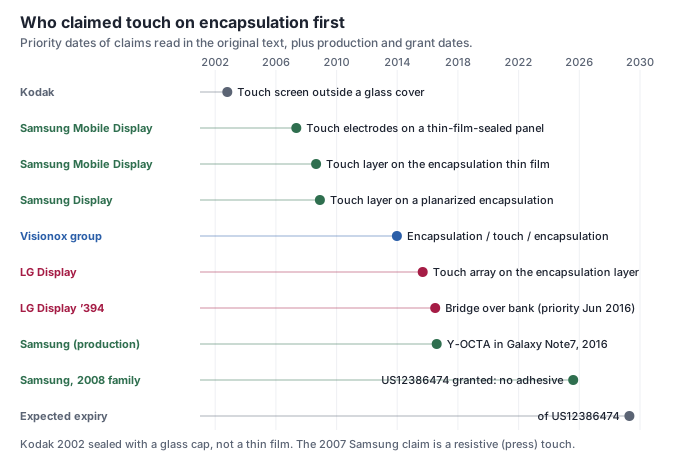
The first to claim “placing touch on top of the encapsulation thin film” was Samsung Mobile Display, in May 2007. That is 9 years before Samsung Display first mass-produced the structure in 2016.
2.1 Drop the film, build directly on the encapsulation
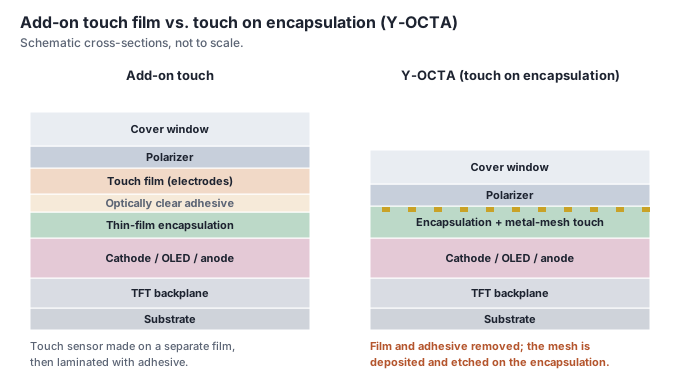
Earlier OLED phones built the touch function on a separate film and laminated it onto the panel. Y-OCTA eliminates that film and its adhesive layer, and forms metal-mesh electrodes — metal lines laid out like a net — directly on the thin-film encapsulation by deposition and etching. Fewer layers make it thinner and better suited to folding screens.
Samsung Display first put this structure into the Galaxy Note7 in 2016 (KIPOST). The industry headed toward the same goal under different names: LG Display’s TOE and BOE’s FMLOC.
2.2 The earliest claim dates to 2007
Kodak stands at the front of touch-on-encapsulation. A 2002 Kodak patent (US6879319B2) formed a touch screen on the outside of the glass cover sealing the OLED. The encapsulation was a glass cap, not a thin film.
The first claim to move to thin-film encapsulation is a Korean patent (KR100873080B1) filed by Samsung Mobile Display on May 10, 2007.
…a display panel including an encapsulation thin film sealing an organic electroluminescent element, and an external input device formed on the display panel to generate an electrical signal from an external touch, wherein the external input device includes an upper substrate having a third electrode formed on the display panel and a fourth electrode crossing it…
KR100873080B1 claim 1, translated from the Korean original (Samsung Mobile Display, filed 2007-05-10)This first claim is not today’s capacitive type but a resistive type, in which pressing brings two electrodes into contact. Still, it was here that the ground of “forming touch electrodes on a panel sealed with a thin film” was first staked out.
The following year Samsung filed two more. The August 2008 filing (US8237354B2) placed a first touch conductive layer directly on the encapsulation thin film, and the November 2008 filing (US9292118B2) laid a planarization layer over the encapsulation thin films and placed a touch conductive layer on that flat surface.
In China, the Visionox group (Kunshan New Flat Panel and Go-Visionox) stacked an encapsulation layer, a touch layer, and an encapsulation layer in sequence in a December 2013 filing (US10061416B2). Within the range this piece confirmed, LG Display first claimed touch on an encapsulation layer in September 2015 (Section 3).
2.3 A claim with a 2008 date, granted in 2025
Samsung’s November 2008 filing did not end there. It carried on through continuation applications to 9 grants in the US alone, and the last of them (US12386474B2) was granted on August 12, 2025. Its priority date is still November 28, 2008.
…a first thin film layer formed on the common electrode; a second thin film layer formed on the first thin film layer; an organic layer formed on the second thin film layer; and a touch sensor formed on the organic layer without any adhesive layer for adhering between the touch sensor and the organic layer…
US12386474B2 claim 1 (Samsung Display, priority 2008-11-28 / granted 2025-08-12)A touch sensor placed directly on the encapsulation without an adhesive layer — that is the gist of Y-OCTA. Google Patents estimates its expiration at April 2029. Samsung is still filing new claims in the 2020s, under a 2008 date, on a structure it mass-produced in 2016.
2.4 By the numbers
| US filing | ~2015 | 2016-17 | 2018-19 | 2020-21 | 2022~ | Total |
|---|---|---|---|---|---|---|
| Samsung (Samsung Display · Samsung Mobile Display) | 48 | 50 | 126 | 228 | 270 | 722 |
| LG Display | 4 | 38 | 100 | 128 | 206 | 476 |
Among patents filed in the US through 2015 and granted, Samsung has 48 and LG 4 — 12 times as many. In 2016-17 the gap narrowed to 50 versus 38, around the time Samsung mass-produced Y-OCTA and LG came in. Counted with the same search query, granted patents from Chinese companies number 186 for BOE, 98 for CSOT, 58 for Tianma, and 20 for Visionox.
3. LG came in in 2015
The first filing in LG Display’s own list of 1,603 TOE patents, submitted to the tribunal, is from September 2015. And where LG’s TOE patents placed their novelty was not “touch on encapsulation” itself but the layout, routing, and layer structure on top of it.
3.1 The starting point LG wrote down itself
LG Display submitted an exhibit to the PTAB titled “LG Display TOE Patent List” (EX2012). It lists 1,603 patents across 10 countries: 480 in the US, 397 in Korea, 317 in China, and 96 at the European Patent Office, in that order. 1,071 of them are granted.
The first line of the list is a Korean application filed on September 24, 2015 (10-2015-0135110). It is the only 2015 filing; the count grows to 66 in 2016 and 176 in 2017, and runs at 150-235 per year after that.
The earliest LG touch-on-encapsulation claim this piece found at the US Patent Office dates to the same month. A US patent (US9947727B2) with a Korean priority date of September 7, 2015 put “a touch electrode array on the encapsulation layer” into claim 1. That patent is not on LG’s list. Either way, LG’s starting point is September 2015 — 8 years after Samsung’s first claim.
3.2 Where LG’s TOE placed its novelty
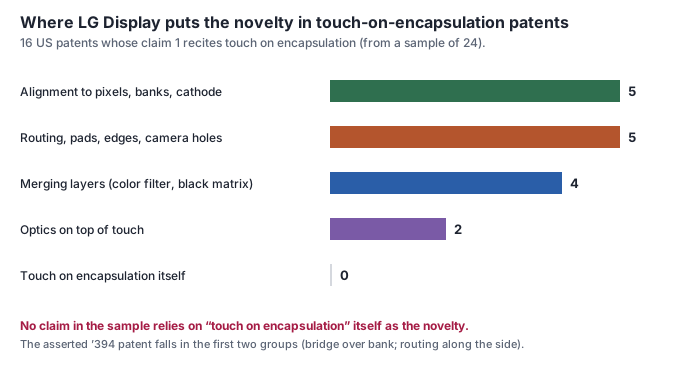
If the ground of the principle was already taken, what did the latecomer claim? We picked 6 LG US granted patents from each of four US filing-year bands (2016-17, 2018-19, 2020-21, 2022~), 24 in total, and read claim 1.
Of the 24, 16 had “touch on encapsulation” as an element of claim 1. The other 8 were caught by the search through a claim other than claim 1. We then sorted the 16 by what they newly limited in the characterizing portion after “wherein.”
| Where the novelty lies | Count | Examples |
|---|---|---|
| Layout aligned to pixels, banks, and cathode | 5 | Touch sensor and routing overlap the bank (US10877584B2, US10809829B2) · touch electrode over the cathode’s zigzag openings (US10996803B2) · bridge electrode on the bank (US12740195B2) |
| Routing, pads, edges, camera holes | 5 | Touch routing down the side of the encapsulation (US11903291B2, US12144226B2) · encapsulation layers meeting each other around a functional module such as a camera (US11449162B2) |
| Merging layers | 4 | Black matrix and color filter on the encapsulation covering touch lines (US11009976B2, the first line of LG’s list) · touch electrode coplanar with an insulating film inside the encapsulation (US10866663B2) |
| Optics on top of touch | 2 | A prism in each mesh opening (US12150364B2) · a lens layer (US12010868B2) |
Among the 16, no claim put forward “placing touch on the encapsulation” itself as the novelty. All of them took touch on encapsulation as a given and claimed what goes where on top of it. The asserted patent in Section 4 also spans the first category (layout overlapping the bank) and the second (routing along the side of the encapsulation).
4. ‘394: the two lines Samsung prior art left standing
The US examiner found that a single 2015 Samsung Display filing already contained every claim of LG’s application. What survived were two lines — “the bridge overlaps the bank” and “the routing runs along the side surface of the encapsulation” — and LG rewrote those two as independent claims to get the patent granted.
4.1 History of the asserted patent
The priority date of ‘394 is June 30, 2016 (Korea 10-2016-0083006). Two US patents claiming priority to the same Korean application (US10505142B2, US10727436B2) were granted first; ‘394 was filed again in June 2020 and granted on February 15, 2022. The complaint used claim 1 of this patent to target the Tianma OLED panel in the Motorola edge+.
4.2 What the examiner saw
Tianma summarized this prosecution history in its IPR petition.
During prosecution, the Examiner found that Kang651 anticipated all claims except two dependent claims.
IPR2025-01579 Tianma petition (Paper 1), p. 6 (citing Ex-1002, p. 148)Kang651 is a Samsung Display application with a September 30, 2015 priority date (US20170090651A1). The examiner found that this one document had everything: touch electrodes, bridges, two levels of conductive lines, the insulating film between them, the encapsulation unit, and touch pads. The two surviving dependent claims are these.
Claim 10 required the first or second bridges to overlap the banks and claim 19 required “the second conductive lines are disposed along a side surface of the encapsulation unit.” … Rewriting these claims into independent form led to allowance.
IPR2025-01579 Tianma petition (Paper 1), pp. 8-9Granted claim 1 of ‘394 lays out in sequence the touch sensor on the encapsulation unit, the bridges, the two levels of conductive lines and insulating film, and the bank exposing the anode, then attaches this one line at the end.
…wherein at least one of the first bridges or the second bridges overlaps the bank.
US11251394B2 claim 1, characterizing portion (LG Display)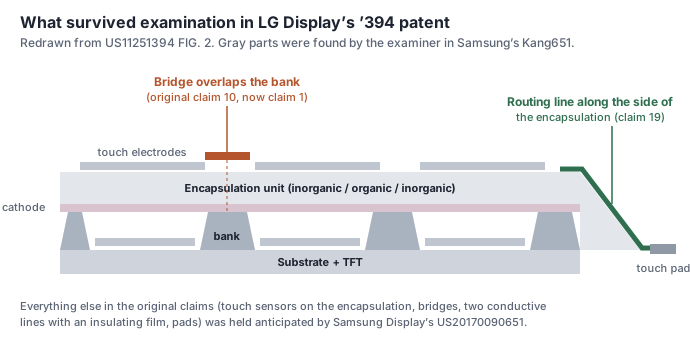
4.3 Why put the bridge on the bank
The specification gives the reason for that one line.
The first bridge … is disposed so as to overlap the bank … and, thus, lowering of an aperture ratio due to the first bridges … can be prevented.
US11251394B2 specificationA bridge is a span that crosses to another layer to connect touch electrodes. Whether metal or transparent electrode, it blocks some light. Placing this span on the dam that emits no light — the bank — keeps it from cutting screen brightness. As pixels get denser, banks get narrower, and the span more easily sticks out past the dam.
4.4 Samsung documents LG listed itself
‘394 has 30 prior patents of record. Of those, 12 are Samsung documents (including Samsung Mobile Display). LG itself listed 8 of them when filing, and the examiner added 4. Those LG listed itself include Samsung’s November 2008 filing from Section 2 (US9292118B2) and a Chinese filing by Samsung Mobile Display from August of the same year (CN101661949A). One of the 4 the examiner added is Kang651 from Section 4.2.
LG knew the Samsung documents holding the principle, and claimed the ground that avoided them.
5. Why Tianma couldn’t defend with prior art
Of the 5 documents Tianma relied on to break ‘394, 3 name Samsung on their face and 1 more appears to be from the Samsung family. But the stage on which to argue them never opened. The Director of the US Patent Office established, for the first time, the rule that “a foreign government cannot petition for IPR,” and shut the door on the grounds of Tianma’s shareholder AVIC.
5.1 The weapons were Samsung’s too
Defending with prior art means showing that “the invention already existed.” But two lines remained that the examiner had kept alive even after seeing Samsung documents. So Tianma chose a combination argument — not “it is all in one document” but “combining this and that would have made it obvious.” The petition filed on October 23, 2025 (IPR2025-01579) had five grounds.
| Ground | References | Applicant | Priority date | Claims targeted |
|---|---|---|---|---|
| 1 | Kwon224 + Kim524 | Samsung Display + Samsung Display | 2015-06 · 2014-12 | 1-4, 6-8 |
| 2 | The above two + Zhu837 | + Kunshan/Visionox group | 9-16, 18 | |
| 3 | The above two + Jang513 | + No applicant on the publication (inventor Jang) | 2012-04 | 5 |
| 4 | The above two + Kim481 | + Samsung Mobile Display | 2010-09 | 17 |
| 5 | Kim481 + Kim524 | Samsung Mobile Display + Samsung Display | 19 |
Of the five documents, three list Samsung as the applicant on their face. Jang513’s publication lists no applicant (assignee). With an inventor based in Yongin and a subject of “mesh-type sensing electrodes on an encapsulation thin film,” it appears to be a Samsung-family document, but this piece could not confirm that. The petition also submitted Kang651, which the examiner had used, as a separate exhibit. Kim481’s abstract opens with “an integrated touch screen panel formed directly on an encapsulation thin film.” The material used to attack LG’s patent was also Samsung’s prior art.
5.2 The Patent Office door and the court door
In the US there are two ways to challenge the validity of a granted patent (general law).
| Path | Who decides | Standard of proof |
|---|---|---|
| Patent Office IPR | Administrative judges with technical training | Preponderance of the evidence: “more likely than not” is enough |
| Invalidity defense within an infringement suit | Jury | Clear and convincing evidence: a granted patent is presumed valid |
That is why defendants look to IPR first. And on December 30, 2025, LG Display filed a request for “discretionary denial” asking that this first door be shut (Paper 7).
5.3 “An issue of first impression”
Patent Office Director John A. Squires denied institution on February 18, 2026 (Paper 11), and on March 18 issued a decision giving the reasons (Paper 12). The Patent Office announced the same day that it had designated the decision as precedential.
The decision itself describes this as an issue being addressed for the first time.
Before turning to the RPI issue, I address an issue of first impression: whether the U.S. Supreme Court’s decision in Return Mail, Inc. v. United States Postal Service, … (2019) applies to a foreign government just as it applies to the U.S. Government.
IPR2025-01579 Paper 12, p. 3In Return Mail in 2019, the US Supreme Court held that a US federal agency is not a “person” under the patent statute and therefore cannot petition for IPR. The Director extended that to foreign governments.
Based on Return Mail and cases applying the term “person” to foreign governments, a foreign government is not a “person” under the AIA, and therefore is not permitted to seek review of a patent before the Office as a petitioner in AIA proceedings.
IPR2025-01579 Paper 12, p. 4Then came the facts. LG pointed out that Tianma’s own court disclosures listed AVIC Innovation as a shareholder holding “10% or more” of Tianma, and that AVIC (Aviation Industry Corporation of China) is owned by the Chinese government and on the US Commerce Department’s export control list. The decision assessed Tianma’s rebuttal this way.
…Petitioner does not provide any documents clarifying its relationship with AVIC, such as documents describing the rights attendant to AVIC’s shares. Instead, Petitioner submits a conclusory declaration that simply states that none of the entities Patent Owner identifies funded, controlled, or directed the IPR, or had the ability to control the IPR.
IPR2025-01579 Paper 12The decision also recounted LG’s argument that, treating the export-controlled companies and Tianma as a single bloc, they would rank in the top 10 for IPR petitions filed in 2019-2024. The decision did not address the technical content of ‘394 in a single line.
5.4 What changed was the law, not Tianma
A PTAB search for the party name “Tianma” returns 11 cases. Of those, 9 are IPRs Tianma filed against Japan Display (JDI) patents.
| When | Cases | Outcome |
|---|---|---|
| April 2016 | Tianma → JDI, 2 | Reached final written decisions |
| June-July 2021 | Tianma → JDI, 7 | 5 terminated by settlement · 2 institution denied |
| October 2025 | Tianma → LG, 1 (‘394) | Institution denied under the foreign-government rule |
| February 2026 | LG → Tianma, 1 (PGR, US12,293,691) | Terminated by settlement, June 2026 |
AVIC had been inside the ownership structure on Tianma’s side since 2011 (Section 6). With that stake in place, Tianma filed IPRs in 2016 and 2021, and the two 2016 cases were heard to the end. What changed in 2026 was not Tianma but the Patent Office’s law. LG’s request for discretionary denial pinpointed exactly the place where that new rule would first be applied.
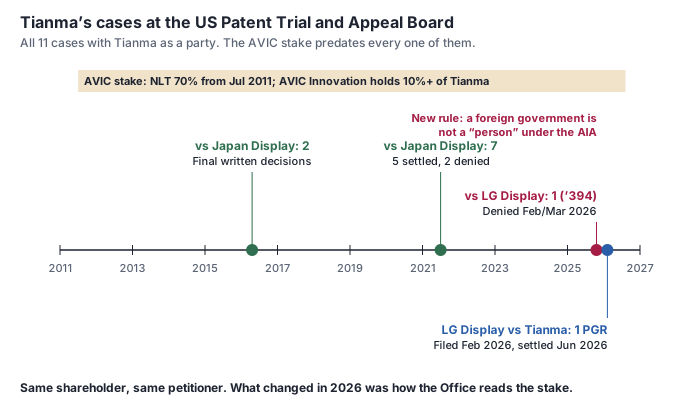
LG, too, filed a post-grant review (PGR) against a Tianma patent (US12,293,691) in February 2026. It appears related to the countersuit Tianma filed in the Western District of Texas in December 2025, but the original complaint was not checked. This petition ended in a settlement in June.
6. 10 years of negotiation, from LCD to OLED
The AVIC stake that blocked the 2026 IPR was already spelled out in a 2011 letter from Tianma’s side to LG. The two companies’ negotiations began with an LCD license and only moved to OLED in 2021.
Below is the history LG Display presented in its complaint (paragraphs 45-75) and in its PTAB exhibits.
| When | What happened |
|---|---|
| April 2001 | LG Display (then LG.Philips LCD) and NEC cross-license LCD patents. LG’s US annual report (20-F) also lists the cross-license with NEC |
| February 2011 | NEC, AVIC, and Tianma announce a capital alliance in small and medium LCD |
| July 2011 | NEC transfers a 70% stake in its LCD subsidiary to AVIC, launching NLT Technologies. Having lost the “subsidiary (over 50% ownership)” requirement, the 2001 license did not carry over |
| September 2011 | NLT letter to LG: “We are now a joint venture of AVIC 70% and NEC 30%, so please continue the license” (EX2002) |
| 2011-2015 | 4 rounds of face-to-face negotiation between LG and NLT. Settled on “Tianma controls NLT, so sign with Tianma first” |
| 2015 | First meeting in Shanghai in July; claim charts on 11 US TFT-LCD patents sent in October |
| 2016-2018 | After 4 meetings, Tianma’s point of contact leaves; starting over from scratch with the successor. 46 more patents notified in 2017. The successor also leaves in 2018 |
| October 2020 | Letter addressed to Tianma’s CEO, with claim charts on the Xiaomi Redmi Note8 panel attached (EX2004) |
| 2021 | “Tianma acknowledged the need for a license but made no counteroffer.” On October 29, OLED appears for the first time in a list of more than 150 patents (asserted patents ‘493 and ‘388, plus the two parent applications of ‘394) |
| 2023-2024 | After 14 meetings, talks halt in February 2024 when a counteroffer is rejected. In August, Tianma sends LG’s China subsidiary a warning letter: “take a license to Tianma’s patents” |
| 2025 | Suit filed in June. LG wrote that “for nearly 10 years it gave notice of infringement of at least 237 US patents” |
| 2026 | IPR denied in February and March; joint dismissal filed May 22; cases closed May 26 (Western District) and May 28 (Eastern District) |
The 2015 and 2020 letters covered TN and IPS LCD, in-cell touch, and LTPS patents. The words Y-OCTA structure or TOE never appear even once in either letter. The ‘394 family is first confirmed on the negotiating table in the October 2021 “list of patents related to mobile OLED products.” ‘394 itself was granted three and a half months after that.
The starting point of the negotiation and the outcome of the IPR are tied to the same ownership structure. When NEC’s stake passed to AVIC in 2011, the 2001 license was cut off — and because of that very stake, Tianma was turned away at the Patent Office door in 2026.
7. Why doesn’t Samsung sue LG?
If Samsung holds the principle, what about LG’s TOE panels? This is as far as public materials answer that question.
The two companies fought once in a big way. According to LG Display’s annual report, in September 2012 LG sued Samsung Display and Samsung Electronics for OLED patent infringement, Samsung Display sued LG for leaking OLED trade secrets, and in December Samsung Display sued LG on LCD patents. Each side also filed invalidity actions against the other’s patents. In February 2013 they agreed in principle under government mediation, and in September 2013 withdrew all suits and invalidity actions.
After that, foreign media citing Korean reports said that cross-license talks broke down in June 2014 — Samsung wanted one and LG was not interested. The cross-license partners LG Display names in its annual report are Hitachi, HannStar, Hydis, NEC, and AUO; Samsung is not among them. However, the report also says it “has entered into such agreements with other third parties,” so it cannot be concluded that no license exists.
Today both companies point their blades not at each other but at China. Samsung Display took BOE-related OLED panels to the US International Trade Commission in December 2022 and settled in November 2025. LG sued Tianma. In 2025 there were also reports that LG transferred LCD patents to Samsung Display, assisting Samsung’s suits against BOE and CSOT.
8. What this analysis does not say
- Settlement terms. The court record shows only the joint dismissal and closure. Who paid whom and how much has not been disclosed
- Whether Tianma’s panels actually infringed ‘394. The court closed the case before ruling. The Patent Office did not look at the technology either
- Any current license between Samsung and LG. It cannot be confirmed from disclosures
- The technical content of the other 6 asserted patents. This piece noted only their titles and the products they targeted
- Representativeness of the LG sample. The 24 patents are the most recently published in each band, and Samsung patents were not classified the same way
- The path from Samsung’s first claim to mass-production technology. The 2007 first claim is resistive. Which patent the 2016 Y-OCTA practiced cannot be determined from patent documents alone
- The other side of the negotiation story. Section 6 is LG’s account
9. Conclusion
The idea of putting touch on top of the encapsulation film was claimed first by Samsung in 2007 and mass-produced first by Samsung in 2016. A Samsung-family patent bearing a 2008 date was newly granted as recently as 2025, on “a touch sensor without an adhesive layer.”
LG Display entered the field in September 2015, and instead of the principle claimed the layout, routing, and layer structure on top of it in more than 1,600 patents. ‘394, aimed at Tianma, was one such patent. The examiner stripped away everything else with a single Samsung document and left only “the bridge overlaps the bank” and “the routing runs along the side surface of the encapsulation.”
Tianma tried to break those two lines with Samsung documents again. But the US Patent Office shut the door before looking at the technology, with a rule it established for the first time. It was the same door Tianma had walked through against JDI in 2016 and 2021. What changed was not the AVIC stake, unchanged since 2011, but the law that reads that stake.
This decision has been designated precedential. Any panel maker with Chinese state ownership that wants to challenge a Korean patent by IPR in the US will have to pass the same question first. In this lawsuit, the place for a technical fight never opened — and had it opened, the documents laid on that table would have been Samsung’s.