Quantum Dot Color Conversion Layers: 316 Patents
A quantum dot top plate over a blue OLED is a bundle of techniques for stopping light that leaks in three directions. Yet of the 13 top-plate patents Samsung Display filed with priority dates up to 2016, 10 were written against an LCD background, and none of their independent claims mentions liquid crystal. Even now, only 6 of its 188 structure and process patents narrow the light source to organic emission. The part was designed to be indifferent to its light source.
1. Overview
1.1 A color-changing layer laid over blue
The panel Samsung Display sells under the name QD-OLED can be described in one line. Every subpixel lights the same blue OLED, and only above the red and green subpixels do quantum dots absorb that blue and convert it to longer wavelengths. Above the blue subpixel sits a layer with no quantum dots that lets the light straight through. This piece covers the patents that claim that upper part, the quantum dot color conversion layer.
The idea is not new. The independent claim of US5294870A, filed by Kodak on December 30, 1991, put it this way. The organic EL medium emits blue with a peak below 480nm, one pixel is divided into subpixels, and a fluorescent medium that absorbs blue and emits a longer wavelength is placed in only one subpixel.
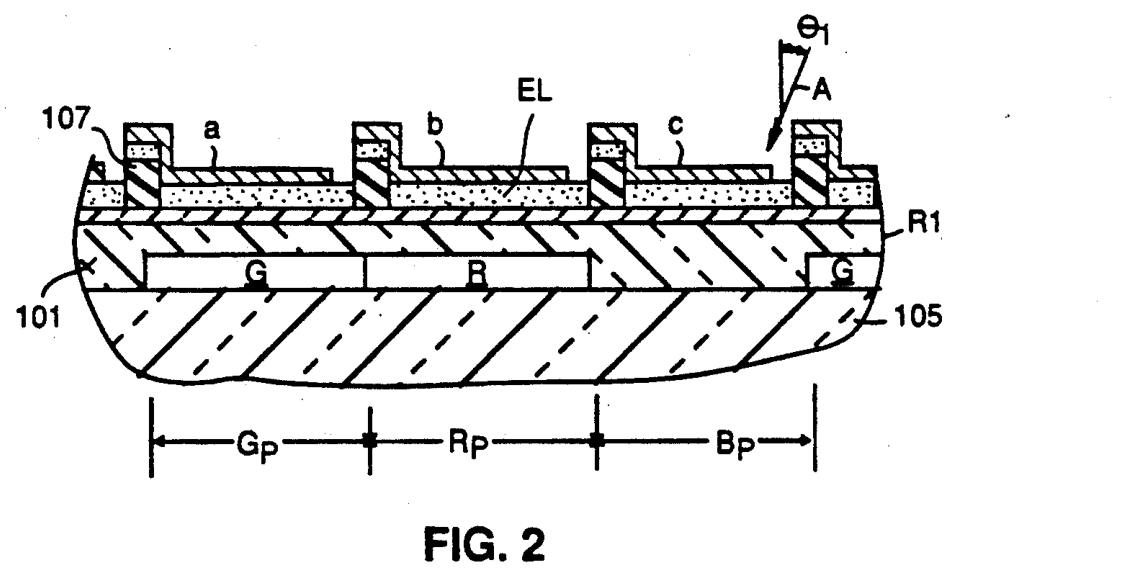
The body of the specification says the same thing today’s structure does.
The pixels emitting green and red also use the same blue-emitting organic EL medium as the blue subpixel.
And there is one more sentence. Arguing that a spin-coated planarizing layer is better than a rigid plate inserted to planarize over the fluorescent media, it gave the reason as “because the upper surface of the fluorescent medium can be placed closer to the newly created plane.” Kodak wrote this down as a reason about the planarization process, not as a matter of light. But how far apart the emitting layer and the color-changing layer sit comes back in Section 2 as a matter of light.
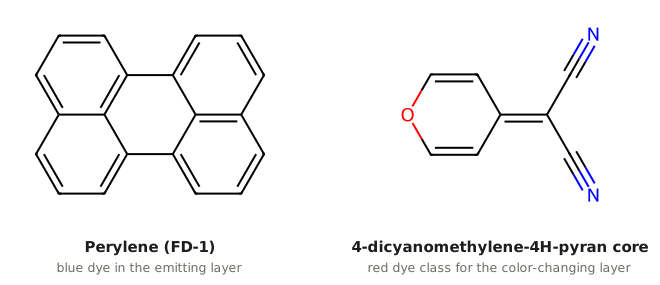
Kodak also named its materials. For the blue-emitting layer it doped a blue fluorescent dye such as perylene (FD-1) into an aluminum chelate host, and as a concrete example of the medium converting to red it gave fluorescent dyes of the 4-dicyanomethylene-4H-pyran class. For green it only referred to another patent, so that side is not drawn in this piece.
In 1996 NEC patented a structure with a color conversion medium placed over an organic EL (US5717289A). The rights to these two originators split and went to two Korean companies.
| Originating patent | Movement of rights (US assignment records) | Expiry |
|---|---|---|
| Kodak US5294870A (1991) | Assigned to Global OLED Technology on 2010-02-26. A company set up in 2009 when LG acquired Kodak’s OLED business, 65% owned by LG Display | 2011-12-30 |
| NEC US5717289A (1996) | 2004-03-26 Samsung SDI → 2008-12-15 Samsung Mobile Display → 2012-08-29 Samsung Display (merger) | 2017-01-29 |
Samsung Display first shipped QD-OLED at the end of 2021. Both originators had already ended before that.
1.2 Scope
| Item | Value |
|---|---|
| Data | Google Patents originals of US granted patents (independent claims, legal status, assignment records), collected 2026-09-13 |
| Population | Union of 15 search queries, 1,459 patents |
| First screen | 425 whose independent claims actually contain quantum dots, wavelength conversion or color conversion |
| Excluded | Self-emissive devices in which the quantum dots are the emitting layer itself, quantum dot films for liquid crystal backlights, claims specific to nanorod or micro LEDs |
| Analyzed | 316 |
| Read in full | 29 |
| Background re-judged | 120 Samsung Display structure patents (every one read by a person) |
1.3 Why they are not called “QD-OLED patents”
Going through the independent claims of the 316 one by one, only 26 patents limit every independent claim to an organic light-emitting device. The remaining 289 have at least one independent claim that names no light source. Terms the specifications use, such as color conversion substrate and wavelength conversion pattern, are used in exactly the same way over a blue OLED, over liquid crystal and over a nanorod LED. So this piece names them not by product but by what they claim.
2. Light leaks three ways
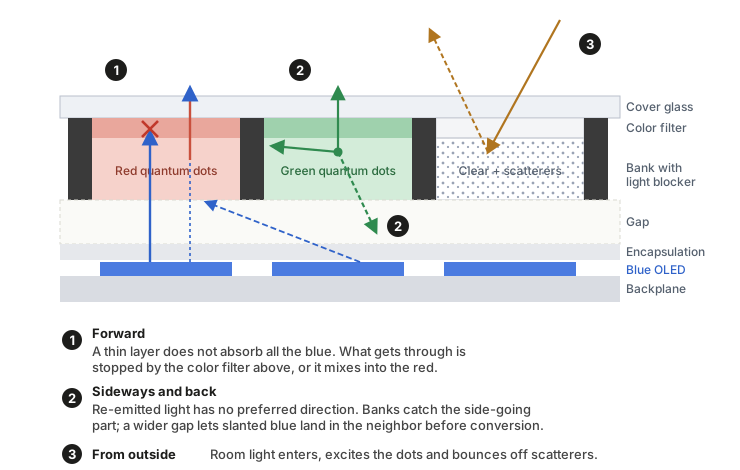
Each specification wrote down in its own way the problem a quantum dot color conversion layer has to solve. Gathered together, they come down to three directions in which light leaks.
2.1 Forward: unconverted blue comes straight out
A quantum dot layer has a limited thickness. Limited thickness means limited absorption.
A quantum dot pattern of limited thickness also has a limited absorption rate for excitation light (e.g., blue light), and blue light that is neither absorbed nor converted exits the pattern as mixed-color light.
US11060019B2 · Samsung ElectronicsThe first countermeasure to appear was placing one more color filter layer over the quantum dot layer.
With the color filter layer located between the substrate and the color conversion layer, it effectively prevents part of the blue light the quantum dots fail to convert from being seen from outside.
US9703191B2 · Samsung DisplayThe second countermeasure is lengthening the path light travels through the quantum dot layer. QD Vision’s 2007 patent US8759850B2 called the scatterers placed among the color conversion material “scatterers used to increase the absorption path.”
2.2 Sideways and back: converted light has no direction
The light a quantum dot re-emits after absorbing blue does not remember the direction of the light that came in.
Light emitted from quantum dots has low directivity, so a considerable amount of the light whose color the quantum dots converted also travels toward the light-emitting element and does not contribute to display.
US12057531B2 · Semiconductor Energy LaboratoryLight that goes sideways comes out of the neighboring subpixel.
When light emitted by the wavelength conversion material travels to a neighboring pixel, a light leakage defect, in which light leaks from an unintended pixel, can occur.
US10048530B1 · Samsung DisplayThis is where distance comes in. Blue leaving a blue OLED at a slant moves sideways before it reaches the quantum dot layer, and the farther away the quantum dot layer is, the farther it travels. Samsung Electronics’ US11271050B2 compared the two ways of placing the top plate directly on this criterion.
If the quantum dot color conversion layer is patterned directly on a thin-film-encapsulated OLED, its photoluminescence properties can degrade on exposure to the ordinary environment, so additional encapsulation is needed and the process becomes complicated. If it is formed on a separate glass substrate and bonded, using two substrates raises cost, and the distance between the OLED and the quantum dot color conversion layer grows, which can cause color mixing.
US11271050B2 · Samsung ElectronicsHow much mixes is not set by distance alone. Subpixel pitch and aperture ratio move with it. The simulator below calculates with those three and nothing else.
2.3 From outside: the light in the room comes in
The last is light coming in from outside. Quantum dots do not pick out and absorb only the blue OLED’s light. They respond to room lighting too, and scatterers send incoming light back out.
Outdoors, where there is much ambient light such as external light, the display device is hard to use because of optical problems such as reflection and scattering.
US11054690B2 · Samsung Display2.4 The countermeasures collide
The countermeasures for the three directions do not work independently. Block one side and another opens. The specifications wrote down that collision themselves.
- Scatterers reduce the blue leaking forward but send back light coming in from outside. “Because scatterers reflect external light and lower the contrast ratio, a blue pigment can be put in the transmissive layer” (US10712606B2)
- So patents appear that aim to cut down on scatterers. “If the light path is lengthened, the light scattering agent can be reduced or eliminated, raising transmittance and removing the external light reflection problem” (US10707275B2), “Recycling light makes it possible to reduce light scattering agents such as TiO₂ used to lengthen the light path” (US12317721B2)
- Making the top plate separately protects the quantum dots but increases the distance; building it on directly reduces the distance but exposes the quantum dots to the process (US11271050B2)
As for why anyone goes to this trouble, BOE summarized it in its background. Mass-produced large OLEDs mainly use white OLED and color filters, which consume a lot of power and fall short in color reproduction, and so a structure of blue OLED with red and green quantum dot color conversion layers was proposed (US11910688B2). And BOE in turn cited insufficient color purity as a problem of that structure. That is the “blue leaking forward” of Section 2.1.
3. Each branch has its countermeasures, and each countermeasure a different owner
3.1 Blue leaking forward: scattering and reuse
Of the 316, 29 put scatterers into their claims (judged by independent claim keywords). Rights in this branch have moved several times.
The independent claim covers a light source and a light conversion layer made of light converting material, colorant (dye or pigment), matrix and scattering particles. Every element that makes up a quantum dot color conversion layer is in a single claim. There are reports that Samsung Electronics bought 53 quantum dot related US patents from Merck in two rounds, and the assignment date of this patent coincides with the second of those periods.
It is the most cited of the 316 collected. It went to Samsung Electronics a month after its collateral was released.
US10712606B2, whose specification noted that scatterers reflect external light, moved in the opposite direction. Samsung Display filed it, and it went to TCL CSOT on 2022-07-21. What this patent’s independent claim covers is a hydrogen blocking layer covering the quantum dot color conversion member and the optical filter.
3.2 Light leaking sideways and back: banks, resonance, stacking
69 patents claim banks, and 64 of them are Samsung Display’s (judged by independent claim keywords). This branch is effectively held by one company.
The independent claim covers a bank between the first and second color conversion layers and a light-blocking layer wrapping the bottom and side faces of that bank in one continuous piece. The light-blocking layer blocks both the incoming light and the light emitted by the two color conversion layers. It is the most cited among the structure claims. This patent comes back in Section 4.
The countermeasure for light leaking back came from the light source side. Sony’s US7531856B2, filed in 2005, sets the optical distance between the reflective surface and the emitting layer differently for pixels with and without a color conversion layer. The claim is that pixels without a color conversion layer are tuned so blue comes out strongest, and pixels with one so the converted light comes out strongest.
The assignment record runs as follows. Assigned to JOLED on 2015-07-15, collateral pledged to INCJ on 2023-04-20, assigned to JDI Design and Development on 2024-01-31, assigned to Magnolia Blue on 2025-07-18. Whether Magnolia Blue has asserted this patent could not be confirmed.
There are 14 patents claiming a stacked (tandem) structure of several emitting layers together with a color conversion layer, and 11 of them are outside Samsung Display (SEL, BOE and others). Of the 6 claiming resonance or optical distance, 5 are likewise outside Samsung Display. The representative on Samsung Display’s side is US12262576B2, which claims, over a stack of three emitting layers of which two are blue and one is green, a wavelength conversion pattern containing quantum dots and scatterers, a color filter above it and an inorganic layer between the two (cited by 69, expires 2039-07-10).
3.3 Light from outside: removing the polarizer
OLED displays carry a polarizer to reduce external light reflection. This branch holds that the color filter over the quantum dot color conversion layer can do that job instead.
Because the color filter absorbs a considerable amount of external light, external light reflection can be reduced without adding a polarizer or the like.
US11818937B2 · Samsung DisplayLG Display wrote down the same goal. The specification of the original patent US10714540B2 sets as its task “a display device that reduces external light reflection without a polarizer by placing, under the color conversion layer, a color filter that transmits the monochromatic light emitted by the OLED.” The independent claim places color conversion layers in the red and green subpixels over a blue OLED and a light scattering layer only in the blue subpixel, with the side face of that scattering layer in contact with the black matrix.
The reissue was filed exactly two years to the day after the original grant. US patent law allows a reissue that broadens the claims only within two years of grant (35 U.S.C. § 251). Independent claim 1 of the original patent recited the light source as an “organic light-emitting diode,” whereas new independent claim 26 of the reissue patent recites the same structure with only “light-emitting element.” What this change means for any particular product is not judged here.
LG Display’s earlier approach was different. US10283572B2, with a 2015 priority date, claimed a single color conversion layer made by mixing color conversion material into the filler between two substrates and curing it, together with color filters. The independent claim states that this layer is wider than each of the red and green color filters and lies across both. It is a different starting point from dividing the material up subpixel by subpixel.
4. The top plate was used in LCD first
4.1 Same patent, same top plate, different light source
Look again at US10185066B2 from Section 3.2. Its background opens with liquid crystal displays: because color filters cut light to a third, a photoluminescent LCD that swaps them for a photoluminescent layer was proposed. Yet it has two drawings.
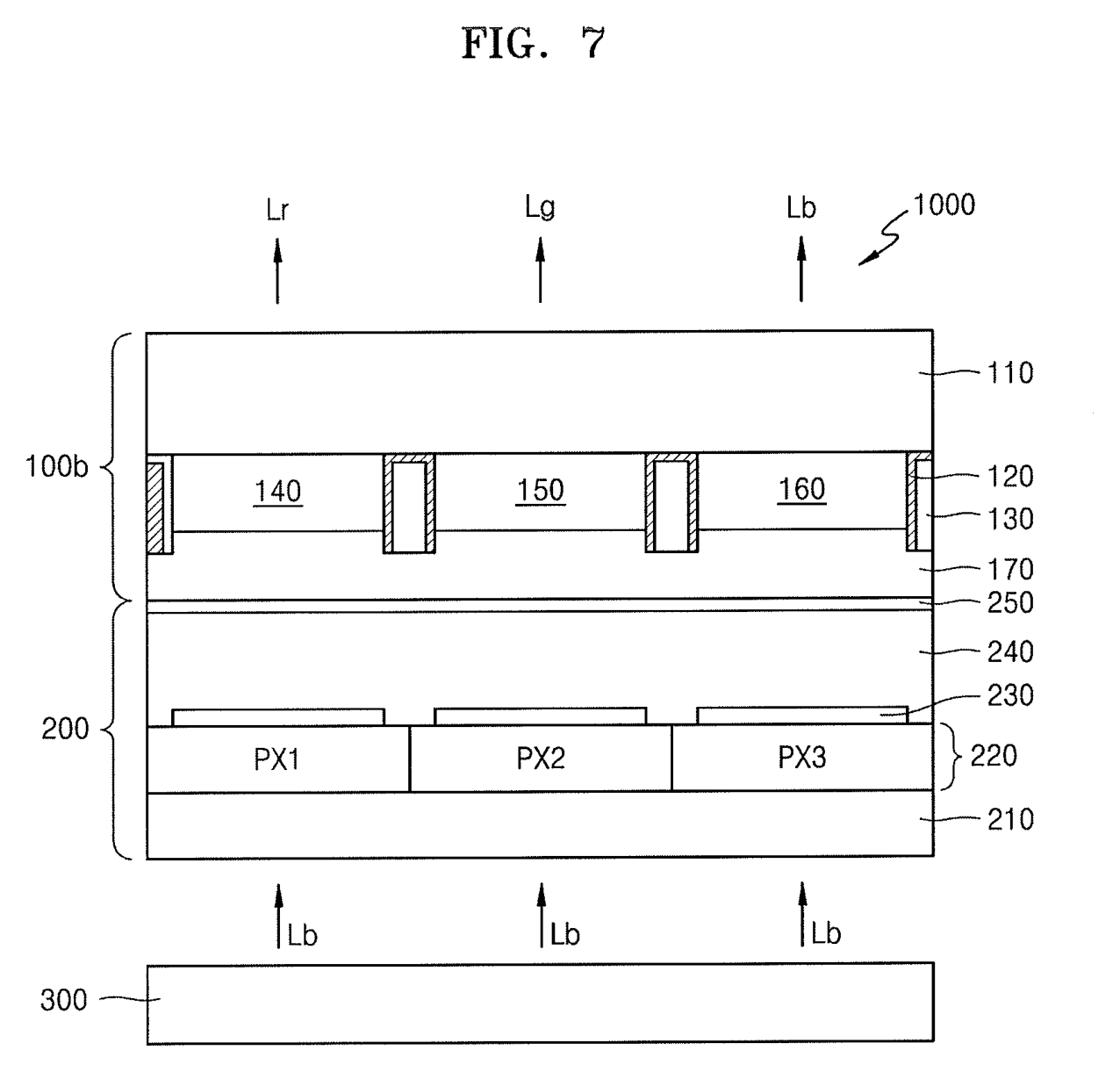
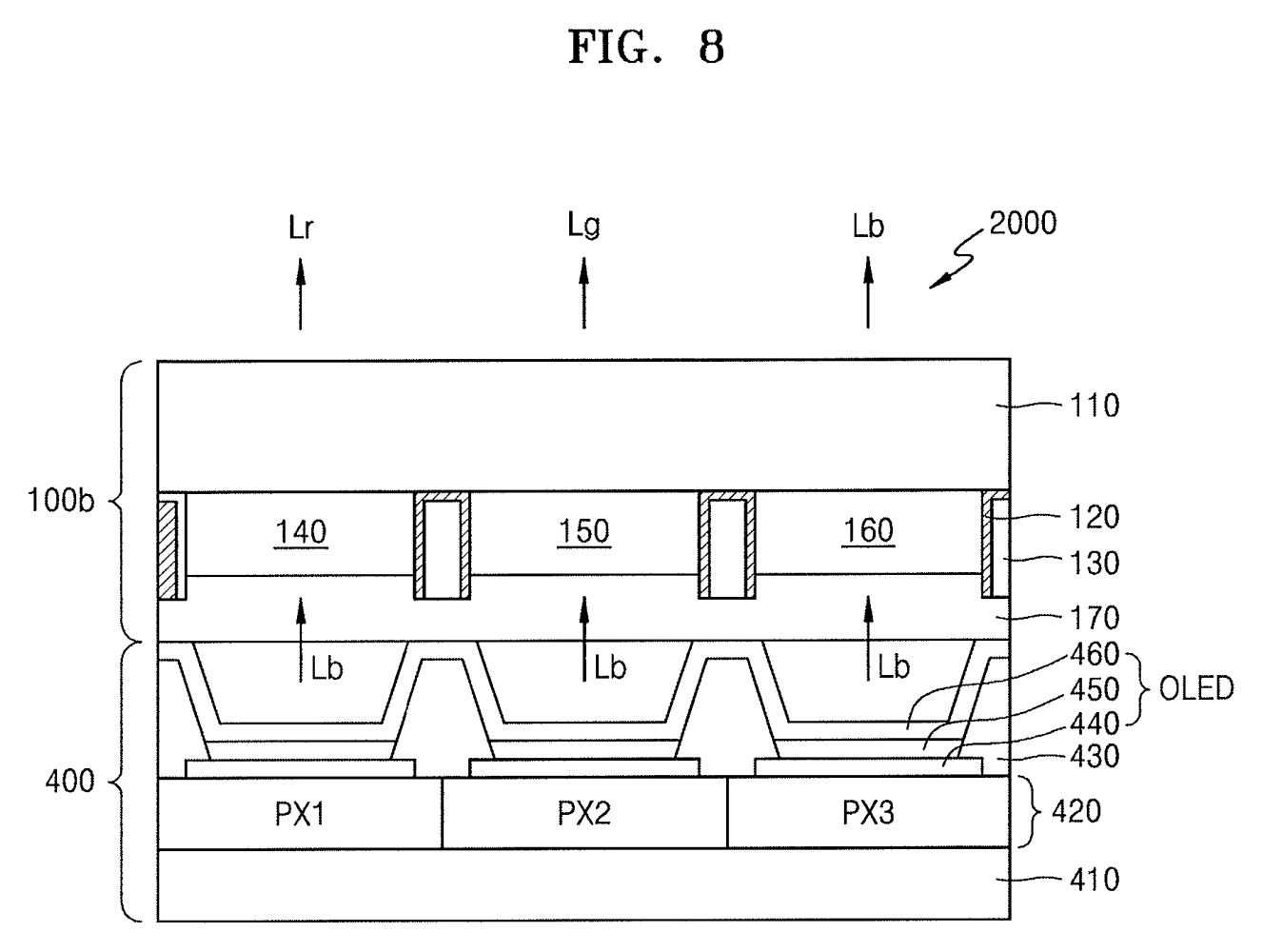
Within one patent, the same top plate was placed both over liquid crystal and over an organic light-emitting panel. The claims cover that top plate only as a “color filter” and name no light source. From the start, the top plate was designed as a part indifferent to its light source.
4.2 What the specifications were written against
To check whether this was peculiar to one patent, the full text of all 120 structure patents Samsung Display filed with priority dates through 2020 was read. The criterion is how many times LCD and OLED are mentioned across the whole text. A patent was counted as “LCD-centered” if it mentions LCD 10 or more times and that count is more than twice the combined mentions of OLED and inorganic LED. Boilerplate lists such as “various display devices such as LCD and OLED” are filtered out by this criterion.
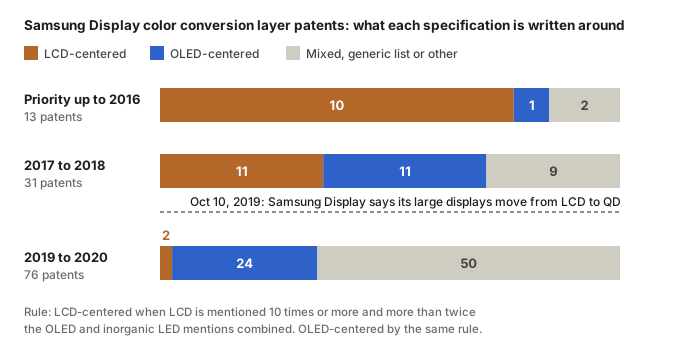
The backgrounds of the 13 up to 2016 open like this.
Using a color conversion layer containing phosphor on the upper substrate improves the viewing angle and color reproduction of an LCD, but light extraction efficiency can fall.
US11163195B2 · Samsung Display · 2014Light loss occurs in the polarizer and color filter of a liquid crystal display. So a display device including a color conversion panel was proposed as a high-efficiency display with reduced loss.
US11243435B2 · Samsung Display · 2016Among those 10, not one names liquid crystal, a polarizer or a backlight in an independent claim. On October 10, 2019, Samsung Display announced a 13.1 trillion won investment and said it would “shift the direction of large display technology from the existing LCD to QD display.” Around that point, the backgrounds of the specifications moved from LCD to OLED. Many of the 50 “mixed” patents from 2019–2020 name OLED together with nanorod and micro LEDs.
4.3 A company that names no light source in its claims
That the top plate is indifferent to its light source shows in the claims as well. Among structure and process patents, leaving out material claims, the share in which every independent claim is limited to an organic light-emitting device was counted by owner.
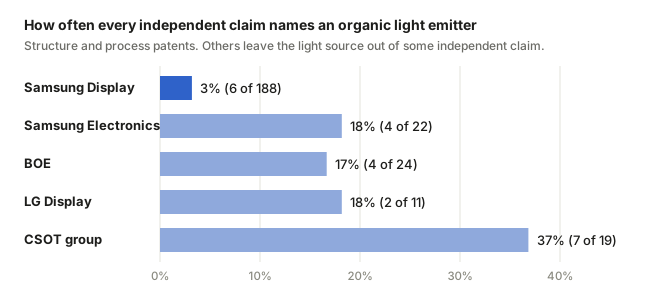
Samsung Display limited the light source to organic emission in only 6 of 188. The company holding close to two-thirds of this piece’s sample wrote almost all of those rights without a light source. A top plate first used over liquid crystal moved over onto organic emission, and its claims never carried, from the start, a light-source limitation that such a move would have run into.
4.4 Patents let go, and patents that never went to court
Of the 316, 9 have already expired, most of them because maintenance fees were not paid. Samsung Display’s US10725333B2, cited 47 times, is one of them, a patent whose specification describes both liquid crystal and organic light-emitting embodiments. Why it was let go is not stated anywhere.
Litigation records were also searched. Checking the legal events of all 1,459 patents in the population, 1 carried a litigation flag, and none of the 316 analyzed did. In the same period, the big lawsuit over quantum dots arose not over color conversion layers but over how quantum dot particles are made. The suit the UK’s Nanoco brought against Samsung over quantum dot synthesis and film patents ended in a 150 million dollar settlement in 2023, and the accused products were LCD TVs using quantum dot film.
5. What this analysis does not say
- “The claims carry no LCD limitation” is a statement about the wording of the claims. It means only that those claims do not limit the light source and name no liquid crystal. Whether any product falls within those claims was not judged
- It is not that “most structure patents are for LCD.” Of the 316, those with an LCD-centered background are 14%. Among the 10 most cited, 2. What holds is only the time order of Samsung Display’s early patents
- US10185066B2 has an LCD background, but its body contains an OLED embodiment. It is not an “LCD-only” patent
- The 69 bank, 29 scatterer and 14 stacking patents are counts judged by independent claim keywords. What a person read in the original is the 29 patents and the 120 backgrounds
- Only US granted patents were covered. Korean and Chinese grants and pending applications are left out. Litigation records in other countries are sparser than those of US courts
- There were no citation relationships among the 29 read. The flow of this piece is not a citation lineage but a grouping of the problems the specifications wrote down
- Whether Magnolia Blue has asserted its rights, and whether a quantum dot color conversion layer license exists between LG Display and Samsung Display, could not be confirmed
6. When they open up
| Expiry | Patent | Branch | Current owner |
|---|---|---|---|
| 2011-12-30 (ended) | US5294870A | Originator: fluorescent medium over blue | Global OLED Technology |
| 2017-01-29 (ended) | US5717289A | Originator: color conversion medium | Samsung Display |
| 2027-03-02 | US7531856B2 | Back: differentiated optical distance | Magnolia Blue |
| 2027-12-30 | US7659661B2 | Monochrome emission + color conversion layer | Samsung Display |
| 2028-07-23 | US8759850B2 | Forward: quantum dot color conversion component | Samsung Electronics |
| 2036-05-19 | US10545378B2 | Forward: colorant and scattering particles | Samsung Electronics |
| 2037-07-18 | US10185066B2 | Sideways: bank light blocking | Samsung Display |
| 2038-12-19 | USRE50125E1 | Outside: polarizer-free structure | LG Display |
| 2039-07-10 | US12262576B2 | Back: stacked light source + quantum dots | Samsung Display |
The rights to the idea of laying a color-changing layer over blue have already ended twice. The rights that remain hang on how to block the three directions in which light leaks from that layer, and the thickest bundle among them is the top plate first used over liquid crystal. And the 50 patents from 2019–2020 already name organic emission and inorganic LEDs together in a single specification.
7. Appendix: core patents read in the original
| Number | Current owner | Priority | Branch | Status |
|---|---|---|---|---|
| US5294870A | Global OLED Technology | 1991-12-30 | originator | expired |
| US5717289A | Samsung Display | 1996-01-30 | originator | expired |
| US7659661B2 | Samsung Display | 2004-11-17 | monochrome emission + color conversion layer | in force |
| US7531856B2 | Magnolia Blue | 2005-12-06 | back · resonance | in force |
| US8759850B2 | Samsung Electronics | 2007-07-23 | forward · scattering | in force |
| US11163195B2 | Samsung Display | 2014-08-05 | LCD background · bank | in force |
| US10545378B2 | Samsung Electronics | 2015-02-04 | forward · colorant and scattering | in force |
| US9703191B2 | Samsung Display | 2015-09-02 | forward · color filter | in force |
| US10283572B2 | LG Display | 2015-12-30 | single conversion layer in filler | in force |
| US10185066B2 | Samsung Display | 2016-08-11 | sideways · bank light blocking | in force |
| US11243435B2 | Samsung Display | 2016-11-18 | LCD background | in force |
| US10712606B2 | TCL CSOT | 2016-12-27 | hydrogen blocking · notes scatterer reflection | in force |
| US10725333B2 | Samsung Display | 2017-02-08 | sideways · bank | expired (fees) |
| US10048530B1 | Samsung Display | 2017-07-27 | sideways · bank light blocking | in force |
| US11060019B2 | Samsung Electronics | 2017-10-12 | forward · notes absorption limit | in force |
| US12317721B2 | Samsung Electronics | 2017-11-02 | forward · recycling | in force |
| US10707275B2 | Samsung Electronics | 2017-11-15 | forward · light path | in force |
| US11054690B2 | Samsung Display | 2017-11-15 | outside · metal grid | in force |
| US11271050B2 | Samsung Electronics | 2017-11-21 | compares placement approaches | in force |
| US10714540B2 | LG Display | 2017-12-27 | outside · blue pixel scattering layer | in force |
| USRE50125E1 | LG Display | 2017-12-27 | reissue of the patent above | in force |
| US12057531B2 | SEL | 2018-07-20 | back · stacking | in force |
| US12262576B2 | Samsung Display | 2018-09-17 | back · stacking + quantum dots | in force |
| US11342525B2 | Samsung Display | 2018-11-19 | sideways · air-gap boundary | in force |
| US11910688B2 | BOE | 2018-11-29 | background contrasts white OLED | in force |
| US11818937B2 | Samsung Display | 2019-02-07 | outside · no polarizer | in force |
| US10943956B2 | CSOT | 2019-05-27 | directly on encapsulation · sawtooth encapsulation layer | in force |