Micro LED Mass Transfer: An Analysis of 28 Patents
Moving something means sticking it down and letting it go. What switches that adhesion on and off is what splits mass transfer into five branches. Yet not one of the companies that had only the moving technology kept its own patents. They went to Apple right after collateral was released, through an assignment for the benefit of creditors, and to a bonding equipment maker.
In the previous piece on nano LEDs, one thing was deliberately set aside. Once a device grows larger, floating it in ink and laying it down with an electric field stops working, and each one has to be picked up and moved. At that moment count stops being a matter of area and becomes a matter of time. This piece is that place.
But while gathering patents, something unexpected came first. Not one of the companies that first built this technology holds those patents today.
1. Overview
1.1 Background and purpose
That mass transfer is the gate to micro LED displays is close to common knowledge in the industry. A single 4K panel carries about 8.3 million pixels, and with one chip per color that means 24.9 million to be moved. eLux wrote the situation into the background section of its own specification.
“In a display consisting of millions of devices, such a process can take several hours to complete, which is inefficient.” (US10418527B2, background)
This piece tracks who tried to pass that gate and how, using granted patents and USPTO assignment records. In the previous piece, assignment records confirmed that two nano LED lineages went to Samsung on a single day, 2018-09-07. The same material is used here for a different question. Where are the companies that built the technology now?
1.2 Scope
| Item | Content |
|---|---|
| Sample | 28 US granted patents |
| Companies | 10 (Semprius · LuxVue · Uniqarta · Tesoro Scientific · Rohinni · eLux · PlayNitride · Mikro Mesa · VueReal · Point Engineering) |
| Priority range | 2007-01-17 to 2022-08-29 |
| Items checked | Independent claim substance · figures in the specification · the full assignment record · legal status |
This is not an exhaustive survey. It is a landmark sample representing each company’s lineage. There are many more patents outside it.
1.3 Data sources and search
Everything was confirmed directly on Google Patents originals. News and market research reports were not used as grounds.
| Stage | Method |
|---|---|
| Mapping | 4 exact phrases (mass transfer · transfer head · transfer printing · pick and place) × US grants. 348 patents, 118 assignees |
| Company selection | From the 118, large firms, panel makers and universities were removed, leaving 72 that were read through to pick out transfer specialists |
| Change of ownership | The full assignment event list on each patent’s detail page was read. It exists only on US grants |
| Legal status | The status of each patent (in force / expired for fee-related reasons) |
1.4 Classification
This piece splits the companies two ways. The criterion is whether they hold device patents.
- Transfer-only companies: they have the moving technology (transfer head, stamp, laser, fluidic assembly) and the inspection around it, but no patents on the structure or epitaxy of the light-emitting device itself
- Companies that hold devices as well: they hold LED structure, epitaxy and electrode patents alongside the moving technology
No ratios were used, only presence or absence. A small change to the regular expression classifying titles moved the same company’s ratio between 4 percent and 19 percent. A ratio is a number the classifier produces, and building a conclusion on it lets the classifier decide the conclusion.
2. Transfer means sticking and releasing
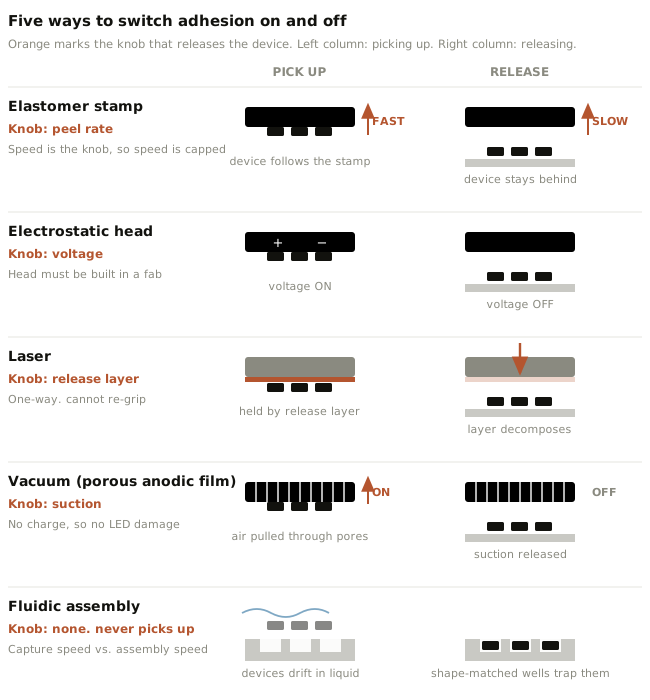
Moving something is, in the end, sticking it down and letting it go. It has to be released from where it was, stuck to a hand, and released from that hand as it is placed. Which means the adhesion has to be switchable on and off. Always stuck and you cannot put it down; never stuck and you cannot pick it up.
That is exactly where the methods of mass transfer divide. What switches the adhesion.
| Method | Switching on | Switching off | Representative |
|---|---|---|---|
| Elastomer stamp | press into contact | peel slowly. Peel rate sets the adhesion | Semprius |
| Electrostatic head | apply voltage | cut the voltage | LuxVue |
| Laser | hold with a permanent adhesive layer | decompose a heat or UV sensitive layer | Uniqarta |
| Vacuum | draw through a porous film | release the vacuum | Point Engineering |
| Fluidic assembly | never picks up at all | devices settle into shape-matched wells | eLux |
2.1 Each method runs into a different wall
These are not five ways of solving one problem. Each of the five ran into a different wall. And that wall generally shows up as speed.
An elastomer stamp controls adhesion by speed, so its speed cannot be raised freely. The principle is written into the Semprius specification.
The adhesion of an elastomeric stamp is controlled by adjusting the delamination rate.
Peel fast and the device comes along; peel slowly and it stays. The knob that switches adhesion is speed itself, so raising speed for throughput means failing to release when release is required. That is why Semprius claimed a shear offset.
Shear-offset printing allows a higher delamination rate to be achieved without sacrificing print quality.
Instead of pulling straight up, pushing sideways creates a difference in adhesion, which is a way out of the knob being speed.
The electrostatic head uses voltage as the knob rather than speed. Apply current to grip, cut it to release, independent of speed. It pays elsewhere. The head itself has to be built by semiconductor processing. That claim 1 of LuxVue’s US9620478B2 is not a transfer method but a method of making a transfer head is the evidence. Mesa structures on a substrate covered with a passivation layer is a process no different from making a device.
And voltage carries a price. Point Engineering’s specification names LuxVue directly and writes the problem down.
LuxVue Technology Corporation of the United States proposed a method of transferring micro LED devices using an electrostatic head. However, this method has the problem that the charging phenomenon caused by the voltage applied to the head damages the micro LED during electrostatic induction.
Point Engineering’s answer is vacuum suction. A porous film made by anodizing metal is given vertical pores running through it, with a vacuum chamber above drawing air through. No voltage is used, so there is neither charging nor damage.
The laser uses its knob exactly once. Uniqarta’s claim 1 makes the release layer multi-layered, with one layer a permanent adhesive and another a material sensitive to heat or ultraviolet light. Shine light and that layer decomposes, dropping the device. It is not switching on and off; switch off once and there is no going back.
Fluidic assembly abandons the idea of picking up at all. Float devices in liquid and let them flow, and they seat themselves in wells that match their shape. The parallelism is overwhelming, but there is a wall of speed here too. The eLux specification writes the dilemma down.
Conventional fluidic assembly into wells over large areas runs into two opposing requirements: a maximum velocity for capturing the microcomponents and a minimum dispensing velocity for high-speed array assembly.
Too fast and the devices pass the wells; too slow and filling the whole surface takes a long time. Even in a method that does not pick up, speed is the gate in the end.
2.2 Which branch each of the ten companies stands on
| Company | Country | How adhesion is switched | Device patents | Those patents now |
|---|---|---|---|---|
| Semprius | US | elastomer stamp (peel rate) | none | X Display Company, after a creditor assignment |
| LuxVue | US | electrostatic head (voltage) | none | Apple |
| Uniqarta | US | laser (release layer decomposition) | none | Kulicke and Soffa |
| Tesoro Scientific | US | test after transfer | none | Apple |
| Rohinni | US | deposited placement | none | Cowles Semi |
| eLux | US | fluidic assembly (never picks up) | yes | its own name |
| PlayNitride | Taiwan | device centered | yes | its own name |
| Mikro Mesa | Taiwan | transfer head + device | yes | its own name |
| VueReal | Canada | cartridge + inspection | yes | its own name |
| Point Engineering | Korea | vacuum suction (porous film) | yes | its own name |
All five without device patents are in someone else’s hands, and all five with them are in their own name.
2.3 The timeline of the five that changed hands
These are the dates left in the assignment records. All were confirmed on the originals.
| Company | First assignment | Collateral | Final |
|---|---|---|---|
| Semprius | 2010-07-26 | 2014-10-30 Silicon Valley Bank + Horizon Technology Finance | 2017-04-11 assignment for the benefit of creditors → 2017-04-13 X-Celeprint → 2020-05-11 X Display Company |
| LuxVue | 2012-02-13 | 2013-03-21 Comerica Bank → 2013-05-20 TriplePoint Capital | 2014-05-02 collateral released → 2016-04-25 Apple |
| Uniqarta | 2017-10-19 | not identified | 2021-08-05 Kulicke and Soffa |
| Tesoro Scientific | 2017-12-18 | not identified | 2020-08-04 Apple |
| Rohinni | 2014-12-30 | not identified | 2023-07-27 Cowles → 2024-01-12 Magna Electronics → 2024-05-15 Cowles Semi |
Two of them show assignments to a bank and a venture lender. That means the patents were pledged as collateral. The Semprius chain also carries a 2011-08-30 assignment to the US Department of Energy, a mark that government money was involved.
An “assignment for the benefit of creditors” is an alternative to bankruptcy proceedings. The company hands its assets to a trustee to distribute among creditors and wind down.
These are the dates in the USPTO assignment records copied over as they stand. A diamond is the point at which patents were pledged as collateral, a square the point at which the owner changed. All five rows end in a square.
2.4 The numbers each of them put forward
Three companies wrote a processing scale into their specifications. Before setting them side by side, their different natures have to be seen first.
| Method | Number | Source | What it actually is |
|---|---|---|---|
| Elastomer stamp | array of 256 | US8506867B2 | the condition actually used to draw a yield graph |
| Electrostatic head | more than 100,000 in 1cm × 1cm | US9620478B2 | a calculated ceiling converting head count into device count |
| Fluidic assembly | 56 million per hour | US10418527B2 | the specification itself calls it an “extrapolated” value |
These three were not measured with the same ruler. One is an experimental condition, one a theoretical ceiling, one an extrapolation. Placed side by side they read as “electrostatic is 400 times faster than the stamp,” and there is no basis for that anywhere.
3. Qualitative analysis: 28 patents
They are arranged in the order of how adhesion is switched. Where the company that built each method now stands is seen in the same place.
3.1 Elastomer stamp: peel rate is the knob
This is the root of the lineage. And yet it was not a display company to begin with.
| Number | Priority | What |
|---|---|---|
| US7972875B2 | 2007-01-17 | Optical systems fabricated by printing-based assembly. Jointly held with the Board of Trustees of the University of Illinois |
| US8470701B2 | 2008-04 | Printable, flexible and stretchable diamond for thermal management |
| US7927976B2 | 2008-07 | Reinforced composite stamp for dry transfer printing. A reinforcing layer in the elastomer reduces deformation |
| US8506867B2 | 2008-11 | Printing semiconductor devices by shear-assisted elastomeric stamp transfer. Pushing sideways instead of pulling straight up creates the adhesion difference |
| US10416425B2 | 2009-02 | Concentrator photovoltaic (CPV) modules and receivers |
The US8506867B2 specification records the experimental condition.
Average yield of 4 successive dry transfer printings of an array of 256 silicon chiplets, corresponding to a total of 1,024 chiplets per data point in the graph
The early portfolio is optical systems, embedded OLED driver chips, diamond thermal management and concentrator photovoltaics. It was a company betting one tool, transfer printing, across many applications, and it bet heavily on solar.
Semprius’s patents passed through a creditor wind-down to the entity below, and that entity is now doing something else.
The entity that inherited the Semprius patents. It is still filing. But the subject of its most recent grants has changed.
| Number | Priority | What |
|---|---|---|
| US12609068B2 | 2022-08-29 | Hybrid pulse-width-modulated pixel |
| US12518676B2 | 2023-02-15 | Memory architecture for hybrid cluster displays |
Pixel driving and display architecture.
3.2 Electrostatic head: voltage is the knob, but the head must be built like a semiconductor
Of 60 US grants, 56 concern transfer, and there are no epitaxial structure patents on the light-emitting device itself.
| Number | Priority | What |
|---|---|---|
| US9620478B2 | 2011-11-18 | Method of fabricating a micro device transfer head |
| US8349116B1 | 2011-11-18 | Transfer head heater assembly. Expired, fee related |
| US8518204B2 | 2011-11-18 | Method of fabricating and transferring micro devices. Expired, fee related |
| US9105492B2 | 2012-05 | Compliant transfer head |
| US8569115B1 | 2012-07-06 | Method of fabricating a compliant bipolar head array. Expired, fee related |
| US9828244B2 | 2014-09-30 | Compliant electrostatic transfer head with a cavity. Expired, fee related |
The US9620478B2 specification records the scale.
A 1cm × 1cm micro device transfer head array can pick up and transfer more than 100,000 micro devices, and larger arrays can transfer more.
It is a count of heads on the premise that one head picks up one device. It is not a record of that many actually having been moved, but a ceiling derived from array size.
4 have expired, and two of those are compliant heads, a structure that physically deflects to absorb height variation between devices. The other 52 remain in force.
Why they were let go is not something the specification says. What is confirmed is only that maintenance fees were not paid. Still, abandonment is a strong signal, and two of the four being in the same family is hard to read as coincidence. That is as far as the material allows.
3.3 Laser: the knob is used only once
A method that releases and moves devices with a laser.
| Number | Priority | What |
|---|---|---|
| US10529614B2 | 2014-08 | A handle substrate is attached to the device through a release layer, a tool grips the handle substrate to bring the device into contact with an adhesive layer on the receiving substrate, then separates |
| US10748802B2 | 2019-08 | A transfer method in the same lineage |
Both went to Kulicke and Soffa on 2021-08-05. A semiconductor bonding equipment maker.
3.4 Vacuum suction: the side that uses no voltage
Its main business is anodizing. The Anodic oxide film for electric contact family is that business, and the transfer head came out of the same technology.
| Number | Priority | What |
|---|---|---|
| US11133209B2 | 2017-12-20 | Transfer head for micro LED |
| US10707394B2 | 2018-01-05 | Micro LED structure and method of manufacturing the same |
3.5 Fluidic assembly: giving up the idea of picking up
A method of floating devices and seating them into wells.
| Number | Priority | What |
|---|---|---|
| US10418527B2 | 2014-10 | Fluidic assembly process. A brush sweeps the fluid and fills the wells with devices |
| US10115885B2 | 2016-06 | Fluidic assembly process using a piezoelectric plate |
The US10418527B2 specification carries the conditions and the result together.
The brush rotates in the range of 120 to 300 revolutions per minute and traverses the top surface of the emissive substrate at a speed in the range of 3 to 10 centimeters per second. … This provides a low-cost, high-speed assembly approach, achieving an extrapolated assembly rate of more than 56 million per hour.
The specification itself states that this is “extrapolated.” It is a value scaled up from a measurement on a small area, not a record of that many devices actually having been assembled.
The rights were first held in the name of Sharp Laboratories of America, passed through Sharp headquarters, and came to eLux on 2018-04-18. The spinout is written into the assignment record exactly as it happened.
3.6 The side that holds the moving technology and the device together
Of 241 US grants only a part concern transfer and the majority are devices. The company was founded in 2014.
| Number | Priority | What |
|---|---|---|
| US10047917B2 | 2014-08-21 | Light-emitting module |
The assignment record has 2015-08-12 PlayNitride Inc. and 2024-03-27 PlayNitride Display Co., Ltd. Two lines only. Name changes, not a sale. All 22 in the sample are in force and all are in its own name.
The classic case of one company holding transfer and device together.
| Number | Priority | What |
|---|---|---|
| US9716073B2 | 2014-11-19 | Micro device transfer machine |
It holds transfer patents such as Transfer head array and Method for binding micro device to conductive pad alongside device patents such as Micro-light-emitting diode and Light emitting diode having current confinement structure. Of 20 in the sample, 19 are in its own name and 1 in the name of a Shenzhen subsidiary.
The cartridge approach and inspection and repair are this company’s axis.
| Number | Priority | What |
|---|---|---|
| US10304364B2 | 2015-01-23 | Defect identification and repair in micro device integration systems |
| US12068428B2 | 2015-12-24 | Vertical solid state device |
| US11870006B2 | 2019-05-28 | Improving the efficiency of an LED structure with n-type doped quantum barriers. An epitaxial structure patent |
All 16 in the sample are in force and all are in its own name. That said, the priority distribution of its most recent 100 filings falls from 22 in 2019 to 4 in 2023.
3.7 What comes after transfer: inspection and placement
Once things are moved, defects have to be found and repaired. These are the companies that went for that place.
All 5 US grants concern micro LED, and all of them are test apparatus and transfer.
| Number | Priority | What |
|---|---|---|
| US10600697B2 | 2017-12-18 | Light-emitting diode (LED) test apparatus and method of manufacture |
| US10978429B2 | 2018-06-29 | Light-emitting diode (LED) mass transfer apparatus and method |
Both went to Apple on 2020-08-04. After LuxVue in 2016, Apple took Tesoro as well.
Applications on the lighting and backlight side.
| Number | Priority | What |
|---|---|---|
| US10381176B2 | 2014-12-30 | Keyboard backlighting with deposited light-generating sources |
| US9773457B2 | 2014-12-30 | Light diffusion with an edge-lap light guide. Expired, fee related |
The assignment chain is recent. 2023-07-27 Cowles Company → 2024-01-12 Magna Electronics (automotive components) → 2024-05-15 Cowles Semi.
4. Comparative analysis
4.1 Not one of the builders is left
There are five companies that had only the moving technology. They are not the same five as the five branches in Section 2. The companies that built vacuum suction and fluidic assembly are on the side that remains, seen later, and in their place inspection (Tesoro) and lighting applications (Rohinni) enter here.
What the five have in common is neither nationality nor method. Elastomer stamp (Semprius), electrostatic (LuxVue), laser (Uniqarta), inspection (Tesoro), lighting applications (Rohinni) are all different methods. Founding dates are scattered from 2007 to 2017.
What they share is that they had only the moving technology. And all five had their patents pass into someone else’s name.
4.2 Collateral is recorded before the news
The assignment records for Semprius and LuxVue carry the names of banks and lenders.
Semprius pledged collateral to Silicon Valley Bank and Horizon Technology Finance on 2014-10-30, was released from it on 2017-04-07, and four days later, on 2017-04-11, passed over through an assignment for the benefit of creditors. A wind-down procedure.
LuxVue was pledged twice, to Comerica Bank on 2013-03-21 and TriplePoint Capital on 2013-05-20, and released on 2014-05-02. Then on 2016-04-25 the name became Apple’s.
These dates are not press releases but patent office records. A company need not announce its funding situation; a pledge of collateral is registered as an assignment and stays. It is the same path as the previous piece, where Glo AB was pledged to Fortress Credit, released, and then went to Samsung.
For Uniqarta, Tesoro and Rohinni, however, no collateral was identified. Whether they changed hands without collateral, or whether their small number of US grants kept it out of the sample, cannot be settled with this material.
4.3 The side that remains had something besides moving
All five that kept their own name hold device patents. PlayNitride and Mikro Mesa are Taiwanese LED companies, VueReal holds vertical device and epitaxial structure patents, eLux has nanostructure LED patents, and Point Engineering has micro LED structure patents alongside anodizing as its main business.
Here it becomes tempting to go one step further. What the survivors share might not be devices but “another leg to stand on besides moving.” Point Engineering’s leg is anodizing, not devices.
But this sample cannot say that much. Ten companies cannot separate “presence of device patents” from “presence of another business,” and in this sample the two move almost together. For the same reason causation is not claimed either. Whether they survived because they had device patents, or went as far as devices because they were the kind of company that would survive, is not something patents answer. A company with ample funding might have developed devices and transfer together, or device revenue might have carried the transfer development. Those are different stories, and patents record only the outcome.
What this piece states is co-occurrence. That the five without device patents did not remain, and that the five that remained all had device patents. That far.
4.4 There are layers inside “remained”
Keeping your own name and having a business that runs are different things. The priority distribution of the most recent 100 filings splits three ways.
| Company | Recent priority trend | Reading |
|---|---|---|
| PlayNitride | 25 in 2021, 26 in 2022, 20 in 2023, 13 in 2024 | active |
| VueReal | falling from 22 in 2019 to 4 in 2023 | declining |
| eLux | 23 in 2014, 10 in 2016, almost none since | effectively stopped |
eLux kept its name but has no new filings. What this piece calls “remained” means only that the patents are in its own name. The company’s finances and whether it is in volume production cannot be known from patents.
4.5 The direction the successor took
X Display Company inherited the Semprius transfer patents, but its recent grants are pixel driving and display memory architecture. Instead of carrying the transfer technology forward for sale, it moved toward display modules.
It is tempting to read this as another instance of “transfer alone does not stand,” but the business strategy of a successor entity cannot be judged from patent titles alone. Only the facts are recorded here.
5. Counter-evidence and limits
The conclusions of this piece hold only within the following five limits.
① The sample is ten companies. They were chosen after going through 348 US grants and 118 assignees, but this is not an exhaustive survey. Chinese and Japanese transfer specialists could not be included in this sample.
② Survivorship bias was not fully excluded. A search was made for “a company still independent while doing only transfer without devices” and none was found. All five (Semprius, LuxVue, Uniqarta, Tesoro, Rohinni) changed hands. But not finding one does not mean none exists. The range searched is as stated in ① above.
③ The scope was limited. Equipment majors such as Applied Materials, Kulicke and Soffa and Orbotech stand perfectly well without making devices. What this piece covers is companies founded on micro LED transfer technology, and equipment makers that already stood on another business are out of scope. Remove this limit and the conclusion does not hold.
④ The three numbers were not compared. 256, 100,000 and 56 million per hour are an experimental condition, a calculated ceiling and an extrapolation, so they cannot be placed on the same axis. Which method is faster cannot be answered from this material.
⑤ The reason for expiry was not confirmed. That two LuxVue compliant heads expired for non-payment of fees is a fact, but why Apple let them go is not in the specification.
And one thing is added on throughput. Specifications of 122 granted mass transfer patents were searched for throughput figures and none were found. However, a patent is not a document for recording performance. Writing performance into a specification narrows the claim scope in examination and litigation, so not writing it is normal practice. So this fact cannot be used to say “the industry does not know that number,” only that “the number is not in the place called a patent.”
6. Conclusions and implications
That mass transfer is the gate to micro LED was said fifteen years ago and is said now. Follow the patents of the companies that set out to open that gate, and not one of the builders holds them.
Semprius bet on solar and passed over through a creditor wind-down; LuxVue was pledged to two banks and went to Apple right after being released. Uniqarta went to a bonding equipment maker, Tesoro back to Apple, and Rohinni through an automotive components company to another entity. The methods of all five were different and the outcome is the same.
The companies that now hold those names as their own share one thing. They had something besides the moving technology. Taiwan’s PlayNitride and Mikro Mesa have LED devices, Canada’s VueReal has epitaxial structures and inspection cartridges, and Korea’s Point Engineering has anodizing as its main business.
This is not read as causation. Whether they held on because they had devices, or went as far as devices because they were the kind of company that would hold on, patents do not answer. What can be said is only that not one company without device patents remained in this sample.
And “remained” has to be used carefully too. eLux kept its name but has had almost no new filings since 2016, and VueReal’s filings are declining. A patent being in your own name and a business running are different things. That difference has to be seen not in patents but in disclosures, and it is outside the scope of this piece.
There were five ways to switch adhesion on and off. By peel rate, by voltage, by light, by vacuum, and by never picking up at all. A technology that split into five branches converges into one line in the owner’s name. That the methods differed did not make the outcomes differ.
7. Appendix: patent specification table
| Number | Original assignee | Current owner | Priority | Status |
|---|---|---|---|---|
| US7972875B2 | Semprius / Univ. of Illinois | X Display Company | 2007-01-17 | in force |
| US7927976B2 | Semprius | X Display Company | 2008-07 | in force |
| US8470701B2 | Semprius | X Display Company | 2008-04 | in force |
| US8506867B2 | Semprius | X Display Company | 2008-11 | in force |
| US10416425B2 | Semprius | X Display Company | 2009-02 | in force |
| US9620478B2 | LuxVue | Apple | 2011-11-18 | in force |
| US8349116B1 | LuxVue | Apple | 2011-11-18 | expired |
| US8518204B2 | LuxVue | Apple | 2011-11-18 | expired |
| US9105492B2 | LuxVue | Apple | 2012-05 | in force |
| US8569115B1 | LuxVue | Apple | 2012-07-06 | expired |
| US9828244B2 | LuxVue | Apple | 2014-09-30 | expired |
| US10529614B2 | Uniqarta | Kulicke and Soffa | 2014-08 | in force |
| US10748802B2 | Uniqarta | Kulicke and Soffa | 2019-08 | in force |
| US10600697B2 | Tesoro Scientific | Apple | 2017-12-18 | in force |
| US10978429B2 | Tesoro Scientific | Apple | 2018-06-29 | in force |
| US10381176B2 | Rohinni | Cowles Semi | 2014-12-30 | in force |
| US9773457B2 | Rohinni | Cowles Semi | 2014-12-30 | expired |
| US10115885B2 | Sharp Laboratories of America | eLux | 2016-06 | in force |
| US10418527B2 | eLux | eLux | 2014-10 | in force |
| US10047917B2 | PlayNitride | PlayNitride Display | 2014-08-21 | in force |
| US9716073B2 | Mikro Mesa | Mikro Mesa | 2014-11-19 | in force |
| US10304364B2 | VueReal | VueReal | 2015-01-23 | in force |
| US11870006B2 | VueReal | VueReal | 2019-05-28 | in force |
| US12068428B2 | VueReal | VueReal | 2015-12-24 | in force |
| US11133209B2 | Point Engineering | Point Engineering | 2017-12-20 | in force |
| US10707394B2 | Point Engineering | Point Engineering | 2018-01-05 | in force |
| US12609068B2 | X Display Company | X Display Company | 2022-08-29 | in force |
| US12518676B2 | X Display Company | X Display Company | 2023-02-15 | in force |
Status is copied as displayed in the legal status field on each patent’s detail page. “Expired” means expired for fee-related reasons.