
Penta tandem and tandem WOLED meet on a 24.5-inch esports panel
The esports-only panel Samsung Display says it will mass-produce within the year is 24.5-inch FHD. A company that already has 27, 31.5, 34 and 49 inches went the other way, downward. Converting the monitor specifications announced the same week into the blurred edge width of the metrology standard, a 560Hz QD-OLED with half the refresh rate came out sharper than the world's first 1,100Hz LCD.
This article was published before the English edition began, so the labels inside its figures and simulators are in Korean. The caption and the note under each figure are in English.
HOT ISSUE OF THE WEEK
This column gathers the display industry stories that poured out over one week (Monday to Sunday) and digs a little deeper into the hottest single issue among them.
Week 4 of August: the issues the press covered
The week from 24 to 30 August was half the echo of the week before. News out of IMID 2026 kept reaching the pages, and a few new strands branched off between them.
First, automotive OLED was the biggest new material of the week. Samsung Display confirmed it will supply a 24.6-inch panoramic curved OLED and a 13.2-inch centre control OLED for the Genesis flagship electric SUV GV90, and Ferrari’s first pure electric car, the Lusso, was shown in Korea for the first time, bringing with it a multi-layer instrument cluster overlaying 12.9-inch and 12-inch panels. Omdia tallied automotive OLED shipments growing at 28.9% a year to 12.31 million units in 2030, with Samsung Display at 70.2% and LG Display at 15.9% today, the two together holding 86.1%.
Second, Gamescom 2026 ran in Cologne from 26 to 30 August. Samsung Display made official the mass production within the year of a 24.5-inch QD-OLED for esports, Samsung Electronics showed the 2027 Odyssey line-up, and ASUS put out four ROG Ace models using the 24.5-inch panel.
Third, signals appeared that China’s Gen 8.6 investment is slowing. With every Chinese panel maker apart from the two Korean companies in the red in small and medium OLED, reports emerged that the Chinese government is cutting subsidies and attaching new-technology validation as a condition, pushing domestic equipment makers’ order schedules into next year.
Fourth, localization news continued on the materials and components side. KCC Glass newly entered the optically clear adhesive (OCA) business bonding cover glass and touch sensor, signalling initial volumes late this year to early next, and Kolon Industries’ second-quarter operating profit rose 118% on demand for transparent polyimide for foldables.
Fifth, a forecast of generational change in microdisplays appeared. Omdia expects average selling prices to rise around 2028 as near-eye displays move from white OLED with colour filters to directly emitting RGB OLEDoS and LEDoS.
Of these, LG Display’s FLiPP and Apple’s OLED line-up expansion, already covered in depth in the last issue, reached the pages every day this week too, but will not be reopened here.
The hottest issue of week 4 of August is “the 24.5-inch esports panel.”
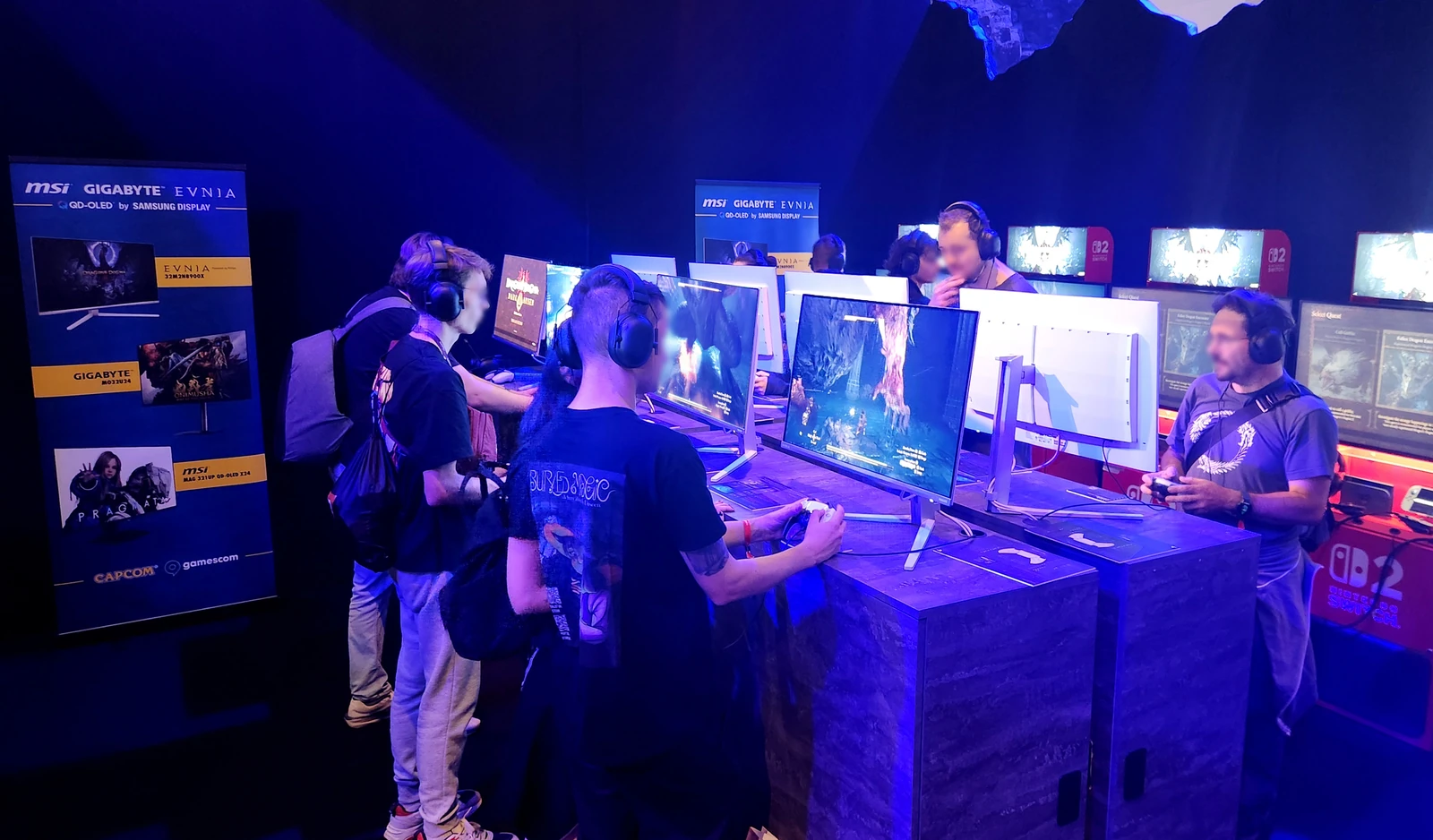
Everything else grew; only this went down
The specification of the panel Samsung Display pinned to mass production within the year at Gamescom is 24.5-inch, FHD.
The QD-OLED monitor panels this company already has are 27-inch UHD, 31.5-inch UHD, 34-inch WQHD, and a 49-inch dual QHD due within the year. Screens kept growing and pixels kept getting denser. And what has been added now is the smallest and coarsest specification in that line. At 24.5-inch FHD the pixel density is about 90PPI, well short of the 160PPI of a 27-inch UHD.
The company’s stated reason is short: “a size where the whole screen fits in one glance.” In FPS and esports, where a split-second judgement decides the outcome, the act of moving one’s gaze is itself a loss, so the screen has to fit whole inside the field of view.
Up to here it is a familiar account. The monitors at professional esports venues have long stayed in the 24-inch range for the same reason. But screen size alone does not explain why the resolution was also brought down to FHD. QHD could have gone into 24.5 inches.
The answer is inside Samsung Electronics’ monitor line-up from the same week.
Trading resolution for refresh rate
Of the four 2027 Odyssey models Samsung Electronics showed at Gamescom, all but one have a mode where lowering the resolution raises the refresh rate.
| Model | Panel | Standard | Lowered resolution |
|---|---|---|---|
| Odyssey OLED G9 · 49-inch | 5th-gen QD-OLED penta tandem | dual QHD 5120×1440 · 360Hz | dual HD 2560×720 · 720Hz |
| Odyssey OLED G8 · 32-inch | 5th-gen QD-OLED penta tandem | UHD · 360Hz | QHD 520Hz · FHD 680Hz |
| Odyssey OLED G7 · 42-inch curved | OLED | 4K · 165Hz | none |
| Odyssey G6 · 27-inch | Fast IPS | QHD · 600Hz | HD · 1,100Hz |
The pattern is visible at a glance. A high refresh rate is not obtained free; it is obtained in exchange for resolution. Fewer pixels means less bandwidth and less time to draw and send one frame, and frames can be swapped that much more often. The G8 cut its pixels to a quarter to raise the refresh rate from 360Hz to 680Hz, a factor of 1.9, and the G6 dropped from QHD to HD to turn 600Hz into 1,100Hz.
Here the place of the 24.5-inch FHD panel appears. Where other monitors buy refresh rate by shaving resolution when they need it, this panel was born at a resolution with nothing left to shave. In dual mode there is a price, shrinking the image or ringing it with a black border, but an FHD-native panel pays no such price. It gets its top refresh rate while using the whole screen.
Esports players dropping game options to minimum and lowering resolution at tournaments is a long-standing practice. This panel raises that practice to the panel design stage.
0.03ms is GtG, not MPRT
The other figure Samsung Display led with for this panel is a response time of 0.03ms. Unlike an LCD, which has to wait for liquid crystal to physically twist, an OLED lights up on the spot when current goes in, so this value is two orders of magnitude smaller than an LCD’s.
But what this number measures has to be set out. 0.03ms is GtG (grey to grey), the time one pixel takes to move from one grey level to another. The metric measuring how sharply an object crossing the screen is seen is a separate one: MPRT (moving picture response time). Samsung Display separates the two in its own glossary. GtG measures a change in pixel brightness, while MPRT measures the time for the trailing image of a moving pattern to disappear over the change of one frame.
And now that refresh rates have reached the hundreds of Hz, the cause of a blurred moving object is not GtG.
When the eye follows a target crossing the screen, the eyeball moves smoothly. During that time the screen’s pixels stay in the same place for the whole frame. So a stationary image is dragged sideways across the retina. This is called sample-and-hold blur, and the metrology standard calls the resulting spread of an object’s edge the blurred edge width (BEW). It is the number of pixels over which the edge luminance rises from 10% to 90%, and MPRT is that width converted into time.
The blurred edge width is set by a very simple multiplication.
blurred edge width = target crossing speed × time the pixel is lit
For a target crossing at 1,000 pixels per second, a pixel persistence of 1ms makes exactly 1 pixel of blur width. The frame length of a 240Hz screen is 4.17ms, so the blur width is 4.17 pixels. Under the same conditions the share made by a GtG of 0.03ms is 0.03 pixels, 0.7% of the total.
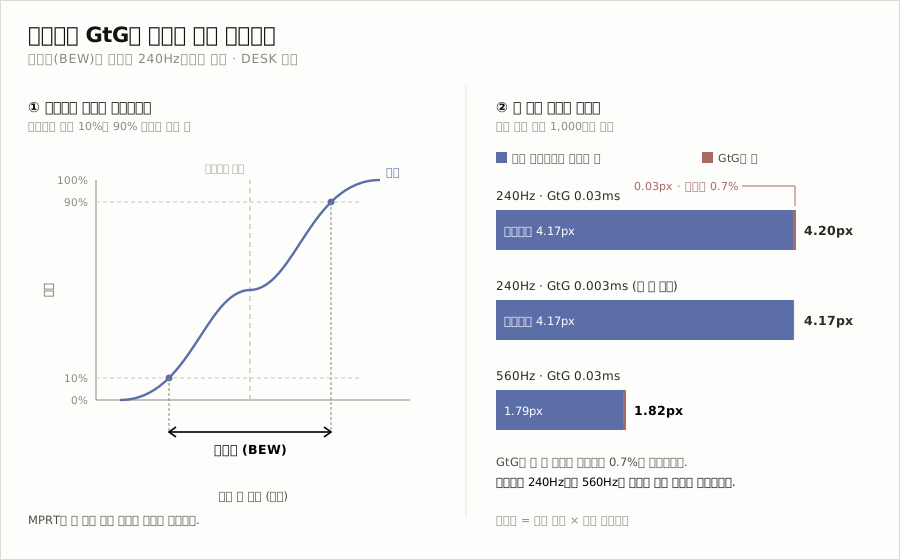
Cut GtG tenfold further, from 0.03ms to 0.003ms, and the screen does not visibly change, because the frame is long. See for yourself below.
Raise the refresh rate from 240Hz to 560Hz and the blur width narrows to less than half, while changing the panel and touching only GtG barely moves it. Turn on black frame insertion (BFI) and pixel persistence halves, so the blur width halves too, but the screen darkens by that much. This is why an esports panel needs high luminance. Only with brightness to spare can persistence be shaved to buy sharpness.
The world’s first 1,100Hz monitor is not an OLED
In this week’s coverage, Samsung Display’s QD-OLED announcement and Samsung Electronics’ 1,100Hz monitor were sometimes introduced as a single package. They are different things.
The 27-inch Odyssey G6 that Samsung Electronics called a world first is a Fast IPS panel with a response time of 1ms. Against the 0.03ms of all three OLED models in the same line-up, that is 33 times slower. And yet this model has the highest refresh rate.
Putting that combination into the formula above gives this. Target speed is held at 1,000 pixels per second throughout.
| Panel · mode | Refresh | Frame length | Persistence share | GtG share | Blur width |
|---|---|---|---|---|---|
| ASUS PG259QWS · tandem WOLED | 720Hz | 1.39ms | 1.39px | 0.02px | 1.41px |
| ASUS XG259QDPG · penta tandem | 560Hz | 1.79ms | 1.79px | 0.03px | 1.82px |
| Odyssey G6 · Fast IPS (HD) | 1,100Hz | 0.91ms | 0.91px | 1.00px | 1.91px |
| Odyssey OLED G8 · FHD mode | 680Hz | 1.47ms | 1.47px | 0.03px | 1.50px |
| Odyssey G6 · Fast IPS (QHD) | 600Hz | 1.67ms | 1.67px | 1.00px | 2.67px |
The 560Hz QD-OLED, at half the refresh rate, has a narrower blur width than the 1,100Hz LCD. The 720Hz tandem WOLED is 26% narrower than the 1,100Hz LCD.
The reason is in the two right-hand columns. At 1,100Hz the frame length is 0.91ms while GtG is 1ms. The next frame arrives before the pixel has reached its target grey level. 52% of the blur width comes from GtG, and raising the refresh rate further will not reduce that half.
This does not mean the Odyssey G6 is a bad product. Making a 27-inch monitor that can move between QHD 600Hz and HD 1,100Hz in OLED would cost far more. The point is that comparing two panels by refresh rate number alone flips the order, and that just as there is a range where GtG becomes meaningless, there is a range where refresh rate becomes meaningless. That boundary is where GtG and frame length become equal, which for a 1ms panel is 1,000Hz.
On top of that, in this region the metric itself wavers. When VESA introduced the ClearMR certification in mid-2022, it gave as its reason that existing methods, MPRT among them, do not accurately reflect the substance of blur. Instead of measuring time, ClearMR counts the ratio of clear to blurred pixels (CMR). And in December 2024 it added three new tiers, ClearMR 15000, 18000 and 21000, for panels above 480Hz. Which means rising refresh rates created a range the existing tiers could not cover. The ClearMR tiers of the 24.5-inch panels announced this time have not yet appeared.
Two ways of stacking one more layer
Two panel makers went head to head for the same 24.5-inch position. And the answers the two produced happen to run in the same direction: stacking one more emitting layer.
Samsung Display gave this structure the name QD-OLED penta tandem back in February. It raised the blue emitting stack from four layers to five, and the company puts forward efficiency 1.3 times and lifetime 2 times, with a monitor peak of 1,300 nits when 3% of the screen is lit. The company’s account is this: a load four were carrying, shared among five, lets them hold out longer or carry something heavier.
LG Display’s tandem WOLED also added a layer. The existing three layers were blue, yellow and blue, and the yellow layer was split into red and green to make four layers of red, blue, green, blue. The company calls it primary RGB tandem.
But the layer counts must not be compared as they stand. The two numbers count different things.
| Samsung Display | LG Display | |
|---|---|---|
| Name | QD-OLED penta tandem | tandem WOLED (primary RGB tandem) |
| Layers | 5 | 4 |
| What those layers emit | all blue | red, blue, green, blue |
| How colour is made | quantum dot colour conversion | colour filter |
| Subpixels | RGB stripe | RGB stripe |
QD-OLED emits only blue and uses that light to strike quantum dots, making red and green. So all five layers are blue, and the sole purpose of adding a layer is to divide the current one blue device would carry and reduce the burden itself. Blue is the highest in energy of the three colours and ages fastest, and that is where the figure of double lifetime comes from.
White OLED, by contrast, needs four layers together to make white, so each layer has its colour fixed. Splitting what one yellow layer did for red and green purifies the colour, but the extra layer raises the drive voltage with it.
The same “one more layer” — but one went to earn lifetime and the other to earn colour.
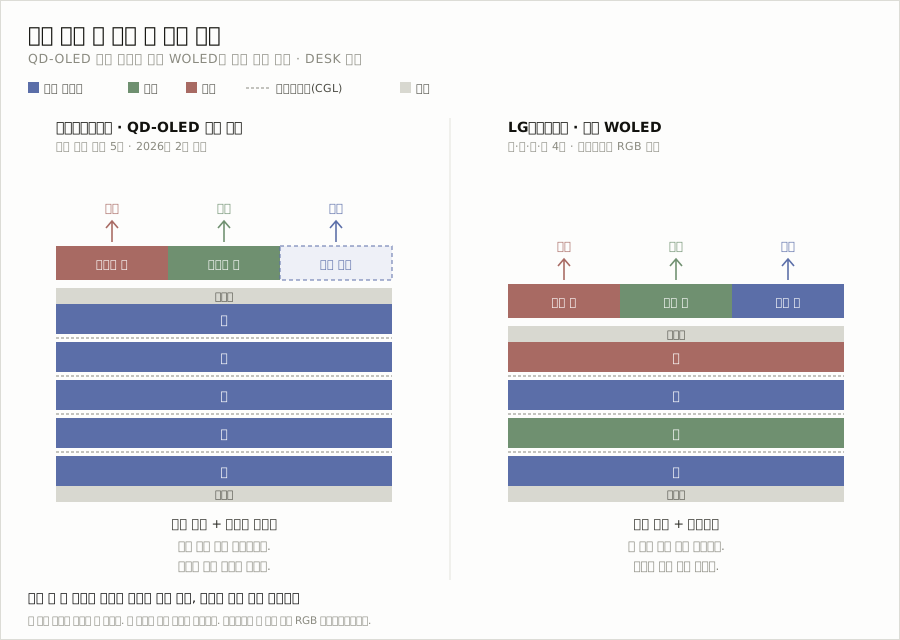
One thing to add. A US patent application Samsung Display filed with a priority date of July 2023, published last year, claims five emitting stacks with charge generation layers between them, and the composition of those five layers is at least two blue, at least one green and at least one red. That is a different structure from penta tandem, whose five layers are all blue. Examination is not finished, so it cannot be read as settled technology, but it does confirm that this company has prepared the five-layer form outside QD-OLED as well.
Four models contesting the same 24.5 inches
How the two companies’ panels actually differ is seen most clearly in the four ROG Ace models ASUS showed at Gamescom. All four are 24.5-inch FHD, split only by panel supplier.
| Model | Panel | Refresh | Response | SDR luminance | HDR peak | Surface | Release |
|---|---|---|---|---|---|---|---|
| ROG Swift PG259QWS | LGD tandem WOLED | 720Hz | 0.02ms | 390nit | 1,700nit | true black glossy | Q4 2026 |
| ROG Strix XG259QWPG | LGD tandem WOLED | 540Hz | 0.02ms | 390nit | 1,700nit | true black glossy | Q4 2026 |
| ROG Strix XG259QDPG | Samsung D penta tandem | 560Hz | 0.03ms | 350nit or more | 1,800nit | black shield matte | Q1 2027 |
| ROG Strix XG259QDNS | Samsung D penta tandem | 360Hz | 0.03ms | 350nit or more | 1,800nit | black shield matte | Q1 2027 |
Three things to read out.
First, LG Display leads on refresh rate. 720Hz is the highest in this table, and by the calculation above its blur width is the narrowest too. That the upper model is priced at 1,099 dollars, 400 dollars more than the 560Hz model, has this difference in it.
Second, the release dates are more than a quarter apart. The two models using LG Display panels come early in Q4 2026, and the two using Samsung Display panels early in Q1 2027. That fits with the “mass production within the year” Samsung Display stated. The one taking the position first is LG Display.
Third, the surface treatments are opposites. The LG Display side is glossy, the Samsung Display side matte with hardness raised to 3H. Glossy makes black look deeper; matte reflects less in a lit environment. Given these are items used under tournament lighting, this choice is not taste but a judgement about use.
What remains: burn-in and ABL
Esports was the use case most unfavourable to OLED. Health bars, minimaps and crosshairs at the edges of the screen stay lit in the same place for hours. A still image staying put for a long time is close to the definition of burn-in.
So the monitors at professional venues have long been the domain of TN and Fast IPS. The two companies adding a layer this time is closer to an answer to this problem than to image quality. Divide the blue stack into five and the current density each layer carries falls, and the device ages more slowly at the same brightness. The double lifetime Samsung Display speaks of is that result.
Something remains, though: automatic brightness limiting (ABL), the behaviour of lowering luminance to protect total panel power as bright areas widen, which is noticeable on screens with large white backgrounds. The peak luminances both companies put out in this announcement are values with only 1.5 to 3% of the screen lit. Neither disclosed what comes out with the whole screen lit.
Outlook
The 24.5-inch FHD will not end with this once; it will harden into the esports specification. Two panel makers entered simultaneously at the same size and the same resolution, and one set maker put four models on top of it at once. That the specification did not fork means the market has already agreed on this size.
The refresh rate contest will change character around 1,000Hz. Above that, frame length falls below 1ms and an LCD’s response time becomes a share that cannot be erased. It is a wall hard to clear while liquid crystal is used, so competition above 1,000Hz becomes the domain of self-emissive panels. But in that range the gains from shaving persistence further fall away quickly, so the next contest will move from the refresh rate number to whether it is bright enough with BFI on.
Whether this prediction is right or wrong can be seen from four things. First, whether next year’s esports panels hold at 24.5 inches or a variant such as 27-inch FHD branches off. Second, whether the next product above 1,000Hz comes as LCD or OLED. Third, whether the ClearMR tiers of these four 24.5-inch models are released, and if they are, whether the order of the 720Hz WOLED and the 560Hz QD-OLED matches the calculation above. Fourth, whether the two companies start writing full-screen luminance and luminance with BFI on into their specification sheets.
The fourth will be answered soonest. No one writes it now, and whoever writes it first is saying they are confident in the number. And the third marks this article’s calculation directly. If the tiers come out reversed, it means this model, which simply added GtG and persistence, fell short in front of real panels, and we will write again about what was missing.