The BOE and Samsung Display under-panel camera patent suit analysed
Four months after BOE sued Samsung Display over four patents, it ended quietly in a licence settlement worth about 1 trillion won. Why a full three-year confrontation between the two was tidied up so fast, and what the claim scope of the four patents actually attached to the suit says in the original. Reference material on licensing strategy for IP and business development.
This article was published before the English edition began, so the labels inside its figures and simulators are in Korean. The caption and the note under each figure are in English.
On 15 July 2025, BOE Technology Group and its subsidiary Chengdu BOE Optoelectronics sued Samsung Display in the Eastern District of Texas (2:25-cv-00715). The claim was that the under-panel camera (UPC, the technology planting a camera beneath the screen) structure used in the Galaxy Z Fold5 and Fold6 infringed four of its patents. This suit was one piece of a far larger dispute the two had carried on since December 2022. An ITC (US International Trade Commission) investigation and several district court suits were running at once, and in November 2025 the two companies dropped their worldwide litigation all at once, closing it with a licence agreement worth about 1 trillion won. We open the four patents actually attached to BOE's complaint in the original.
1. Overview
1.1 Background and purpose
The suits between BOE and Samsung Display are not one or two. One ITC investigation and at least 5 district court suits have overlapped since late 2022, and for most of them no specific patent numbers reached the press. CLAIM picked the one suit whose actual patent numbers were disclosed (BOE against Samsung Display, on UPC) and confirms its four attached patents in the original.
1.2 Scope
No period was set, because the point was to check the gap between the actual priority dates of the four patents and the timing of the suit’s filing and close. It covers 2018 by priority date through to the close of the suit in 2025. The subjects are BOE’s four patents (two of them sibling continuations of the same application) and the four parallel suits in the Samsung-BOE dispute including this one.
1.3 Data source and search strings
| Item | Content |
|---|---|
| Data source | Google Patents (patents.google.com) plus litigation facts cross-checked against public reporting (OLED-Info, The Elec, KED Global, TechCrunch and others) and PacerMonitor case records |
| Route to the patents | The four patent numbers cited in OLED-Info reporting were first compared directly against the Google Patents originals, and only after confirming the actual applicant was BOE (or a BOE subsidiary) were the cards written (rule B-0) |
| Citation check | Two of the four (BOE ② and ③) were confirmed from the “Continuation of application” field of the bibliographic record to be sibling applications split from the same parent application (US11,600,230). The possibility that they are two pieces of the same invention rather than separate patents was reflected before writing |
| Case records | The filing and closing dates of the four parallel suits were confirmed from PacerMonitor’s public case summaries. The complaint originals (matching claims to patents) are paid and could not be obtained |
| Limits | One ITC investigation and other reported suits (for instance Samsung Display’s LCD patent suit) had no patent numbers disclosed and are excluded from this survey |
1.4 Technical classification
BOE’s four patents are divided on a single axis, “what is changed (the lever)”: pixel structure patents adjusting pixel arrangement and density, and wiring structure patents rearranging the wiring crossing the sensor region. They claim the same UPC goal at different layers.
2. Quantitative sketch
Not an exhaustive survey but the four patents attached to the suit, arranged three ways: by priority date, by lever and by case duration.
2.1 Technology roadmap: by priority date
The priority dates of BOE’s four patents are all in 2018, clustered in the four months between June and October. And yet these patents appeared in litigation only 7 years later, in July 2025. Even the Galaxy Z Fold5 launch marked with the dashed line (2023-08) is nearly 2 years earlier than the filing. Those 7 years between priority and filing mean not that the patents are recent but that the dispute caught fire late.
2.2 Lever × patent matrix
Three of the four crowd into the “pixel structure” column, and two of those (② and ③) are effectively sibling continuations of the same invention. There are substantively only two different ideas (pixel versus wiring), yet the suit lines up four patents. It is a case showing that securing several continuations lets the number of patents attached to a complaint be raised from a single invention.
2.3 Duration of the four suits: filing to dismissal
Samsung’s first suit of 2023 dragged on for 2 years before being withdrawn voluntarily. And yet the other three suits newly begun in 2025 (Samsung’s trade secret suit, Samsung’s patent suit and BOE’s patent suit), despite starting at different times, were dropped almost simultaneously, between 19 and 25 November 2025. Which means they were not separate courtroom fights but moved inside a single negotiating package.
3. Qualitative analysis: BOE’s four patents
These are the four patents attached to the suit BOE brought against Samsung Display in July 2025. The full gist of claim 1, the prior art problem the specification states for itself, and the numeric limitations are quoted as they stand.
Title
Display panel and method for manufacturing the same
Gist of independent claim 1
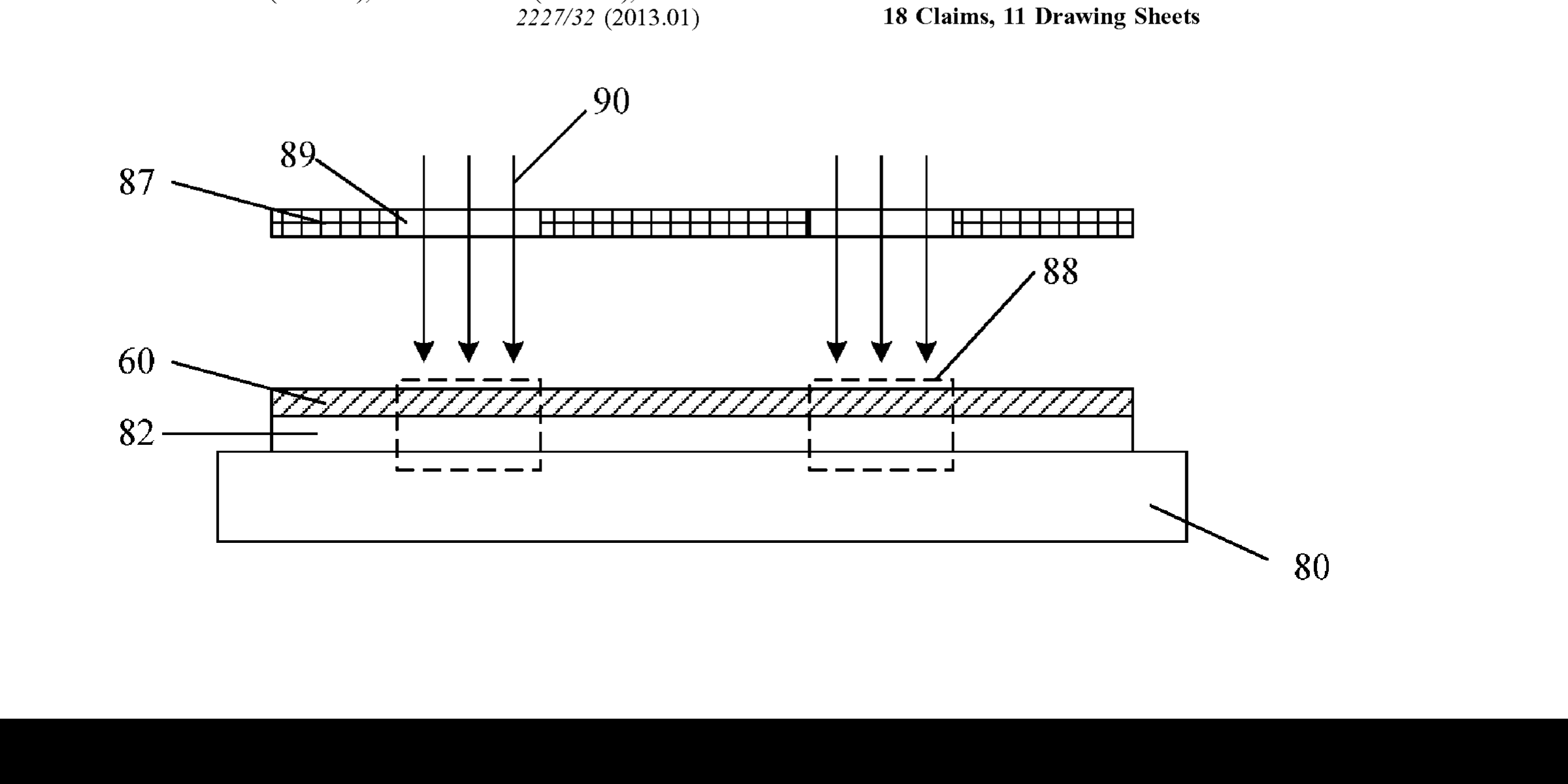
A display panel having a display region including a plurality of first pixel portions and first transmitting portions, wherein the first transmitting portions are configured so that external light transmits from one face of the panel to the other, and at least two first pixel portions are arranged separated by one or more first transmitting portions.
The prior art problem the specification states
The specification describes background rather than criticizing specific prior art. It states only the general need for a technology raising the light transmittance of part of the screen for under-panel components such as cameras and fingerprint sensing.
Numeric limitations
Title
Display substrate and driving method thereof, and display device
Gist of independent claim 1
A display substrate including a first display region composed of first repeating regions containing first and second pixel portions, and a second display region composed of second repeating regions containing third pixel portions and transmitting pixels, wherein the second display region has lower pixel density and higher light transmittance than the first.
The prior art problem the specification states
No quotation from the specification. Only the design goal of securing transmittance and resolution together by varying pixel density by region is carried in the claims.
Numeric limitations
Title
Display substrate and driving method thereof, and display device
Gist of independent claim 1
Title and claim structure effectively identical to BOE② (US12266309B2). A structure grading pixel density and light transmittance between the first and second display regions.
The prior art problem the specification states
It shares the same specification as BOE②.
Numeric limitations
Title
Array substrate, display panel, and display device
Gist of independent claim 1
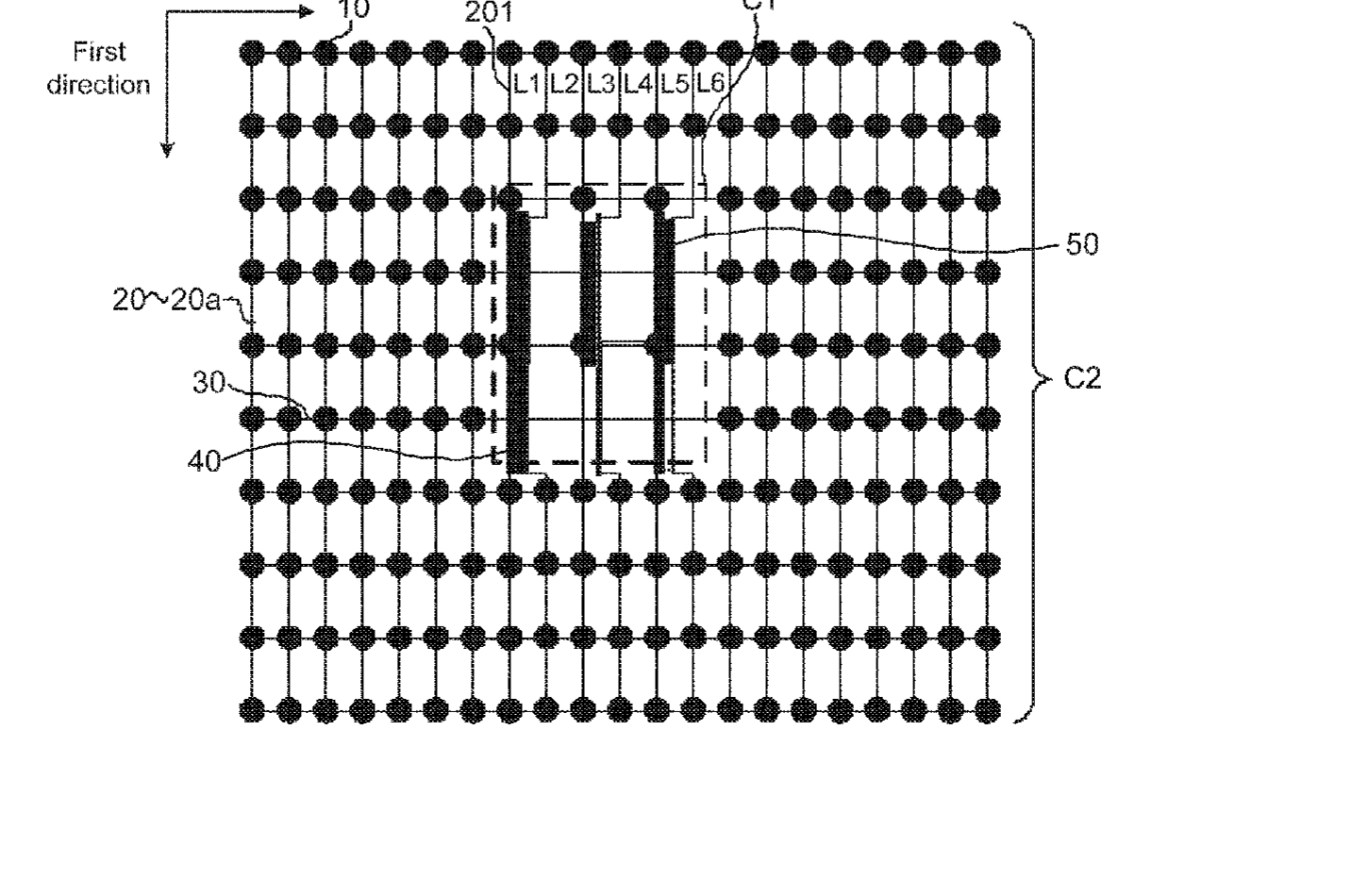
An array substrate including a base substrate, a plurality of first wires extending in a first direction, and one or more first light-shading strips arranged on the base substrate, wherein the wires crossing the sensor region are divided into groups, each group forming one gathering portion, and the orthographic projection of each gathering portion falls within the orthographic projection of the corresponding shading strip.
The prior art problem the specification states
The problem that wiring crossing the sensor component region disturbs the spacing between pixels and degrades image quality in that region. The goal is to gather the wiring under the shading strips without disturbing the pixel arrangement itself.
Numeric limitations
4. Comparative analysis
4.1 BOE① and ②③: two generations within pixel structure
BOE① (US11037994B2, priority 2018-08-29) is the simplest idea. Place transmitting portions between pixels so light passes through the panel. It leaves the pixel arrangement itself uniform and cuts holes in the gaps.
BOE② and ③ (US12266309B2 / US12307976B2, priority 2018-06-20) go a step further. The screen is divided into two regions: above the camera the pixel density is lowered and transmittance raised, while the rest keeps its density. The claim scope widens toward designing different pixel layouts by region rather than uniform gaps. What is interesting is that these two patents are sibling continuations of exactly the same invention. The bibliographic line “Continuation of application No. 17/578,175, now Pat. No. 11,600,230” appears identically on both.
Attaching continuations split from the same invention to a suit as separate patents is not rare in US patent practice. It is a strategy of widening the reach of an infringement claim with slightly different claim scope. From a reader’s side, though, it is worth knowing that the number “four patents” is in reality “three different ideas (transmitting portions, pixel density, wiring).”
4.2 BOE④: touching the wiring, not the pixels
BOE④ (US11695017B2, priority 2018-10-11) aims at a problem on a different layer. Not the pixels themselves but the wiring crossing between them. Leave the wiring crossing the sensor region as it is and the pixel arrangement becomes irregular and image quality falls. So those wires are grouped and gathered beneath the shading strips. Where the three pixel structure patents solved “how to let light through,” this one solves “how to hide the circuitry.”
That it was filed by the PCT route (PCT/CN2019/110371), entering the US national phase after an international application, also differs from the other three (all direct US filings or continuations). It may mean BOE had multi-country protection in mind for this idea in particular from the start.
4.3 Litigation: why did 7-year-old patents appear now?
All four have 2018 priority dates, and yet the suit was filed only in July 2025. The gap itself is not unusual. US patent suits are commonly filed after the opponent’s product has actually reached the market, and after negotiations have broken down at that. It fits the flow of BOE responding with a countersuit only after the Galaxy Z Fold5 (2023-08) and Fold6 had sold in the market for some years, and after the ITC investigation and litigation offensive Samsung Display began in December 2022 had intensified.
The suit indeed closed four months later, on 21 November 2025. Not a win or a loss but “mutual withdrawal following settlement.” There is no record of a court judging the substantive infringement of the four patents.
5. Counter-evidence and limits
Whether all four are genuinely the patents attached to the complaint was not confirmed directly from the complaint original. The patent numbers cited in public reporting such as OLED-Info were compared against Google Patents to confirm they are BOE filings, but the complaint document itself is paid and access-restricted and could not be read.
The grounds for judging BOE② and ③ “sibling applications” are only the continuation notation in the bibliographic record. Whether claim 1 of the two is identical down to the wording was not compared. Even as continuations, claim scope can change during prosecution.
The 7-year priority-to-litigation gap is not read as “BOE belatedly dug up the patents.” Patent suits are generally filed after the opponent’s actual infringing product reaches the market, and this suit does not depart from that ordinary pattern.
That the suit ended in four months is not taken to mean BOE’s case was weak. A suit closed by settlement ends without a court judgement on whose case was stronger. Nor does this article judge which side the (undisclosed) settlement terms favoured.
Commentary a tool attaches is not used without verification. A search result summary referred to case 2:25-cv-00430 and 2:25-cv-00715 as though they were the same suit, but comparison against the PacerMonitor original showed the suit with BOE as plaintiff was 2:25-cv-00715 alone. Written without checking, the case number would have gone in wrong.
6. Conclusions and implications
BOE’s UPC patent suit against Samsung Display looks on the surface like “a head-on collision over four patents,” but open the originals and there are substantively only three different ideas (transmitting region layout, graded pixel density, wire gathering), and even those have priority dates all crowded into the single year of 2018. That the suit was filed only in 2025 and ended in settlement four months later carries a strong sense of being a matter of negotiating timing between the two companies rather than of the patents’ freshness. Indeed the three other suits between Samsung Display and BOE over the same period were withdrawn together within the same ten days. Read each suit alone and you ask “who won”; place them side by side and they converge on one question, “when did the settlement close.” A next piece could confirm from the originals Samsung Display’s suit on the other side, whose patent numbers were not disclosed this time (2:25-cv-00412, aimed at the Nubia and RedMagic devices using BOE panels).
- search strings
- the four patent numbers cited in public reporting compared individually against the Google Patents originals, with the assignee field checked directly (rule B-0)
- reference dates
- priority date and litigation filing and closing dates, 2018 to 2025
- data obtained
- 2026-08-14
- classification rule
- lever (pixel structure versus wiring structure) × patent, with continuation relations confirmed from bibliographic records
This analysis is a compilation based on published patent gazettes, public reporting and public court records, and is not the official position of any company or party to the litigation. It makes no judgement of its own on infringement or invalidity.
7. Appendix: full patent and litigation specification
| Category | Number | Status | Priority / filing | Note |
|---|---|---|---|---|
| BOE① | US11037994B2 | granted | 2018-08-29 | transmitting region pixel layout |
| BOE② | US12266309B2 | granted | 2018-06-20 | graded pixel density (sibling of BOE③) |
| BOE③ | US12307976B2 | granted | 2018-06-20 | graded pixel density (sibling of BOE②) |
| BOE④ | US11695017B2 | granted | 2018-10-11 | wire gathering and shading, PCT route |
| this suit | 2:25-cv-00715 | closed (settled) | filed 2025-07-15 → closed 2025-11-21 | BOE v Samsung Display, E.D. Texas |
| parallel suit ① | 2:23-cv-00309 | closed (voluntarily withdrawn) | filed 2023-06-26 → closed 2025-06-04 | Samsung Display v BOE, patent |
| parallel suit ② | 2:25-cv-00325 | closed (settled) | filed 2025-04-01 → closed 2025-11-25 | Samsung Display v BOE, trade secret |
| parallel suit ③ | 2:25-cv-00412 | closed (presumed settled) | filed 2025-04-17 → closed 2025-12-02 | Samsung Display v BOE, patent (Nubia and RedMagic) |