LG Display's budget WOLED strategy, back to a 2-stack tandem
For more than 10 years OLED went in one direction only, stacking layers. Samsung Display went as far as 5 this year. Yet LG Display announced that in its budget tier it cut 3 layers down to 2 and still raised color gamut coverage from 76.5% to 82.5%. How that is possible, and what was left unsaid instead, checked against the patent drawings.
This article was published before the English edition began, so the labels inside its figures and simulators are in Korean. The caption and the note under each figure are in English.
This column gathers the display industry stories that poured out over one week (Monday to Sunday) and digs a little deeper into the hottest of them.
Week 2 of August, the issues the press covered
The news filling industry pages from August 10 to 16 fell into five strands.
First, money went to Gen 8.6. A forecast that global display capital expenditure would jump 57% year on year ran repeatedly from early in the week. The Gen 8.6 and Gen 8.7 OLED lines for IT at Samsung Display, LG Display and BOE are drawing that money in. Yet by Omdia’s count that same week, capacity additions themselves grow only 1% while average utilization holds at 82%. Investment is up but capacity is flat, and the answer is that the money went not into new capacity but into converting existing lines to OLED. Universal Display (UDC), which supplies the emissive materials, reconfirming its second-half earnings momentum sits on the same current.
Second, Busan got ready. Notices ran all through the latter half of the week that IMID 2026, the largest display academic and exhibition event in Korea, would be held at BEXCO from August 18 to 21. More than 1,000 research papers will be presented, covering Gen 8.6 IT tandem OLED, ultra-fine RGB OLEDoS, stretchable panels and AI-based smart fabs. At the same venue the Korea Display Industry Association is holding an international standards forum and a meeting of the International Committee for Display Metrology (ICDM) to discuss foldable crease measurement methods, optical characteristics of automotive curved and slidable displays, and luminance measurement criteria for XR microdisplays. It is a move to hold the standards first.
Third, foldables moved to a materials fight. An Omdia report that Samsung Display had for the first time put a reinforced titanium plate support structure into the Galaxy Z Fold8, cutting thickness to 4.1mm, ran repeatedly through midweek. It is the material covered in the previous issue. Added to it were Apple’s preparations to enter foldables and Samsung’s formalization of a rollable pipeline.
Fourth, costs tightened. Samsung Electronics’ half-year report confirmed raw material purchases of 55.8 trillion won in the first half and a 211% surge in mobile memory prices. Where cost pressure on set makers pushes panel choice has become the thing to watch in the second half.
Fifth, people and processes got attention. LG Display started an in-house technology academy pulling together R&D and manufacturing know-how. The aim is to grow internally the people who will stabilize production yield on the Gen 8.6 line.
And there was one story that fit cleanly into none of those five strands yet never once left the pages all week.
The hottest issue of week 2 of August is “LG Display’s 2-stack WOLED.”
The industry stacks; LG took one away
To see why this announcement is a reversal, start with the one direction OLED has gone for the past 10 years. There is one answer. Upward.
When LG Display’s large WOLED entered production in 2013 it had two emissive layers stacked. It became three, and in the 4th generation in 2025 it went up to four. That 4-stack structure, which the company calls “primary RGB tandem,” pushed peak luminance to 4,000 nits, up 33% on the preceding generation. At CES 2026 it presented 4,500 nits from there.
Competitors are going the same way. Samsung Display raised the emissive stack of QD-OLED from four layers to five this year and named it “Penta Tandem.” It stated up to 4,500 nits for TV panels and twice the lifetime.
Yet the new structure LG Display research fellow Joong-Keun Kim disclosed at the Display Business Forum went in exactly the opposite direction. Three layers were cut to two. And with that it held luminance and color temperature at the level of the existing 3-stack, and said color gamut coverage came out higher instead.
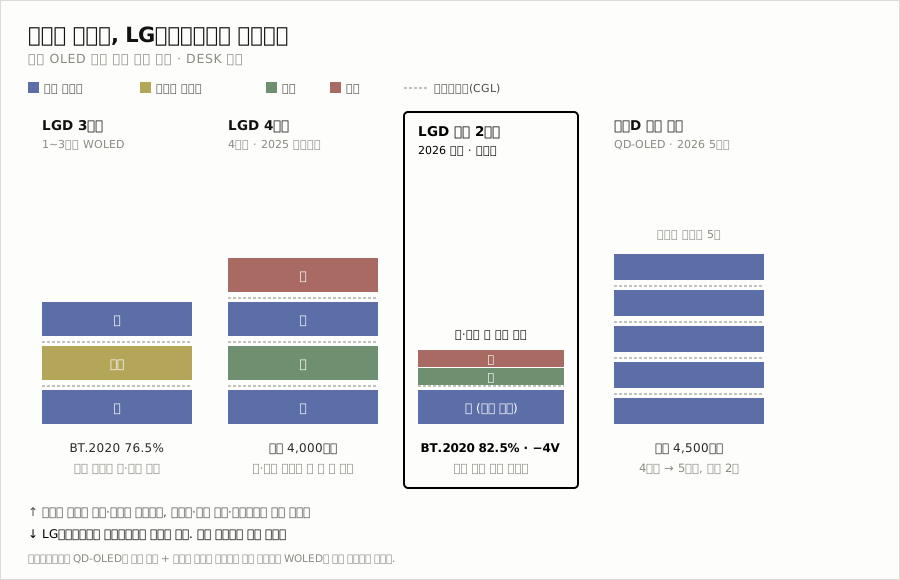 Put the four structures on one axis and only the new 2-stack goes downward. Samsung Display’s QD-OLED puts quantum dot color conversion over a blue light source, so stack count alone does not compare directly with WOLED. Source: LG Display Newsroom and Samsung Display Newsroom announcements combined.
Why stack at all
To see why taking one away is unusual, look at what stacking was buying in the first place.
A tandem stacks emissive layers one above another and joins them with a charge generation layer (CGL). The core of it is that these layers are connected electrically in series. The same current passes through the layers in turn and emits light once in each. With two layers the same current yields two portions of light; with four, four portions.
Two things are gained. One is luminance. The light from each layer adds up, so overall brightness rises. The other is lifetime. The electrical stress one layer would have to bear alone is divided by the number of layers, slowing the aging of the organic materials. It is a trade that buys brightness and lifetime at once, so premium panels continuing upward was reasonable.
The problem is the price. Being in series, voltage adds up with the layer count as well. The drive voltage each layer demands accumulates as it is. On top of that another set of expensive emissive material goes in per layer, another charge generation layer is needed between layers, and the vacuum deposition process lengthens accordingly. The more you stack the brighter it gets, and the more you stack the more expensive and hotter it gets.
On a premium TV that price is worth paying. On a 600,000 won monitor it is not.
Why two layers gave wider color
So how is it explained that color gamut coverage rose after a layer was removed? This is the real content of the announcement.
The existing 3-stack was blue, yellow-green, blue. A yellow-green layer is inserted between two blue layers to make white. Large WOLED passes this white light through color filters to extract red, green and blue.
The weakness of that structure is that one yellow-green layer doubles as red and green. The spectrum of a yellow-green emissive layer is broad and blunt. To get pure red and green out of it, the color filter has to shave heavily off both sides. Light is thrown away in proportion to what is shaved off, and there is a limit to the purity of what remains. That is why the 4th generation stacked one more layer to separate red and green.
The new 2-stack solved the same problem without stacking more. One blue layer was removed, and in its place the single yellow-green layer was split into two emissive layers, red and green, put together inside one stack. The stack count fell from three to two while the number of emission colors actually rose. Red and green each get their own narrow peak, so there is less for the color filter to shave off and color purity rises.
Whether that explanation actually holds can be checked by passing the spectra through the color filters. Below you can switch between the two structures and adjust the bandwidth of the color filter.
Two things stand out. First, the amount of light surviving into the red channel differs. In the 3-stack the red filter scrapes at the long-wavelength tail of the yellow-green emissive layer, so little light passes. Second, the center wavelength of the red scraped out that way is short. The filter center sits at 620 nanometers, but the center of mass of the light actually passing lands ahead of it, closer to orange. In the structure with a separate red emissive layer, that center of mass moves toward the filter center. That is why a deeper red comes out with the same filter.
Narrow the filter bandwidth and the 3-stack’s center wavelength deepens too. But the light passing falls sharply as the price. This trade, giving up brightness to obtain color, is where the 3-stack was trapped before the emissive layers were divided.
In numbers it is 82.5% of the BT.2020 color space, ahead of the existing 3-stack’s 76.5% by 6 percentage points. The color temperature of a white screen rose to about 6,700K, and performance comparable to the 3-stack came out under both 6,500K and 10,000K conditions. On top of that, resetting the optical position of the emissive layers also reduced the color shift seen when viewing the screen at an angle, the company said.
What 4V tells you
The most honest number in this announcement is not the color gamut but the voltage. Drive voltage came down by more than 4V against the existing structure.
That figure meshes exactly with the explanation above. A tandem stack is a series connection, so one stack demands roughly its own share of the drive voltage. Go from three layers to two and exactly one layer’s share drops out. 4V is that one layer’s share.
When voltage comes down, a string of things comes down with it. Power consumption falls, heat falls, the burden on the power supply and thermal design falls, and the set maker’s cost falls with it. In the panel itself, one set of expensive emissive material and one charge generation layer drop out, and deposition process steps are reduced.
Given that the budget SE panel LG Display commercialized this year cut manufacturing cost by about 20% against the existing one, this 2-stack amounts to the next step on that cost reduction line. The place it aims at is clear as well. Not premium but mid-tier TVs and budget monitors, the band competing head-on on price with mini LED LCD.
The patent has been saying it for 5 years
The grounds that this structure is not a concept made for a presentation are in the patent.
US patent US12,108,618, filed by LG Display with a priority date of 2020-12-24 and granted in 2024-10, contains exactly the structure now announced. A first stack with red and green emissive layers together sits toward the transparent 1st electrode, a charge generation layer is laid over it, and a second stack with only a blue emissive layer is placed toward the reflective 2nd electrode.
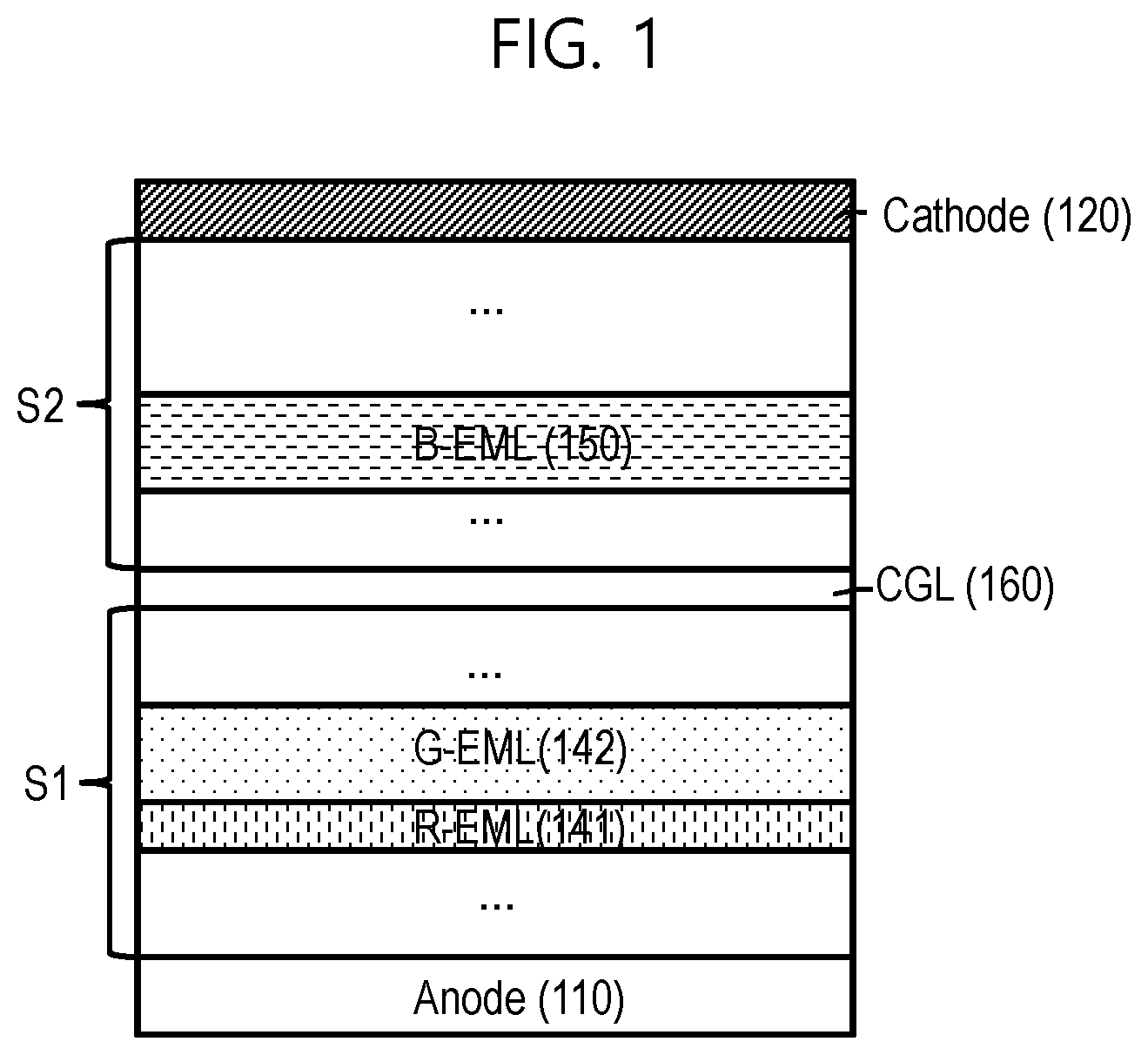 From the bottom: anode (110), the first stack (S1) containing red (141) and green (142) emissive layers together, the charge generation layer (160), the second stack (S2) with only the blue emissive layer (150), and the cathode (120). The announced structure of “red and green separated instead of yellow-green” is exactly what the drawing shows. Source: US12,108,618, LG Display, USPTO published material.
What deserves attention is the purpose the patent states for itself. Preventing luminance variation with viewing angle, improving color shift, and lowering drive voltage. It overlaps exactly with the three results presented at this forum. For that purpose the patent specifies the optical position of the emissive layers numerically. It sets the total distance between the two electrodes at 150 nanometers to 200 nanometers and restricts the thickness of the 1st electrode to between 0.1 and 0.26 times that distance. This numerical range is the substance of what the announcement expressed as “adjusting the optical position of the emissive layers.”
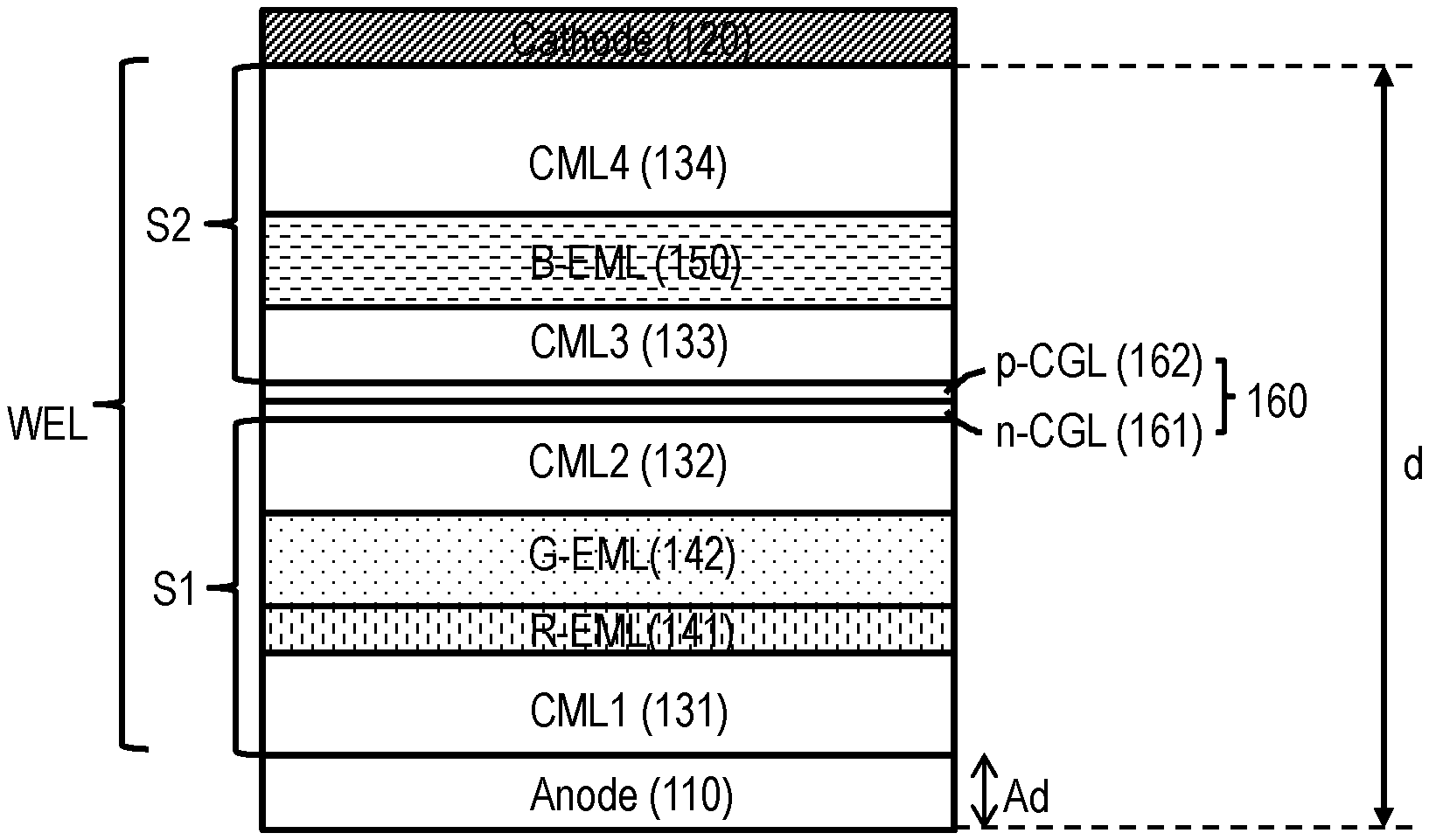 A detailed drawing from the same patent. On the right, d is the total distance between the two electrodes; at lower right, Ad is the anode thickness. The ratio of 0.1 to 0.26 times that the claim restricts is the relation between these two values. The first stack (S1) holds the red and green emissive layers, the second stack (S2) the blue, and n-type and p-type charge generation layers (161 and 162) join them. Source: US12,108,618, LG Display, USPTO published material.
There are three inventors, and the roman-letter name of one of them (Jung Keun Kim) is the same as the presenter at this forum. The priority date is 5 and a half years earlier than this announcement. It is less a cost reduction idea that appeared suddenly than a design long prepared and brought out at the point the market needed it.
Easy to confuse with blue phosphorescence
It is easy to read this announcement together with the blue phosphorescence news from the same period as one lump. But they are different matters, and mixing them leads to a wrong conclusion.
LG Display announced in 2025-05 that it had, as a world first, succeeded in verifying productization performance of a blue phosphorescent OLED panel on a production line. The structure used then was also a 2-stack tandem, but entirely different in character. It was a hybrid structure with blue fluorescence below and blue phosphorescence above, taking the stability of fluorescence and the low power of phosphorescence together, lowered power consumption by about 15%, and targeted small and mid-size IT panels such as smartphones, tablets and AI PCs.
This 2-stack WOLED is for large TVs and monitors, and the emissive layer composition is different. What the announcement mentioned was a “new blue emissive material”; it was never stated as blue phosphorescence.
The grounds that settle the confusion are on the materials supplier’s side. Universal Display, the key supplier of blue phosphorescent material, still could not give a commercialization date for blue phosphorescence at its Q2 results this year. The reason given is that it depends on customer roadmaps. In the same announcement material revenue fell 26%, and annual guidance was narrowed to the lower end of the 630 million to 670 million dollar range. Blue phosphorescence has not yet entered the stage of lowering the cost of large panels.
Put together: this cost reduction was not made by a new emissive material but obtained by redesigning the arrangement of the layers.
What was given up
That is what was announced, and what was not announced is the real measure of this technology.
LG Display did not disclose panel lifetime, burn-in resistance or long-term durability for this structure. That is not a trivial omission. As set out above, the two things a tandem bought by stacking layers were luminance and lifetime, and of those, lifetime comes from dividing electrical stress across the layer count. Cut three layers to two and the remaining two take on more of what they had been dividing. The efficiency of the new blue emissive material may have risen enough to offset it, but no figure showing that offset has appeared yet.
Peak luminance is the same. The phrase repeated in this announcement is “comparable to the 3-stack,” not that it surpassed it. At a point when the 4-stack speaks of 4,000 nits and a competitor’s 5-stack of 4,500 nits, this structure was never an object for that arena.
So the character of this technology is clear. It is not a technology chasing premium, but one that gives up premium in order to come down to the price band of mini LED LCD. LG Display ends up running two opposite lines inside one company at the same time, going up with the 4-stack at the top and down with the 2-stack at the bottom.
Outlook
This technology will go into production. The grounds are that both the filing date of the patent and the market it aims at are clear. It is a design filed 5 and a half years ago and already granted, and the target market the company itself named is the mid-tier band competing with mini LED LCD. To grow share in the OLED monitor market you have to open that band rather than the premium above it, and it is hard to build the cost structure for it any other way.
Where it goes in first, though, will be split. Putting a structure with undisclosed lifetime data into a monitor that shows the same screen all day is uncomfortable to do first. TVs are more likely to come first, in my view.
Whether this judgment was right or wrong can be seen from two things.
First, whether lifetime and burn-in data for this structure are disclosed at IMID 2026 in Busan this week. If lifetime figures come out alongside in paper form, it is a signal that production is nearer than expected. If it talks only about color gamut and voltage to the end and leaves lifetime blank, that means lifetime is exactly the task remaining.
Second, whether LG Display gives this panel a separate brand name at CES early next year. The company has already divided tiers by naming premium “Tandem WOLED” and budget “OLED SE.” The moment a third name is attached to the 2-stack structure, this stops being a research result and becomes a product to sell.