
Samsung Display's HIAA, putting physical buttons into a car display
With European safety assessment requiring physical buttons for five functions including the indicators from 2026, the automotive display industry split two ways. Samsung Display cut an 80mm hole and planted a button in it; Panasonic and Microchip answered with a hole-less KoD. The two patent strategies compared from primary material, for planning and sales teams building a regulatory response roadmap.
This article was published before the English edition began, so the labels inside its figures and simulators are in Korean. The caption and the note under each figure are in English.
This column gathers the display industry stories that poured out over one week (Monday to Sunday) and digs a little deeper into the hottest single issue among them. For 20 to 26 July, this week’s hot issue was the automotive “80mm hole OLED” Samsung Display showed at K-Display 2026.
From 5mm in diameter to 80mm. Samsung Display grew the technology it used for smartphone camera holes 16 times over in 7 years. Calculated by area rather than diameter it is 256 times. And the real reason for that expansion lay not in the technology itself but in automotive safety regulation.
The buttons that vanished, called back by law
For the past few years the fashion in car interiors was to strip out physical buttons and unify everything into one large touchscreen. And yet Euro NCAP, the European new car safety assessment programme, decided that from January 2026 it will not award its top rating (5-Star) to vehicles that have not kept physical buttons for five functions: indicators, hazard lights, horn, wipers and the SOS button. The grounds are safety. A Euro NCAP official noted that touchscreen operation can take a driver’s eyes off the road for up to 40 seconds. Volkswagen reverted its steering wheel switches from touch to physical buttons, and Hyundai added physical buttons to the facelifted Ioniq 5.
The problem is that carmakers have spent those years selling the “smooth, buttonless screen” as a symbol of premium. Reattaching physical buttons for the regulation means giving that smooth design up. The answer Samsung Display brought out at K-Display 2026 (22 to 24 July) was to satisfy both at once: a centre fascia prototype with an 80mm hole cut into the screen itself and a gear selector dial and air vent physically planted inside it. The screen still looks continuous, and inside it sits a dial you really turn with your hand.
From 5mm to 80mm
The technology’s name is HIAA (Hole in Active Area). It began in 2019 when Samsung Display first commercialized a 5mm camera hole in a smartphone screen. The company says it has since accumulated more than 500 related patents. What it showed at K-Display this time is at the level of an 80mm diameter, capable of up to 100mm.
Looked at in numbers, it is hard to feel why this expansion is a big deal. By diameter it is 16 times, but what actually matters on a screen is that “the edge length of the perforated region” grows in proportion to the diameter, and that entire edge is a vulnerable point where moisture and impurities can penetrate. Between the circumference of a 5mm circle for a single camera hole and that of an 80mm circle taking a whole gear dial, the length of vulnerable section to be managed itself grows 16 times. By area the difference is larger. The area of a circle is proportional to the square of the diameter, so the area an 80mm hole actually takes on the screen is 256 times that of a 5mm hole. On top of that, the circuitry driving the pixels has to be newly routed around a hole that large. It is an engineering problem of a different order from cutting one camera hole.
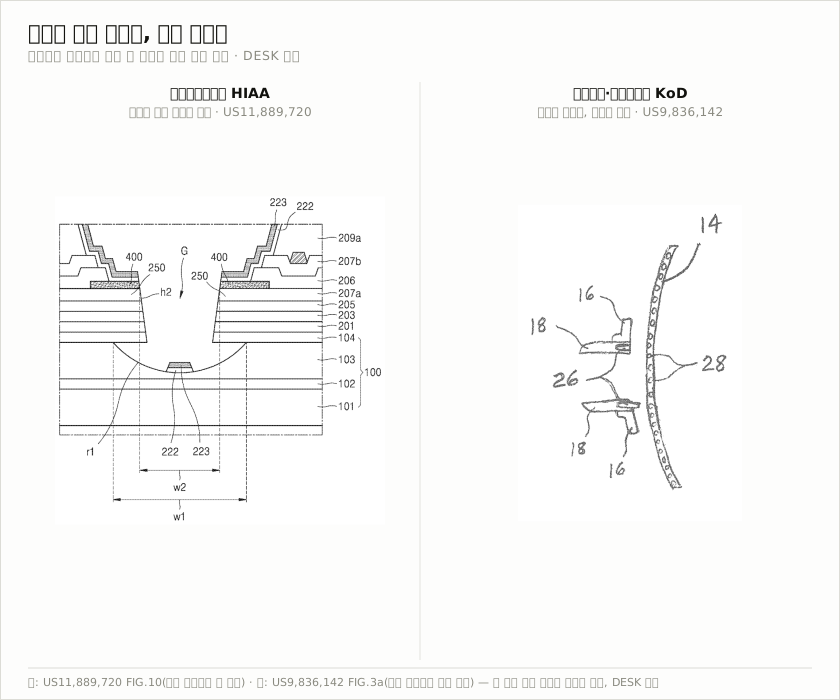 On the left is the actual hole cross-section in the Samsung Display patent, on the right the hole-less cross-section in the Panasonic and Microchip patent. Both images are the official original figures of each patent, edited side by side by DESK. For sources see the list above.
How to cut a hole and not die
How this problem is actually solved is set out in a patent Samsung Display holds. US11,889,720 (“Display apparatus including a groove…”), filed in August 2021 and granted in January 2024, describes a structure cutting a groove along the hole edge. A first groove is cut in the substrate layer and a second groove overlaid in the inorganic insulating layer above it, forming an undercut.
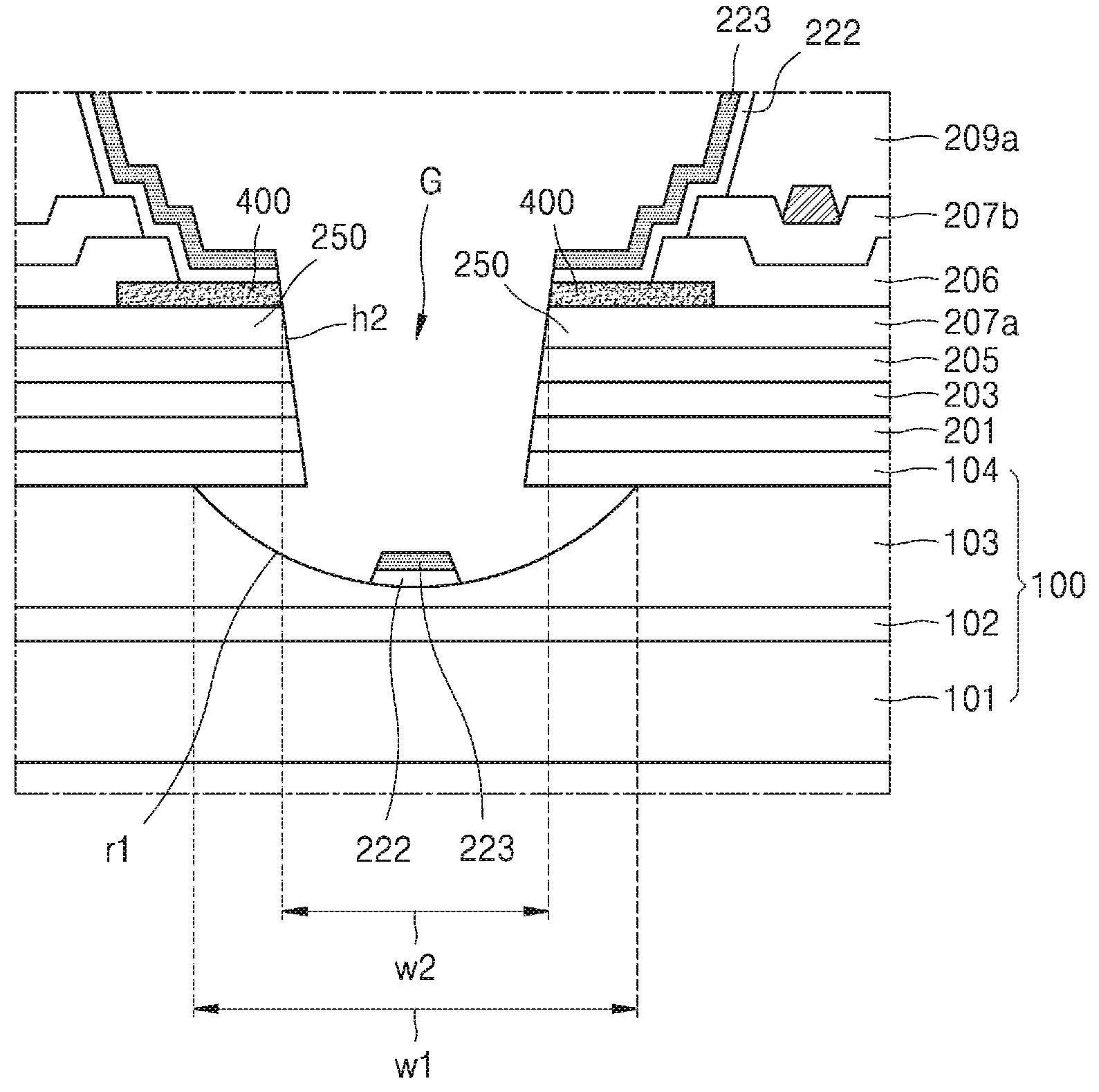 The stepped groove at the hole edge severs the organic emitting layer partway. For moisture to penetrate it must cross that severed section, and an inorganic film covers over it to block the way. Source: US11,889,720, USPTO published material.
The groove does two things. First, it physically severs the organic material layers vulnerable to moisture, such as the organic emitting layer, at the groove point, blocking the path by which moisture entering at the hole edge travels sideways into the emitting layer. Second, the undercut structure also blocks cracks in the inorganic insulating layer, caused by the cutting process that makes the hole, from spreading sideways. The larger the hole, the harder managing that edge becomes as a whole, and this patent standardizes the management method itself.
There is also a route that cuts no hole
And yet there are companies solving the same problem the opposite way. The KoD (Knob-on-Display) technology Panasonic and Microchip built together. This side cuts no hole in the panel at all. Instead a knob (dial) with a conductive pad on its underside is simply laid on the surface of an ordinary capacitive touchscreen. Turn the knob and the position of the conductive pad beneath changes, and the touch sensor the screen already had detects that change of position and reads it as rotation. Nothing new has to be built on the screen side.
The two technologies start from different places. Samsung Display’s HIAA solved the same problem as Panasonic’s foundational patent (filed 2016, US9,836,142 “Capacitive Rotary Encoder”) from a panel maker’s position. It redesigns the panel and makes a real hole. Panasonic and Microchip’s KoD solved it from a component maker’s position. The panel is left as it is, and only the accessory laid on top and the controller chip recognizing it are new. Microchip has since 2022 developed the technology into an MPMK version working even on standard touch patterns, and is supplying samples.
Which is advantageous becomes clearer set out as a table.
| Samsung Display HIAA | Panasonic and Microchip KoD | |
|---|---|---|
| Method | cuts a real hole in the panel | panel unchanged, only the knob laid on |
| Technology needed | OLED panel redesign (groove and encapsulation structure) | uses the existing capacitive touch sensor as is |
| Commercialization stage | prototype (first shown at K-Display 2026) | samples supplied (MPMK, from 2022) |
| Extensibility | tied to Samsung Display panels | applicable to most capacitive touchscreens |
| Strength | screen and component physically completely one | low cost and lead time, applies straight to existing production lines |
The story is not over
One thing has to be made clear at this stage, though. HIAA is still a prototype. The centre fascia exhibited at K-Display is a concept product, and there is as yet no confirmed carmaker customer. How stably the assembly method of planting physical components inside a screen reproduces on a production line, and how much the cost rises against the established method, are not in this announcement’s material either. KoD, on the other hand, has had samples out for several years and yet, within the material this article confirmed, no production vehicle adopting it could be found. What the two share is that neither has yet gone into an actual production vehicle. At the same exhibition Samsung Display also showed a slidable OLED whose screen is normally hidden and extends vertically up to 15.5 inches when needed, likewise part of the same centre information display (CID) concept. The direction of holding several functions in one screen is clear, but which combination goes into an actual production vehicle is not yet settled.
Outlook
This contest ultimately pits “how perfectly it looks like one thing” against “how cheaply and quickly it can be applied.” HIAA has room for screen and dial to run together with genuinely no physical boundary, so the screen appears to flow through the knob’s position too. In exchange, collaboration with the panel maker (Samsung Display) and as-yet-unproven production reliability stand in the way. With KoD, the knob is visibly a separate component laid on the screen, but existing touchscreen production lines and supply chains can be used as they are, so the barrier to entry is far lower.
In a fight over cost and lead time, “the side using existing infrastructure as it is” generally wins. That the Euro NCAP regulation is pinned to January 2026, leaving carmakers little time, is also likely to work in favour of something immediately applicable like KoD. HIAA’s real strength lies elsewhere, though. Attempts to integrate not only knobs but bulky components such as air vents into the screen are outside KoD’s range. The two technologies solve the same problem (coexistence of touchscreen and physical operation) but aim at components of different size and complexity. The next thing to watch is this: whether carmakers go to a division of labour, using KoD for “small, common controls (dials)” and HIAA for “large, special controls (gear dials, air vents),” or whether one of the two encroaches on the other’s territory.