Narrowing the Emission Linewidth of a Yellow Nanographene with Two Boron Atoms
Yellow to red has been the range where multiple-resonance design struggled to narrow the FWHM. A nanographene with two boron atoms inside its core reached 10 nm in cyclohexane, and devices delivered 17 nm with 21.4% external quantum efficiency.
The full width at half maximum (FWHM) of an emitter is the width of its spectrum at half the peak height. The narrower it is, the purer the color and the wider the resulting color gamut. It is the most direct figure for color purity in displays.
Multiple resonance (MR) design has become the established route to a narrow FWHM. Boron and nitrogen are placed alternately in the core so that the highest occupied and lowest unoccupied molecular orbitals sit on different atoms. The design has spread from blue to red, but in the yellow-to-red range the FWHM has been especially hard to reduce.
Sudhir K. Keshri and 1 co-author at Marwadi University and Kyushu University reached 10 nm in that range.
Two design routes to a narrow FWHM
Two methods have so far been established for narrowing the FWHM of polycyclic aromatic emitters. One is to make the molecular skeleton rigid so the structure does not deform in the excited state. The other is to localize the electron density on alternating atoms through the multiple resonance effect.
If the skeleton moves even slightly at the moment the molecule emits, the vibrational levels corresponding to that motion overlap in the spectrum and broaden it. Both methods therefore aim at the same thing: making the molecule move less when its electronic state changes.
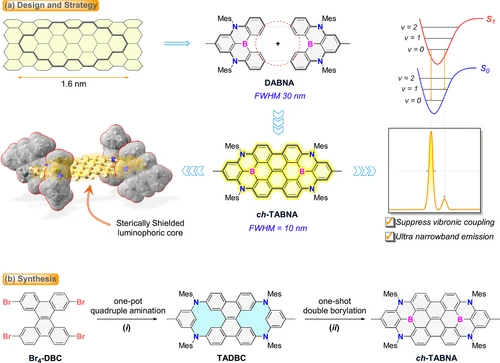
This molecule combines both in one skeleton. It is a nanographene the authors named ch-TABNA.
Placing two boron atoms inside the core
ch-TABNA places two boron atoms in an inner cavity of the molecular skeleton. They are not attached at the periphery but sit in an inner position surrounded by rings. This arrangement creates the multiple resonance character and at the same time holds the skeleton planar.
The synthesis has two steps. Amines are coupled using a palladium catalyst, then a tandem bora-Friedel-Crafts reaction with boron tribromide introduces both boron atoms at once. The yields are 15% and 10%, respectively. The defining feature of the synthesis is that the two boron atoms are introduced in a single reaction rather than in separate steps.
Single-crystal X-ray structure and density functional theory calculations confirmed that the skeleton is planar and rigid and that the electron density is split in a multiple resonance pattern.
Crystal structure and suppressed vibronic coupling
An emitter that is narrow in solution is not guaranteed to be narrow in a device. When molecules stack closely in the solid state, interactions arise that broaden the spectrum and lower efficiency.
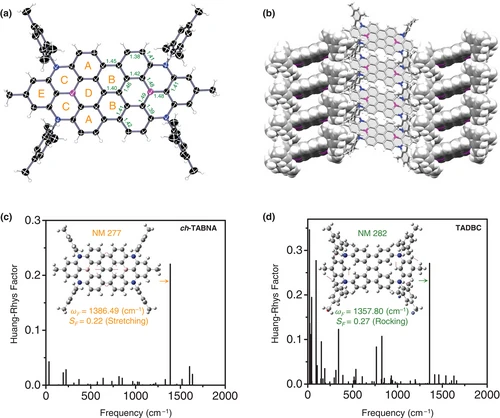
The molecular packing of ch-TABNA in the crystal shows no pi-stacking between neighboring molecules. Mesityl groups attached outside the skeleton physically prevent the molecules from stacking.
Vibronic coupling was calculated alongside the reference compound TADBC. Plotting the Huang-Rhys factors against vibrational mode frequency shows that coupling in ch-TABNA is suppressed in both the low-frequency and high-frequency modes. What remains is a single mode at 1,386.5 cm⁻¹, which alone still contributes to the linewidth.
A Stokes shift of 7 nm and an FWHM of 10 nm
In toluene solution the absorption peak is at 562 nm and the emission peak at 569 nm. The Stokes shift, the difference between the two, is only 7 nm. This means the energy spent on the molecule relaxing after absorbing light is that small, and it is a direct indication that the skeleton is rigid.
Under the same conditions the emission FWHM is 13.8 nm (53 meV) and the absolute photoluminescence quantum yield is about 100%. The emission decay is single-exponential with a lifetime of 9 ns. Switching the solvent to cyclohexane moves the emission peak to 561 nm and brings the FWHM down to 10 nm (40 meV). The authors state that 40 meV is the smallest value reported for organic yellow-to-red emitters.
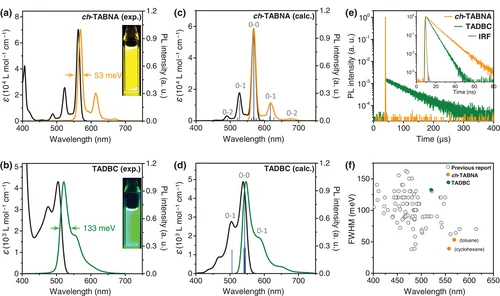
The absorption spectrum shows clearly resolved vibronic structure. The 0-0, 0-1 and 0-2 transitions are at 562 nm, 522 nm and 488 nm, close to the 568 nm, 526 nm and 490 nm calculated by Franck-Condon analysis. Compared with the 504 nm absorption peak of the reference TADBC, ch-TABNA is shifted 58 nm toward the red.
21.4% external quantum efficiency with a TADF host
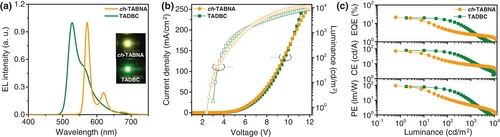
Devices were made with two hosts. In an mCBP host, the electroluminescence peak was at 573 nm, the FWHM 17 nm and the CIE coordinates (0.50, 0.48). The width grew from 13.8 nm in solution to 17 nm but stayed narrow.
To harvest triplets, the host has to do that work. The team replaced mCBP with 32aICTRZ, a bipolar thermally activated delayed fluorescence host, and doped ch-TABNA at only 1 wt%. This gave an electroluminescence peak of 572 nm, an FWHM of 17 nm (64 meV), CIE coordinates of (0.51, 0.48) and a maximum external quantum efficiency of 21.4%. The turn-on voltage is 2.9 V.
Distance to industry
Yellow is not a primary color in displays. In an architecture that builds the screen from red, green and blue, there is no slot for a yellow emitter as is. The value of this paper lies in the design rather than in yellow itself.
Multiple resonance design first took hold in blue, and the FWHM widened toward longer wavelengths. Larger molecules have more vibrational modes, and holding the skeleton rigid becomes harder. This result shows that placing two boron atoms in an inner cavity of the skeleton works in that range. What happens when the same design is pushed to red is the next question, and the paper does not go that far.
The device figures also need to be read with their conditions. The 21.4% external quantum efficiency is a maximum, and how much it drops at higher luminance has to be checked separately in the efficiency curves in the paper. There is no lifetime measurement in this paper. Operational lifetime is a common problem for multiple resonance emitters, so that value is needed for any production decision.
Synthesis yield also counts toward the distance. The two steps give 15% and 10%. That is enough at the research stage, but material cost is another matter. Still, finding a route that introduces both boron atoms in one reaction reduces process steps and has value in itself.