Haze and Cycling Lifetime of Electrochromic Polymer Films Controlled by Annealing
Densifying the film to remove haze left only 30.4% of the charge capacity after 100 cycles. A film made hazy with 3% antisolvent and annealed at 150 °C returned below 1% haze and kept 91.3%. Clarity and lifetime hinge on the same process variables.
Electrochromic materials change their transmittance with an applied voltage. The technology goes into building windows and car sunroofs, and on the display side it is also a material for reflective displays that emit no light and use ambient light instead.
Two values are usually checked when such a material is evaluated: how dark it gets (modulation range) and how fast it switches (switching time). Yina Moon and 6 co-authors at Purdue University and the US National Institute of Standards and Technology looked at neither. They studied haze, the effect that makes a window look cloudy even at the same transmittance.
Why a film looks cloudy at the same transmittance
Haze is defined as the fraction of transmitted light that deviates by 2° or more from the incident direction. It is a question of which direction the light leaves in, not of how much light passes. Two films with the same transmittance can therefore look entirely different to the eye.
In a window this is a safety matter. A cloudy window obscures the view and shifts the perceived color away from the intended one. Haze in thin films has been studied in many materials; in oxides it is known to be governed by coating and etching conditions and by nanoparticle size. In organic materials, there are reports that it depends on spherulite formation or crystal size in semicrystalline polymers.
For organic electrochromics, however, the origin of haze had never been worked out. The team chose ECP-black from the ProDOT family. It absorbs evenly across the whole visible range and darkens to a neutral gray, and it is one of the most widely used materials in the field.
A curve that bends between 3% and 4% antisolvent
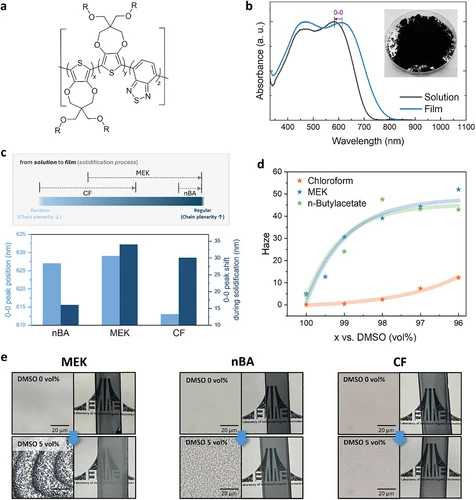
The team mixed a set amount of antisolvent into a good solvent that dissolves the polymer, cast films and annealed them. An antisolvent does not dissolve the polymer, so the amount added sets how strongly the polymer aggregates in solution.
Three good solvents were compared: chloroform, n-butyl acetate and methyl ethyl ketone. The antisolvent was dimethyl sulfoxide. With n-butyl acetate and methyl ethyl ketone, adding just 1% antisolvent by volume made haze rise sharply, while with chloroform it rose gradually. Subsequent experiments therefore used chloroform. The number in each sample name is the chloroform volume fraction: CF97 means 3% antisolvent.
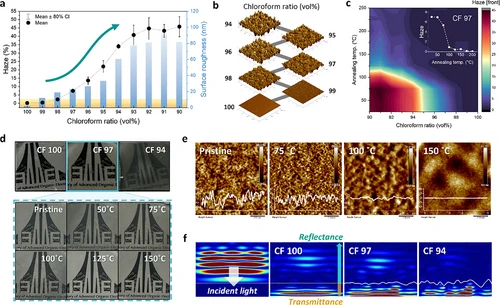
The bend in the curve was narrow. Haze jumped the moment the antisolvent went from 3% to 4%. CF100, with no antisolvent, was below 1%; CF99 and CF98 rose slightly but stayed within an acceptable range. CF97 reached about 7%, and beyond that haze kept rising until it saturated at 45% near CF90. This means the solvent composition has to be controlled in 1% steps in the process.
Two causes: surface roughness and aggregate size
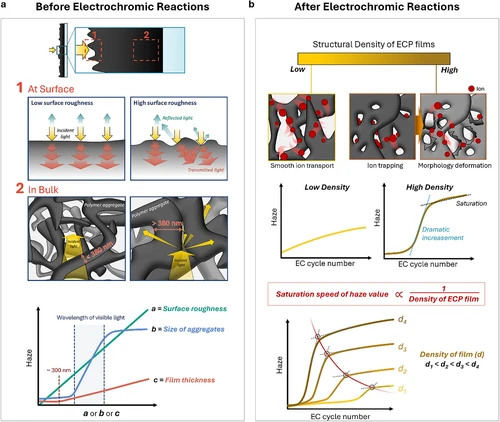
Based on Mie scattering theory, the team split the cause of haze into two: surface roughness and polymer aggregate size.
Surface roughness measured by atomic force microscopy rose with antisolvent content. Once the root-mean-square roughness reached about 100 nm, haze stopped rising and leveled off. That signals roughness alone cannot explain what happens after saturation.
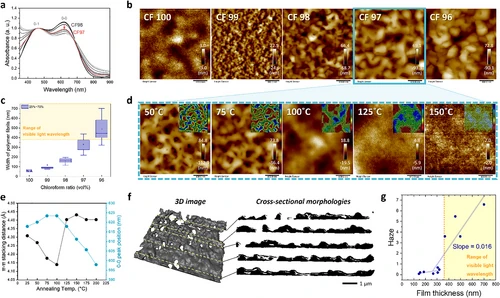
Aggregate size fills the gap. When the shortest dimension of an irregular polymer aggregate, that is, its thickness, falls within the visible wavelength range, it affects how light is refracted. Since visible light spans 380 nm to 750 nm, the probability of producing haze rises sharply once aggregate thickness exceeds 380 nm. Haze also varied with the micro-voids created by aggregation and with film thickness. Film thickness increased with the antisolvent fraction and decreased with annealing temperature.
Above 100 °C the fibrous structure disappears
Annealing reversed the haze. Regardless of solvent fraction, haze dropped markedly once the annealing temperature exceeded about 100 °C. CF97 began to drop already at 75 °C and fell below 1% after 100 °C.
What happened inside the film was stepwise. At 75 °C the fiber-like structure was still visible, but the fibers thinned slightly and aggregation between them loosened. At 100 °C the fibrous structure could no longer be distinguished and surface roughness fell sharply. At 150 °C the surface became smoother and more uniform still. The pi-stacking distance narrowed to 10 Å with 100 °C annealing.
Up to this point the conclusion looks simple: use less antisolvent and anneal at a high temperature to make the film dense.
Stability ranking reverses under cycling
The team built devices and ran electrochemical cycling. The ranking flipped.
CF100, made without antisolvent, showed a gradual but large rise in haze after about 400 cycles, and its brightness changed abruptly between 100 and 300 cycles. CF97 saturated before 200 cycles, earlier than the other samples. After 200 cycles, surface roughness had increased in every sample.
Charge capacity makes the difference clearer. The values are taken from cyclic voltammograms and give retention of the initial charge density after 100 cycles.
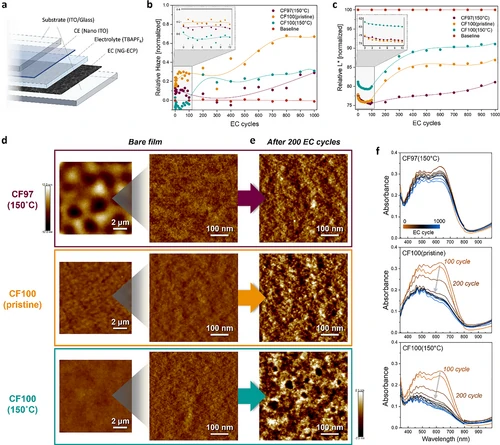
Unannealed CF100 retained 40.7%, and CF100 annealed at 150 °C, the densest film, retained only 30.4%. By contrast, CF97, made with 3% antisolvent and annealed at 150 °C, kept 91.3%. The clearest film degraded fastest, and the film that had been hazy before annealing lasted longest.
The reason the team gives is the path ions take in and out. Gaps left between aggregates serve as ion transport channels. A fully densified film is optically clear but leaves no room for ions to pass, and it does not survive repeated operation. Pairing CF97 with 150 °C annealing removes the fibrous structure and brings haze below 1% while leaving the channels in place.
Distance to industry
The paper does not create a new material. It explains haze and lifetime together using two existing process variables, solvent composition and annealing temperature, applied to ECP-black, a material already in use. That makes it something a production line can pick up directly.
The conditions should be read narrowly, however. The 91.3% figure is a 100-cycle value for one condition, CF97 paired with 150 °C. A window that switches only a few times a day still accumulates tens of thousands of cycles over 10 years, so 100 cycles is a range for seeing trends, not for estimating lifetime. The rise in CF100 haze after 400 cycles is likewise a result measured only up to that point.
Still, what process engineers can take away is clear. Clarity and lifetime are in a trade-off, pointing in opposite directions, and the variables that separate them are solvent composition and annealing. Densifying a film to lower haze can carry a cost in lifetime unless repeated-operation tests are run alongside.
There is also something for metrology. Roughness is measured by atomic force microscopy, and aggregate thickness from the height distribution in the same image. Both can be run on the production floor; the only check needed is whether the sizes are comparable to visible wavelengths.